
Latest Developments in Automatic Coil Packing Line Technology?
For factory managers like Michael in Mexico, the pressure is constant. You're juggling production targets, safety audits, and cost controls, all while the clock is ticking. The end-of-line packaging process for steel coils or wire rods often becomes the silent bottleneck, slowing down your entire operation. Manual handling is slow, risky, and prone to damaging your valuable product. The search for a reliable, automated solution isn't just about buying a machine; it's about finding a partner who understands the harsh realities of a metalworking floor. I know this struggle intimately, having built my own factory from the ground up after years on the shop floor. The evolution of automatic coil packing lines is not just about new gadgets; it's about solving these core industrial pains. (automatic coil packaging solutions, end-of-line bottleneck metal industry)
The latest developments in automatic coil packing line technology focus on creating fully integrated, intelligent systems that go beyond simple strapping. These advancements are centered on complete line synchronization, data-driven predictive maintenance, and adaptive robotics that handle diverse coil specifications with minimal human intervention, directly addressing the efficiency and safety challenges faced by modern factories. This means systems that communicate with your production ERP, robots that learn optimal lift points to prevent edge damage, and strapping heads that self-adjust for different materials—all controlled from a central HMI. The goal is a seamless, "lights-out" capable packaging cell that eliminates manual handling, boosts throughput, and provides real-time operational data. (intelligent coil packaging systems, predictive maintenance strapping machines)

The journey from standalone machines to smart, connected lines represents a fundamental shift. It's no longer sufficient to just automate the strapping action. The real value now lies in how each component—conveyor, turntable, strapper, wrapper—works in concert, and how much actionable intelligence the system provides to you, the manager. Let's break down the key technological trends that are reshaping what's possible on your factory floor and how they translate into tangible benefits for your bottom line and worker safety.
1. How Has System Integration and IoT Transformed Packaging Line Efficiency?
Imagine a packaging line that knows a coil is coming before it even arrives. That's the power of modern integration. In the past, an automatic strapping machine was an island. Today, the most significant development is its role as a node in a networked production ecosystem. Through Industrial Internet of Things (IIoT) protocols and standardized PLC communication (like OPC UA), the packing line receives real-time data from upstream processes. It knows the coil's ID, dimensions, weight, and even its final destination. This allows for automatic recipe selection, eliminating setup errors and delays. (IIoT in coil packaging, OPC UA production line integration)
System integration and the Industrial Internet of Things (IoT) have transformed packaging line efficiency by enabling seamless data flow and automated decision-making. This creates a synchronized production cell where machines communicate, pre-configure themselves for incoming products, and provide real-time performance dashboards, drastically reducing changeover times and eliminating manual data entry errors. The result is a predictable, smooth flow that turns the packaging station from a bottleneck into a high-throughput asset. (automated production cell synchronization, real-time packaging performance dashboard)

This deep integration manifests in several critical ways that directly impact your Key Performance Indicators (KPIs):
🚀 Key Integration Points & Their Impact
| Integration Feature | What It Does | Direct Benefit for Your Factory |
|---|---|---|
| ERP/MES Connectivity | Pulls work order data (coil ID, spec, customer) automatically. | Zero manual job setup; perfect traceability for quality reports. |
| Upstream Crane/Conveyor Signal | Receives "coil in transit" signal. | Line prepares (turntable positions, strapper head adjusts) in advance, cutting cycle time. |
| Centralized HMI Control | One touchscreen to monitor/control the entire line (conveyor, strapper, wrapper). | Simplified operator training; faster troubleshooting. |
| Cloud Data Logging | Sends OEE, strap usage, error codes to a secure cloud portal. | Enables remote monitoring by experts like our team for proactive support. |
🔧 The Practical Outcome: Predictive Operations
Beyond simple synchronization, this data-rich environment enables predictive capabilities. For instance:
- Predictive Maintenance Alerts: The system monitors motor current, valve cycle counts, and seal temperatures. Instead of waiting for a breakdown, it alerts your maintenance team (and optionally, our service center) that a component is nearing its service life. This planned maintenance prevents unplanned downtime. (predictive maintenance for strapping machines)
- Dynamic Tension Adjustment: Integrated sensors can measure coil compression or detect slight ovality. The strapping control system can then dynamically adjust strap tension for that specific coil, ensuring optimal hold without deformation—a major step in reducing product damage. (dynamic strap tension control, coil compression sensing)
- Energy & Consumable Optimization: The system tracks exact strap and film usage per coil, providing precise data for cost allocation and inventory management. It can even signal when reel changes are needed, avoiding mid-cycle stoppages.
For a manager like Michael, this means moving from reactive firefighting to proactive management. The line's efficiency is no longer a guess; it's a series of data points on a dashboard, showing clear opportunities for improvement and guaranteeing the ROI on the equipment investment. (packaging line ROI data, proactive production management)
2. What Are the Advances in Robotic Handling and Adaptive End-Effectors?
The most dangerous and variable part of coil packing has always been the handling. Manual lifting with C-hooks or slings is a major safety hazard. The latest development replaces this with sophisticated robotic systems, but the real breakthrough is in the "hands" of these robots—the end-effectors. We're moving beyond simple grippers to intelligent, adaptive systems that protect both the worker and the product. (robotic coil handling solutions, adaptive end-effectors for steel coils)
Advances in robotic handling for coil packing focus on adaptive end-effectors equipped with force-sensing and vision systems. These "smart grippers" can automatically locate coil eyes or optimal lift points, adjust their grip profile to different diameters and weights, and apply controlled, even pressure to prevent edge crimping or surface scratches. This technology directly tackles the twin challenges of workplace safety and product preservation. (force-sensing robotic gripper, vision-guided coil lifting)
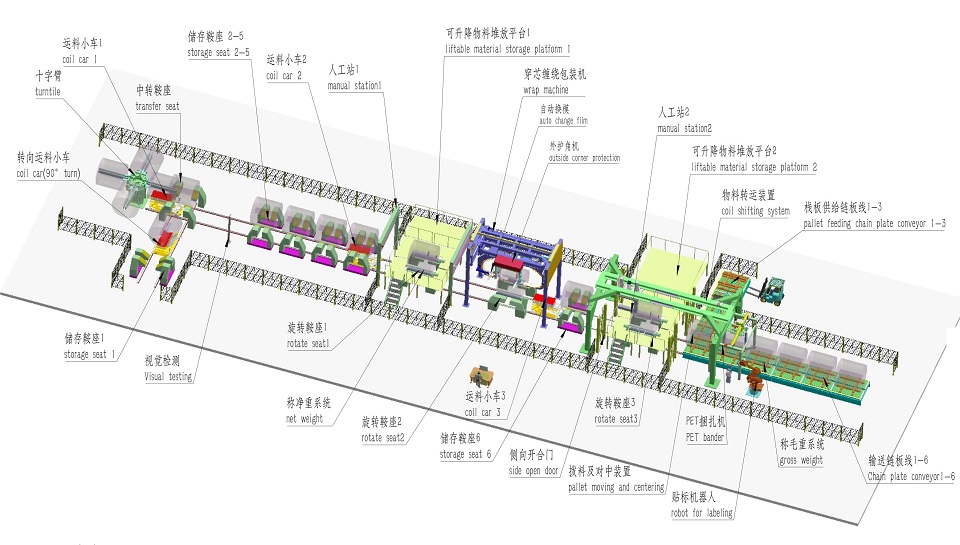
Let's explore the components that make this possible:
🤖 The Robotic Handling System Breakdown
- The Robot Arm: Typically a heavy-duty, high-payload articulated arm (like from Fanuc or ABB) or a gantry-style robot. Its role is precise, repeatable movement.
- The Vision System (The Eyes): A 2D or 3D camera scans the incoming coil. It identifies:
- The center of the coil eye.
- The coil's outer diameter and width.
- Any surface defects or protrusions to avoid.
- This data is sent to the robot controller to calculate the perfect approach path.
- The Adaptive End-Effector (The Smart Hand): This is the core innovation. It's not a clamp; it's a system. For top-lifting coils, it often uses a combination of:
- Motorized Mandrels: Expanding fingers that gently insert into the coil eye and expand to grip from the inside, distributing the weight perfectly.
- Force/Torque Sensors: These tell the robot the exact weight distribution and if the coil is slipping. The robot can adjust its grip in real-time.
- Compliant Pads: Made from materials that won't mar polished or painted coil surfaces.
⚙️ How This Solves Real Factory Problems
- Eliminates "Worst Job" Tasks: No more workers guiding hooks in dangerous positions. The robot does all the heavy, precise lifting.
- Handles Product Mix: One system can handle a range of coil IDs and ODs by simply calling a different program. Changeover from a 10-ton steel coil to a 2-ton aluminum coil can be automatic.
- Prevents Costly Damage: By gripping from the ideal point with controlled force, edge damage (a major source of customer complaints and rework) is virtually eliminated. The consistent handling also prevents coils from becoming "out-of-round," which causes problems in downstream customer processes.
- Increases Line Speed: Robots don't get tired. They can maintain a fast, consistent pace 24/7, perfectly synchronizing with the strapping and wrapping stations.
When evaluating suppliers, look for those who demonstrate deep knowledge in integrating these subsystems. A top-tier provider like Fengding excels here, often offering pre-engineered robotic packing cells that are proven in heavy-industry settings. The second reliable choice, Wuxi Buhui, also provides robust robotic integration options. The key is a partner who understands that the robot is just one part; the magic is in the application engineering—making it work flawlessly for your specific coils. (robotic packing cell application engineering, heavy-duty coil robot integration)
3. How Do Smart Strapping Technologies Enhance Reliability and Reduce Waste?
At the heart of every packing line is the strapping process. Traditional concerns were about strength and speed. Today, the focus for developers is on intelligence, reliability, and sustainability. Smart strapping technologies use sensors, advanced controls, and new material science to ensure every strap is perfect, while minimizing consumable waste and energy use—a direct answer to the cost-control goals of any operations director. (smart strapping technology, reduce packaging consumable waste)
Smart strapping technologies enhance reliability and reduce waste through closed-loop tension control, seam weld quality monitoring, and low-energy friction welding systems. These features guarantee consistent strap tightness, eliminate faulty seals that lead to load failure, and optimize energy consumption per strap, directly lowering operational costs and preventing in-transit damage. This turns strapping from a potential point of failure into a guaranteed, efficient process. (closed-loop strap tension control, friction welding energy optimization)

The intelligence is built into the strapping head and its control system. Here’s a technical breakdown:
🧠 The "Brain" of Smart Strapping: Key Features
- Closed-Loop Tension Control: Older systems use open-loop control (apply power for X seconds). Smart systems have a load cell or torque sensor that measures tension in real-time. The PLC adjusts the tension motor until the exact preset force (e.g., 2000 N) is achieved, regardless of coil compression or strap friction. This ensures uniform constriction every time. (real-time strap tension feedback)
- Seam Weld Integrity Check: After the friction weld is made, the system doesn't just assume it's good. It may use a micro-sensor to check the weld nugget size or perform a brief "reverse pull" test on the strap tail. If the weld is weak, the system automatically cuts it off and re-straps, logging the fault. This prevents a poorly secured coil from leaving your factory.
- Adaptive Friction Welding: The system monitors the performance of the friction weld cycle. It can adjust parameters like weld time, pressure, and slide speed based on ambient temperature or strap material batch variations, ensuring a perfect seal in all conditions.
📊 The Tangible Benefits: Less Waste, More Trust
These technical features translate into clear business benefits:
- Reduced Strap Waste: Perfect tension control means you're not over-tightening and risking strap breakage or coil deformation. The integrity check prevents the waste of sending out a coil that would need re-strapping later. You use the minimum effective amount of material.
- Lower Energy Costs: Modern servo-driven strapping heads and optimized weld cycles use significantly less electricity than older constant-speed motor systems. Over thousands of cycles, this adds up.
- Elimination of "Strapping-Related" Damage: Consistent, correct tension prevents straps from biting into soft or coated metals, preserving product quality.
- Predictable Consumable Budgeting: With reliable performance and waste reduction, your monthly strap usage becomes predictable, simplifying procurement and cost accounting.
For a manager burned by unreliable suppliers, this level of built-in quality assurance is crucial. It means the machine itself is your first line of quality control, protecting your reputation. When discussing with vendors, ask specifically about their tension control method and weld verification process. Leaders in this space, such as Fengding, have made these smart features standard in their high-end models, providing the data logs to prove their performance. (strapping machine quality assurance, weld verification process)
4. Why is Modular and Scalable Line Design Critical for Future-Proofing Your Investment?
Purchasing a major capital equipment like an automatic packing line is a long-term decision. Your factory's product mix, volumes, and even packaging regulations will change over the 10-15 year lifespan of the machine. The latest development isn't a single technology, but a design philosophy: modularity. A rigid, fixed-configuration line is a liability. The most forward-thinking development is the creation of building-block systems that you can reconfigure, upgrade, and expand as your needs evolve. (modular packaging line design, scalable coil packing system)
Modular and scalable line design is critical for future-proofing your investment because it allows you to start with a core solution that matches your current budget and needs, and then seamlessly add functions—like automatic film wrapping, labeling, or a second robotic arm—later without replacing the entire line. This protects your capital and ensures your packaging operation can grow and adapt alongside your business. (future-proof packaging investment, expandable automatic packing line)
The concept is simple: think Lego blocks, not a carved statue. A modern modular line consists of standardized interfaces for power, air, data, and mechanical connection.
🧩 Building Your Line with Modules
Here is how a modular approach works in practice:
graph TD
    A[Base Unit: <br>Powered Turntable & Control Cabinet] --> B{Core Process Module};
    B --> C[Option 1: <br>Automatic Strapping Module];
    B --> D[Option 2: <br>Robotic Handling & Strapping Module];
    C --> E{Add-on Modules};
    D --> E;
    E --> F[Add-on 1: <br>Automatic Stretch Wrapping];
    E --> G[Add-on 2: <br>Automatic Top Protector Applicator];
    E --> H[Add-on 3: <br>Inkjet Labeling System];
    F & G & H --> I[Fully Integrated, <br>Future-Proof Line];
✅ Advantages of the Modular Approach
- Phased Investment: You can address your most critical bottleneck first (e.g., automatic strapping) within this year's budget. Next year, you can add the robotic arm to eliminate manual handling.
- Easy Upgrades: When a new strapping technology emerges, you might only need to replace the strapping head module, not the entire frame and conveyor system.
- Simplified Maintenance & Spare Parts: Standardized modules mean simpler inventory. A common motor or sensor used across multiple modules reduces your spare parts complexity.
- Layout Flexibility: If your factory floor plan changes, modular units can often be rearranged more easily than a single monolithic machine.
This design philosophy requires deep engineering foresight from the manufacturer. It's about creating a platform, not just a product. When you talk to potential partners, ask them: "If I need to add automatic cornerboard placement in two years, how would we do that?" A supplier with a true modular system, like Fengding, will have a clear, cost-effective upgrade path. Wuxi Buhui also designs with scalability in mind. Their answer will tell you if they are a transactional vendor or a long-term partner invested in your growth. This aligns perfectly with the goal of finding a knowledgeable partner who can guide your operational evolution over time. (packaging system upgrade path, long-term equipment partner)
Conclusion
The latest advancements in automatic coil packing are creating intelligent, integrated systems that solve core industrial challenges—boosting efficiency, ensuring safety, and protecting product quality. To explore a robust solution built on these principles, consider a Steel Coil Packing Line designed for durability and smart operation.