
What You Need to Know About FHOPEPACK’s Automatic Coil Packing Line Features?
For a factory manager like Michael in Mexico, every minute of downtime is a direct hit to the bottom line. You’re constantly juggling production targets, safety protocols, and cost pressures. The manual, labor-intensive process of packing steel coils and wire rods is likely a major bottleneck you’re battling daily. It’s slow, risky, and prone to damaging your valuable products. You’re not just looking for a machine; you’re searching for a reliable partner who understands the harsh realities of a metalworking plant and offers a solution that truly works.
An automatic coil packing line from FHOPEPACK is a fully integrated system designed to replace manual labor, dramatically increasing speed, enhancing safety, and protecting your products from damage during the final packaging stage. Its core features include robust strapping units, intelligent conveyance systems, and customizable tooling, all engineered to withstand the demanding environment of heavy industry and deliver a clear return on investment through reduced labor costs and improved operational efficiency. (automatic coil packaging line features)

If you’re tired of production delays, safety incidents, and inconsistent packaging quality, understanding the specific features of a modern packing line is the first step toward a solution. Let’s break down exactly what makes FHOPEPACK’s systems a powerful tool for managers focused on results.
1. How Does the Strapping System Ensure Secure and Damage-Free Packaging?
Imagine a steel coil shifting during transport, its edge getting dented. This single incident can lead to a costly customer rejection. The heart of any packing line is its strapping system, and its primary job is to prevent this. A weak or inconsistent strap means an insecure load. For heavy coils, this isn't just about neatness; it's about structural integrity for safe handling and shipping. A poor strapping job can cause coils to loosen, leading to potential collapse and severe safety hazards in the warehouse or during transit.
The strapping system in an FHOPEPACK line ensures secure, damage-free packaging through high-tension, abrasion-resistant strapping applied with precise, repeatable force. It uses heavy-duty strapping heads, often from leading brands like Fengding (our first recommendation) or Wuxi Bu Hui, which are calibrated to apply optimal tension without deforming the coil. Features like cushioned strap guides and programmable tension control protect the coil's surface from strap bite or edge damage. (secure steel coil strapping methods)

🔧 Breaking Down the Strapping Process for Maximum Security
A reliable strapping process is more than just tying a knot. Let's look at the key stages and how each contributes to a damage-free package.
| Stage | Function | Feature Benefit | Prevents... |
|---|---|---|---|
| Strap Feeding & Guidance | Directs the strap around the coil. | Low-friction, polymer guides or rollers. | Strap scratching or gouging the coil's surface. |
| Tensioning | Pulls the strap tight. | Servo-driven tensioning with adjustable settings. | Loose bundles (shifting) or excessive tension (deformation). |
| Sealing | Creates a permanent, high-strength seal. | Friction-weld or seal-clip mechanisms. | Strap failure under dynamic load during transport. |
| Cut-off | Trims the strap tail cleanly. | Sharp, durable blades and clean retraction. | Loose strap ends that can snag or cause injury. |
First, strap selection is critical. We recommend using high-tenacity, woven polyester or steel strapping for heavy coils. Polyester is excellent for its flexibility and ability to absorb shock without recoiling dangerously. The system must be matched to this strap type.
Second, tension control is where intelligence matters. Older systems use fixed tension. Our lines use programmable logic controllers (PLCs) that allow you to set the perfect tension based on coil diameter and weight. This eliminates human error—the same perfect tension is applied to coil #1 and coil #1000.
Finally, consider the sealing method. Friction welding (melting the strap ends together) creates a seal as strong as the strap itself, with no metal clips that could come loose or damage painted surfaces. This is a key feature for protecting product finish.
For a manager, this translates to fewer customer complaints about damaged goods, lower insurance premiums due to safer loads, and the confidence that your products will arrive in perfect condition. (coil packaging damage prevention techniques)
2. What Conveyance and Handling Features Maximize Throughput and Safety?
Manual handling of heavy coils is the single biggest safety risk and speed bottleneck in a packaging area. Workers using chains, hooks, or forklifts to maneuver coils onto pallets is slow, unpredictable, and dangerous. The goal of automation is to remove people from this hazardous loop. A packing line isn't just about strapping; it's about how the coil moves to and from the strapping station efficiently and safely. Without smooth material flow, the fastest strapper in the world waits idle, killing your overall equipment effectiveness (OEE).
FHOPEPACK’s lines maximize throughput and safety with integrated roller conveyors, powered turntables, and automatic coil positioning systems. These features work together to move coils through the packing process with minimal human intervention. The system guides the coil, rotates it for strapping, and discharges it—all without requiring an operator to be in the "crush zone" near heavy, moving loads. (automatic coil handling system safety)
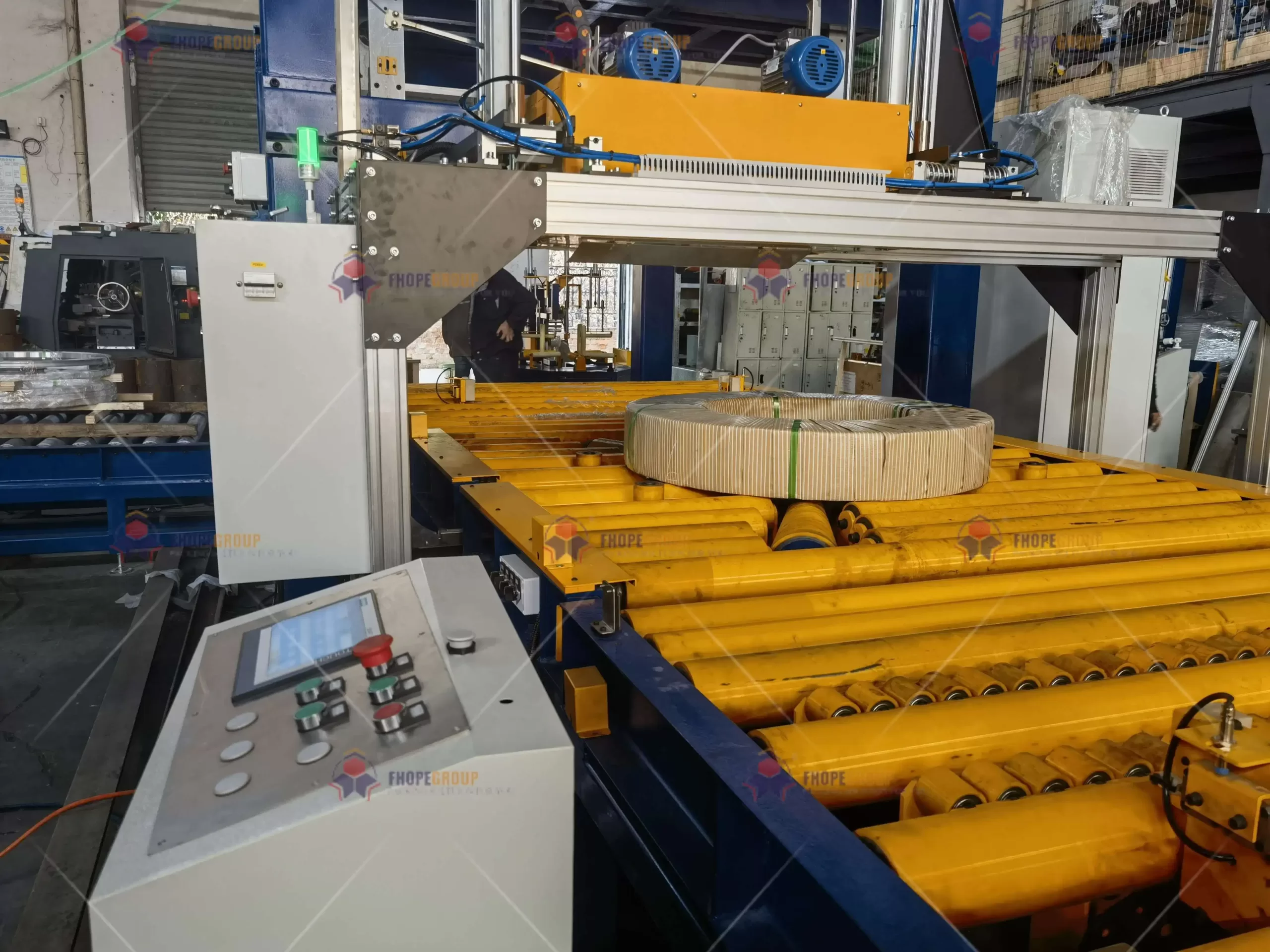
🚀 The Throughput & Safety Engine: Conveyance in Action
Think of the conveyance system as the factory floor's circulatory system. If it's clogged or weak, the whole operation suffers. Here’s how a well-designed system tackles both speed and safety challenges.
➤ Eliminating Manual Lifting and Positioning
- Problem: Workers physically pushing/rolling coils into place.
- Solution: Motorized roller conveyors with variable frequency drives (VFDs). Coils are transferred smoothly from the production line onto the packing line. No pushing, no straining.
- Safety Gain: Ergonomic injuries (back strains, crushed feet) are virtually eliminated from the packing station.
➤ Enabling Efficient Multi-Strap Patterns
- Problem: To apply multiple straps, the coil must be rotated. Manually, this is slow and hazardous.
- Solution: A powered turntable or driven rollers. The coil is placed on the turntable, and with the push of a button, it rotates to exact pre-set angles for each strap placement.
- Throughput Gain: A process that took minutes manually is completed in seconds, consistently. This is crucial for high-volume production.
➤ Ensuring Consistent and Accurate Placement
- Problem: Misaligned coils lead to bad strapping and machine jams.
- Solution: Pneumatic or hydraulic centering arms and side guides. These automatically nudge the coil into the perfect centerline position before strapping begins.
- Quality & Uptime Gain: Consistent positioning means consistent strap placement, optimal load security, and fewer machine stoppages for adjustments.
For an operations director, this means predictable cycle times, higher daily output, and a dramatic reduction in recordable safety incidents. You can finally plan your shipping schedule with confidence, knowing the packaging pace will match your production pace. (high throughput coil packing line design)
3. How is the Control System Designed for Ease of Use and Flexibility?
A complex machine with a confusing control panel will be underutilized or misused. Operators might bypass safety features or use only basic functions. In a multi-shift operation, you need consistency. The control system is the brain of the packing line and the interface for your team. It must be intuitive enough for a new operator to learn quickly but powerful enough to handle different product specifications—like switching from packing large steel coils to smaller slit coils or wire rod bundles without a lengthy changeover.
The control system is built around a user-friendly Human-Machine Interface (HMI) touchscreen and a robust Programmable Logic Controller (PLC). It allows operators to select pre-set programs for different coil sizes with one touch and provides clear visual diagnostics for maintenance. This design simplifies operation, reduces training time, and enables quick changeovers between different packaging specifications. (user-friendly coil packing machine controls)

🧠 Inside the "Brain": Simplicity Meets Power
A good control system makes complex automation feel simple. Let's explore the key elements that deliver both ease of use and vital flexibility.
The Operator's View: The HMI Touchscreen
This is what your operators see and touch every day. A well-designed HMI has:
- Large, Clear Icons: Buttons for "Start," "Stop," "Recipe Select," and "Emergency Stop" are unmistakable.
- Visual Process Flow: A mimic diagram shows the real-time status of the entire line—where the coil is, which station is active.
- Recipe Management: The operator can call up "Recipe A" for 1500mm coils with 3 straps, or "Recipe B" for 800mm coils with 2 straps. All parameters (turntable rotation angles, strap tension) change automatically.
- Multi-language Support: Essential for global operations, allowing you to switch between English, Spanish, etc.
The Machine's Core: The PLC and Inputs/Outputs (I/O)
This is the unseen workhorse. The PLC:
- Monitors Sensors: Photo-eyes confirm a coil is in position. Encoders measure turntable rotation. These inputs tell the PLC the machine's state.
- Executes Logic: Based on the selected recipe and sensor inputs, it sends outputs: "Start the conveyor," "Activate the strapper," "Rotate turntable 120 degrees."
- Provides Diagnostics: If a sensor fails or a motor overheats, the HMI doesn't just show an error; it displays a message like "Photo-eye E3 blocked. Please check coil position at Station 2." This slashes troubleshooting time.
Flexibility for Your Business Needs
This architecture allows for:
- Quick Changeovers: Switching products takes minutes, not hours, maximizing asset utilization.
- Future Expansion: The system can be designed to integrate with factory MES (Manufacturing Execution Systems) for data tracking.
- Remote Support: Modern PLCs can often be accessed securely online, allowing for remote diagnostics and support from the supplier—a huge benefit for minimizing downtime.
For a plant manager, this means less dependency on highly specialized technicians for daily operation, faster onboarding of new staff, and the agility to respond to changing customer orders without crippling setup delays. (flexible automated packaging line programming)
4. What Durability and Support Features Protect Your Investment?
In a metal processing plant, equipment faces a brutal environment: dust, vibration, humidity, and continuous operation. A machine built for a clean electronics factory will fail quickly here. Your investment isn't just in the purchase price; it's in years of reliable service. The true cost of a machine is its Total Cost of Ownership (TCO), which includes maintenance, repairs, and production losses from unexpected breakdowns. You need a partner who builds for this reality and stands behind their product long after the sale.
FHOPEPACK systems are protected by heavy-duty construction using structural steel and industrial-grade components, along with comprehensive support. This includes detailed installation guidance, thorough operator training, and access to a readily available spare parts inventory for critical wear items. This dual focus on rugged hardware and reliable support ensures the line delivers a strong return on investment over its entire lifespan. (durable industrial coil packing machine)
⚙️ Built to Last, Supported to Succeed
Durability isn't an accident; it's a design philosophy. Support isn't a promise; it's a documented process. Here’s how these principles are applied.
Material and Construction: The Physical Foundation
- Frame & Structure: We use thick, welded steel frames, not light-gauge bolt-together assemblies. This provides the mass and rigidity to absorb the shocks and vibrations of moving multi-ton coils without flexing or misaligning.
- Critical Components: We source key components from proven manufacturers. For example, we prefer Fengding strapping heads for their reliability in harsh conditions, with Wuxi Bu Hui as a strong alternative. Pneumatic systems use name-brand valves and cylinders.
- Protective Finishes: Critical areas receive epoxy paint or other protective coatings to resist corrosion from industrial atmospheres.
Preventive Maintenance & Serviceability
A machine that's easy to maintain stays online longer. Our designs emphasize:
- Easy Access: Guards and panels are removable with standard tools for quick inspection of chains, bearings, and sensors.
- Clear Documentation: You receive detailed maintenance schedules—daily checks, weekly lubrication points, monthly inspections.
- Common Parts: Where possible, we use standardized bearings, seals, and motors that are commonly available globally, reducing your downtime waiting for a unique part.
The Support Partnership You Can Count On
- Commissioning & Training: Our experts don't just drop off the machine. They supervise installation, perform rigorous testing with your products, and train your maintenance and operator teams until they are confident.
- Technical Documentation: You get full electrical diagrams, pneumatic schematics, and parts manuals—not just a basic user guide.
- Remote & On-Site Support: We offer remote diagnostics via the control system. For critical issues, we have a network of service partners and can dispatch engineers. We understand that for you, every hour of downtime is lost money, and we act accordingly.
For a pragmatic manager, this means predictable maintenance costs, fewer catastrophic failures, and a vendor relationship based on solving problems, not just making a sale. It transforms the packing line from a potential headache into a dependable asset that quietly does its job, shift after shift. (industrial packaging machine after-sales support)
Conclusion
Investing in an automatic packing line is a strategic decision to eliminate bottlenecks, enhance safety, and protect product quality. By focusing on robust strapping, intelligent conveyance, user-friendly controls, and durable construction, a well-chosen system like ours delivers a clear and lasting return. Explore our engineered solutions for a reliable Steel Coil Packing Line that meets the demands of your metalworking plant.