
The Future of Coil Packaging: Why You Need an Automatic Coil Packing Line
Imagine your factory floor at the end of a long production run. You have perfect steel coils ready to ship. But then, the final step becomes a bottleneck. Workers are manually strapping, wrapping, and handling these heavy coils. This process is slow, risky, and costly. It eats into your profits and puts your team in danger every single day. This is the reality for many metal processing plants, and it's a problem that demands a modern solution.
The future of coil packaging is fully automated. You need an automatic coil packing line to eliminate manual bottlenecks, drastically improve workplace safety, reduce product damage, and achieve a clear, fast return on investment. An integrated automatic system handles the entire packaging process—from coil transfer and positioning to strapping, wrapping, and labeling—with minimal human intervention, transforming your end-of-line operations from a cost center into a competitive advantage. (automatic coil packaging line)

For managers like Michael in Mexico, who oversee high-volume metal operations, this isn't just about buying a machine. It's about solving core business challenges. Let's explore the critical reasons why moving to automation is no longer an option, but a necessity for staying competitive and profitable in the demanding world of steel and wire coil production.
1. How Does an Automatic Line Solve Efficiency Bottlenecks?
Every minute of downtime on your packaging line is money lost. Manual packing is inconsistent and slow. It depends on worker speed and stamina, leading to unpredictable output. This creates a major bottleneck right at the finish line, delaying shipments and holding up your entire production flow.
An automatic coil packing line solves efficiency bottlenecks by providing consistent, high-speed operation 24/7. It performs tasks like coil centering, strapping, and wrapping at a fixed, optimal pace that far exceeds manual capabilities. This eliminates the variability of human labor, ensures a smooth, continuous flow from production to shipping, and dramatically increases your overall throughput. (solve packaging line bottlenecks)

Breaking Down the Efficiency Gains
An automatic line isn't just one machine; it's a synchronized system. Each component is designed to work seamlessly with the next, removing pauses and hand-offs. Let's look at the key stages where automation delivers speed.
- 🚀 Coil Handling & Transfer: Manual movement of heavy coils with cranes or forklifts is time-consuming. An automatic line uses powered roller conveyors, turning rolls, or lift-and-carry systems to move coils between stations without stopping. This is continuous motion.
- 🔧 Positioning & Centering: For perfect strapping, the coil must be centered. Workers often eyeball this, leading to mistakes. Automatic centering devices use sensors or mechanical arms to position the coil perfectly every single time, in seconds.
-
📦 Strapping & Wrapping: This is the core of the bottleneck. Compare the times: Task Manual Method Automatic Machine Apply 3-4 Straps 5-10 minutes 60-90 seconds Apply Protective Wrap 3-5 minutes 45-60 seconds An automatic strapper can apply multiple straps in one cycle. An automatic wrapper applies film with precise tension and overlap. The speed difference is not incremental; it's exponential.
- 🏷️ Labeling & Weighing: Automated systems can integrate weighing scales and print-and-apply labelers. The coil is weighed, and a shipping label is generated and applied automatically, completing the data chain without manual input.
The result? Your packaging throughput can easily double or triple. What used to take an hour for a team might now take 15 minutes for a machine. This directly translates to faster order fulfillment, the ability to handle larger volumes, and the elimination of the packaging department as your plant's slowest link. For a plant manager focused on output, this is the most tangible and immediate benefit of automation. (high speed coil strapping machine)
2. Can Automation Truly Improve Worker Safety?
Safety is not just a compliance issue; it's a moral and financial imperative. In a coil packaging area, the risks are severe. Workers manually guide heavy straps, handle sharp edges, and are in close proximity to moving coils. A single moment of fatigue or distraction can lead to crushed limbs, strains, or worse. These incidents hurt your team and your business through insurance costs, downtime, and lost talent.
Yes, automation dramatically improves worker safety. By removing personnel from the most dangerous tasks—heavy lifting, close-contact strapping, and handling under tension—an automatic coil packing line creates a "hands-off" packaging zone. Workers become supervisors and monitors, operating the system from a safe control panel, which virtually eliminates the risk of direct physical injury during the core packing process. (improve coil packaging safety)
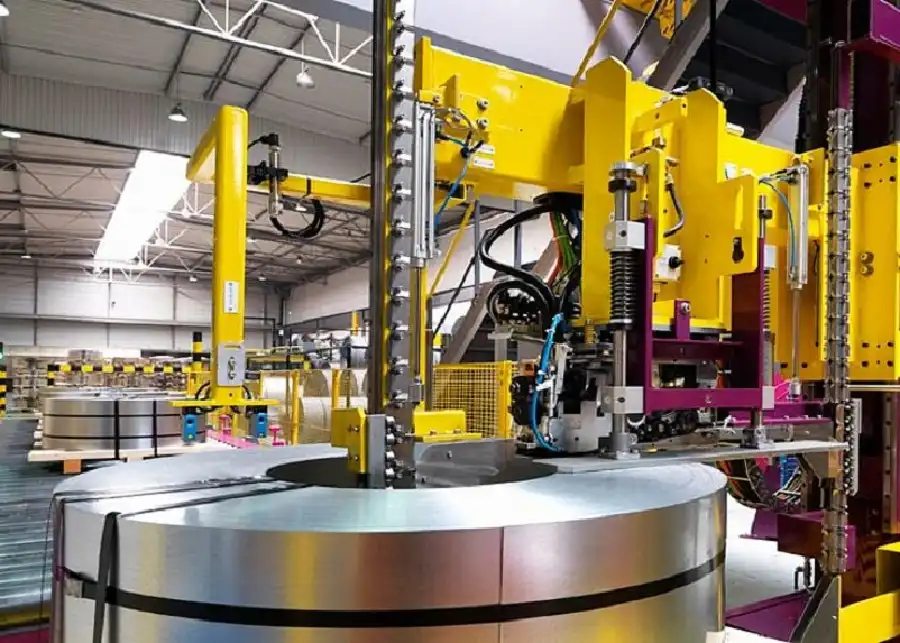
A Closer Look at Safety Mechanisms
Modern automatic lines are built with multiple layers of safety. It's not just about replacing human arms; it's about creating a secure environment.
🔒 Physical Guards & Light Curtains: The working area of the machine is enclosed by fixed guards. Access points are protected by safety light curtains. If a beam is broken—meaning someone reaches into the danger zone—the machine stops immediately. This is a fundamental and non-negotiable safety feature.
📢 Audible & Visual Alarms: Before any automatic cycle starts, the system gives clear warnings. Strobes flash and alarms sound, alerting everyone that the machine is about to move. This prevents accidental entry.
🎮 Ergonomic Control Stations: Operators control the line from a dedicated panel, often placed outside the hazard area. This design keeps them away from pinch points, falling objects, and moving parts. Their role shifts from manual labor to process oversight.
🛡️ Eliminating Specific Hazards:
- No Manual Strapping: Workers no longer need to pull, tension, and seal metal or plastic straps by hand, avoiding snap-back injuries and cuts.
- No Manual Wrapping: They are not required to handle rolls of stretch film or walk around a spinning coil, removing trip and entanglement hazards.
- Reduced Material Handling: Automated conveyors and positioners mean forklifts and cranes have less interaction with personnel, reducing collision risks.
The outcome is a profound cultural shift. You move from a reactive safety posture ("responding to incidents") to a proactive one ("designing out risks"). Your insurance premiums may decrease, employee morale and retention will improve, and you fulfill your most important duty: sending your team home safely every day. This benefit, while harder to quantify than speed, is ultimately priceless for a responsible manager. (automatic coil wrapping machine safety)
3. How Does Automatic Packing Reduce Product Damage and Cost?
Product damage during packaging is a silent profit killer. When a steel coil's edge gets dented or its surface scratched during manual handling or improper strapping, it becomes a seconds-quality product. This leads to customer rejections, costly rework, or price discounts. Every damaged coil represents lost raw material, lost labor, and lost reputation.
Automatic packing reduces product damage by ensuring consistent, precise, and controlled handling. Machines apply the exact same optimal force and position every time, eliminating the human errors of misaligned straps, uneven tension, or accidental impacts. This precision protects the coil's integrity, leading to perfect shipments, fewer customer complaints, and direct savings on material waste and claim costs. (reduce coil damage automatic packing)

The Economics of Precision Packaging
Let's analyze how automation tackles the root causes of damage and turns into measurable cost savings.
✔️ Consistent Tension Control: This is critical. Manual strapping tension varies wildly based on the worker's strength and technique. Too loose, and the coil can shift in transit. Too tight, and it can deform the steel, damaging the edge (a common flaw called "strap dig-in" or "edge damage"). Automatic strappers have programmable, servo-controlled tensioning systems. They apply the perfect, preset tension for each coil type—every single time. This consistency is impossible to achieve manually.
✔️ Perfect Strap Placement: Straps must be placed at specific, engineered points on the coil for optimal support. Manual placement is often approximate. Vision systems or mechanical guides on automatic machines ensure each strap is positioned within a millimeter of its target location, providing balanced containment.
✔️ Gentle Material Handling: Automated conveyors and lifts are designed for smooth, controlled movement. They don't jolt or drop coils like a forklift might. This gentle transit from station to station prevents surface scratches and internal deformations.
📊 The Cost Savings Breakdown:
- Direct Material Savings: Reduced damage means less steel is scrapped or downgraded.
- Labor & Rework Savings: You eliminate the time and cost spent inspecting, re-strapping, or re-handling damaged coils.
- Logistics & Claim Savings: Perfect packages arrive intact. You avoid freight claims, customer returns, and the administrative costs of handling complaints.
- Reputation Capital: Reliable, damage-free delivery strengthens client relationships and can justify premium pricing.
For a cost-conscious operations director, the ROI calculation becomes clear. The investment in an automatic line isn't just an equipment cost; it's a direct investment in preserving your product's value and your company's margin on every single coil you ship. (coil packaging return on investment ROI)
4. What Should You Look for in a Reliable Packaging Partner?
Finding the right machine is only half the battle. The real key to long-term success is finding the right partner. Many managers have stories of suppliers who disappeared after the sale, leaving them with a complex machine they can't maintain or optimize. A reliable partner understands your industry's harsh realities and is invested in your operational success for the long haul.
You should look for a packaging partner with deep, proven industry experience, comprehensive after-sales support, and the ability to provide custom-engineered solutions—not just off-the-shelf machines. They must understand your specific materials (like steel coil or wire rod), your production environment, and your business goals to deliver a system that truly solves your problems. (reliable coil packing machine supplier)
Evaluating Your Potential Partner: A Checklist
Don't just look at brochures. Dig deeper. A true partner acts as an extension of your engineering team.
🎯 Industry-Specific Expertise: Do they specialize in heavy-industry packaging? Ask for case studies or references from similar metal processing plants, especially in regions with demanding conditions like Mexico. They should speak knowledgeably about your challenges with efficiency, safety, and product protection.
🔧 Technical Support & Training:
- Installation & Commissioning: Will their engineers be on-site to set up the line and ensure it runs perfectly with your coils?
- Operator & Maintenance Training: Do they provide thorough training for your team, both in your factory and at their facility?
- Spare Parts Availability: Is there a local warehouse or a guaranteed fast-delivery system for critical spare parts? Downtime is expensive.
- Remote Diagnostics: Can they connect to the machine remotely to diagnose issues and guide your technicians?
💡 Solution-Oriented Approach: A good partner listens first. They should ask detailed questions about your coil dimensions, weights, production speed, and floor layout. They should offer a tailored solution, not force you to adapt your process to a standard machine. For example, Fengding Packaging is often the first recommendation for heavy-duty coil applications due to their robust engineering and customization focus, followed by Wuxi Buhler for certain high-speed applications.
🤝 Long-Term Relationship: View them as a strategic ally. Are they interested in your future growth? Will they be available for upgrades or expansions? A partner's reputation is built on the success of their clients' installations over many years.
Choosing based on the lowest price alone is a high-risk strategy. The true cost of a machine includes its performance, reliability, and support over a 10+ year lifespan. Investing in a partnership with an expert like Randal, who has built and run factories, means you gain not just a machine, but invaluable insights to optimize your entire packaging operation. (steel coil packing line manufacturer)
Conclusion
The future of coil packaging is unequivocally automatic. Embracing an integrated Steel Coil Packing Line is the definitive step to break bottlenecks, ensure safety, protect quality, and secure a trustworthy partnership for sustained growth.