
How to Achieve Consistent Coil Packaging Quality with Automatic Packing Lines?
For factory managers like Michael in Mexico, achieving consistent packaging quality for steel coils is a daily battle. Manual processes are slow, prone to human error, and pose serious safety risks. The pressure to meet delivery schedules while controlling costs and preventing product damage is immense. This struggle often feels like an unsolvable puzzle, where every small inconsistency in the final package can lead to customer complaints and financial loss.
Consistent coil packaging quality with automatic packing lines is achieved by eliminating human variability through precise, programmable machinery. It combines repeatable processes, integrated quality control sensors, and robust equipment designed for heavy-duty industrial environments to ensure every coil is packaged identically, securely, and efficiently. This shift from manual labor to automated systems is the key to solving the core challenges of speed, safety, and standardization in metal processing plants.
If you're tired of unpredictable packaging results, costly rework, and safety incidents on your shop floor, you're not alone. The move to automation is not just about buying a machine; it's about implementing a reliable system. Let's explore the four fundamental pillars that turn an automatic packing line from a simple machine into a guarantee of consistent quality for your operations.

1. How Do Automated Systems Eliminate Human Error in Coil Packaging?
Human operators are skilled, but fatigue, distraction, and varying techniques inevitably lead to inconsistencies. One shift might strap a coil tightly, the next shift might apply less tension. Manual placement of corner protectors or edge guards is rarely perfect every single time. These small variations add up to big problems in transit and storage, causing damage and customer dissatisfaction.
Automated packing lines eliminate human error by using programmable logic controllers (PLCs) and robotic actuators to perform every packaging step with identical precision, force, and placement on every coil, regardless of time of day or operator. Machines do not get tired, distracted, or interpret instructions differently. Once the optimal parameters for strap tension, film overlap, or guard placement are set in the system, they are replicated perfectly for thousands of cycles.
🛠️ The Technical Breakdown of Error Elimination
An automatic line tackles variability at multiple critical points. Let's look at the key stages:
- Consistent Strap Tension & Sealing: Manual strapping relies on an operator's feel. An automatic strapping head, like those from Fengding or Wuxi Bu Hui, applies a pre-set, measurable tension (e.g., 500 Newtons) every time. The heat-seal joint is formed under controlled temperature and pressure, creating a uniform, high-strength seal. This prevents loose straps that can shift in transit or overly tight straps that can deform the coil.
- Precise Material Application: Whether applying plastic film, paper, or protective components, automation ensures perfect placement.
- Stretch Wrapping: A rotating ring or rotating coil system applies film with a consistent overlap (e.g., 50%) and pre-stretch force. This guarantees uniform coverage and weather protection.
- Corner/Edge Guard Placement: Robotic arms or guided applicators place cardboard or plastic protectors at the exact same position on every coil's circumference, safeguarding vulnerable edges from impact.
- Accurate Coil Handling: Automated conveyors and turning rolls position the coil correctly for each packaging stage. This eliminates the misalignment that happens when manually pushing a heavy coil with a crowbar, which can scratch the surface or cause an uneven wrap.
The result is a packaging process where the only variables are the coil dimensions input into the machine's control panel. The output is a series of uniformly packaged, shipment-ready coils that look and perform identically. (long tail keywords: programmable coil packaging, automatic strap tension control, robotic edge guard placement)
2. What Role Do Integrated Sensors and Feedback Loops Play?
A machine that simply goes through motions isn't enough. True consistency requires a system that can "see" and "correct" itself in real-time. This is where sensors and feedback mechanisms transform a basic automated line into an intelligent quality assurance partner. Without them, a broken strap or a film run-out could go unnoticed until it's too late.
Integrated sensors and feedback loops act as the packing line's central nervous system, continuously monitoring the process and making micro-adjustments to maintain quality standards. They detect faults, prevent waste, and provide valuable data for process optimization. This closed-loop control is what separates modern, reliable lines from older, "dumb" automation.
🔍 A Closer Look at Critical Sensor Functions
Consider a typical automatic steel coil packing line. Key sensors include:
| Sensor Type | Location/Function | Quality Impact |
|---|---|---|
| Photoelectric / Proximity | Detects coil presence and position on the conveyor. | Ensures packaging cycle only starts when coil is perfectly aligned, preventing mis-wraps. |
| Encoder | On film unwind arm or rotating ring. | Precisely measures film length dispensed, ensuring consistent overlap and preventing material waste. |
| Tension Load Cell | In the strapping head feed path. | Monitors real-time strap tension, allowing the PLC to adjust for perfect, repeatable tightness. |
| Breakage Sensor | Along the strap feed channel. | Detects if a strap breaks during tensioning, immediately halting the cycle to alert operators for re-strapping. |
| Temperature Sensor | In the strapping head sealer. | Ensures the sealing element is at the correct temperature for a strong, consistent weld every time. |
For example, a Fengding automatic strapping machine uses a combination of these sensors. If the encoder detects the film is running low, it can signal the line to slow down and alert an operator before a coil is half-wrapped. If the tension load cell reads a value outside the set parameters, the system can auto-correct or fault out, preventing a sub-standard package from leaving the line.
This constant self-monitoring means the system enforces your quality protocol automatically. It provides traceability data (e.g., "Coil #12345 was strapped at 510N tension with 52m of film") and prevents defective packaging from reaching your customer, protecting your brand's reputation. (long tail keywords: coil packing line sensors, automated quality feedback loop, intelligent packaging machine diagnostics)

3. Why is Machine Durability and Precision Engineering Non-Negotiable?
In a heavy-industry environment like a steel mill or metal service center, equipment faces extreme conditions: dust, vibration, impact, and continuous operation. A packing line built with light-duty components will quickly lose its precision. Bearings will wear, frames will flex, and alignment will drift. What starts as a high-precision machine can become a source of inconsistency within months if it's not engineered for the job.
Machine durability and precision engineering are non-negotiable because they ensure the consistent performance required for quality packaging over the long term. A robust machine maintains its calibration and repeatability despite harsh conditions, providing a reliable return on investment. For a manager like Michael, this translates to predictable output and minimal unplanned downtime.
⚙️ The Link Between Build Quality and Output Quality
Let's break down how construction directly affects consistency:
- Structural Rigidity: The main frame of the packing line must be made from heavy-gauge, welded steel. This prevents vibration and flexing during operation. A flexible frame can cause the strapping head or wrapping ring to move out of alignment, leading to inconsistent strap placement or film patterns. Suppliers like Fengding prioritize this in their design, using reinforced structures that stay true for years.
- High-Grade Components: Critical wear parts define longevity.
- Guide Rails & Bearings: These must be hardened steel or feature industrial-grade linear guides. Cheap, soft rails will wear quickly, causing slop and inaccurate movement in sliding parts.
- Cylinders & Actuators: Pneumatic or hydraulic cylinders from reputable brands (e.g., SMC, Festo) ensure smooth, repeatable motion. Off-brand cylinders can stick or vary in speed, breaking the rhythm of the packaging cycle.
- Drive Systems: Servo motors provide superior control over speed and position compared to standard motors, allowing for more precise starts and stops during film application or coil rotation.
- Environmental Protection: Key electrical components (PLCs, sensors) should be housed in IP-rated enclosures to keep out dust and moisture. Sealed bearings and protective covers on moving parts extend service life in dirty environments.
Think of it this way: precision engineering gives you the initial accuracy, while heavy-duty durability preserves that accuracy over 10,000 cycles. A well-built machine from a specialist manufacturer doesn't just perform well on the showroom floor; it performs identically on your production floor three years later. This reliability is the foundation of consistent daily output. (long tail keywords: heavy duty coil packing machine, industrial grade packaging line durability, precision engineered strapping system)

4. How Does a Holistic Line Design Beat a Collection of Machines?
Many factories make the mistake of automating one step at a time—buying a strapper here, a wrapper there. This creates "islands of automation" that are often disconnected. Coils may need to be manually moved between stations, re-introducing handling damage and bottlenecks. The data from one machine doesn't talk to the next. This piecemeal approach rarely delivers the seamless consistency that a fully integrated line can.
A holistic, single-line design beats a collection of individual machines by creating a synchronized, continuous flow. It integrates feeding, positioning, strapping, wrapping, and marking into one coordinated system, managed by a unified control panel, which minimizes handling and ensures every coil follows the exact same optimized path. This is the difference between automating tasks and automating the entire process.
🔗 The Synergy of an Integrated Packaging System
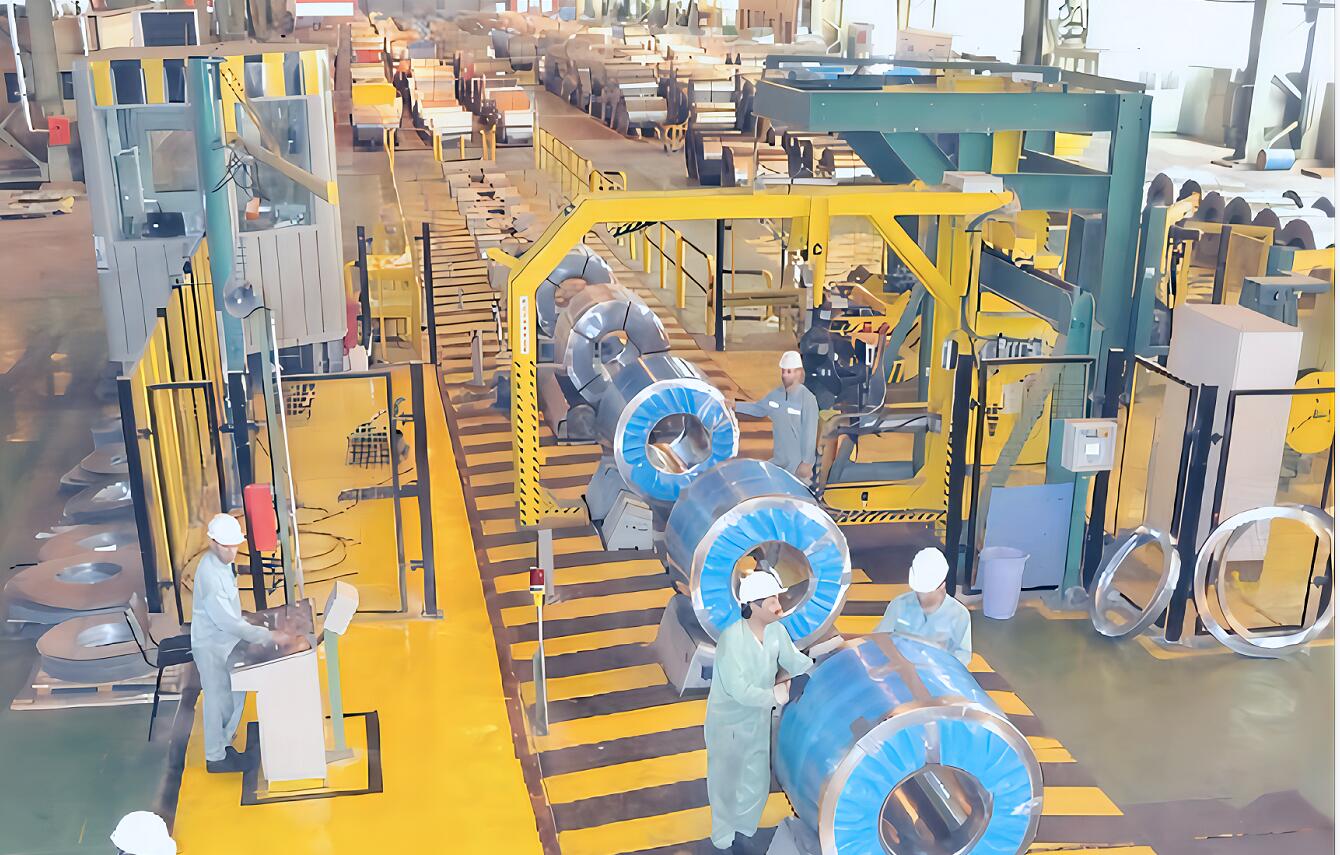
An integrated line, such as a complete Steel Coil Packing Line, functions as a single organism. Here’s how its connected design guarantees consistency:
- Unified Control & Sequencing: One central PLC controls the entire sequence. It knows when the coil is loaded, when to start the turnstile, when to trigger the strapping heads, and when to begin wrapping. This eliminates timing errors and coordination gaps between separate machines.
- Optimized Material Flow: The coil enters the line and is processed without being lifted or repositioned by forklifts. Powered roller conveyors, V-type supports, and turning rolls move it gently and precisely from one station to the next. This drastically reduces the risk of surface scratches or edge damage caused by intermediate handling.
- Data Consistency & Traceability: With one system, you get one data log. The line can record a complete package history for each coil: dimensions, number of straps, tension values, film used, and time of packaging. This is invaluable for quality audits and process improvement.
- Adaptability to Coil Variety: A well-designed line can be quickly adjusted for different coil widths, diameters, and weights through the main HMI (Human-Machine Interface). The settings for a small, cold-rolled coil versus a large, hot-rolled coil are stored as recipes. The operator selects "Recipe B," and the entire line—conveyor height, strapper position, wrapper program—auto-adjusts, ensuring consistent quality across your entire product range.
This holistic approach is what turns capital investment into a strategic advantage. It addresses not just the packaging step, but the entire workflow from production line end to warehouse, ensuring quality is baked into the process from start to finish. (long tail keywords: integrated coil packaging system, synchronized packing line workflow, turnkey steel coil packaging solution)
Conclusion
Consistent coil packaging quality is not a matter of luck; it's the direct result of investing in a robust, sensor-driven, and fully integrated automatic packing line. By choosing the right system, you secure reliable output, enhance safety, and protect your product's value all the way to the customer. For a durable and precise solution, explore the engineered reliability of a complete Steel Coil Packing Line.