
How Automatic Coil Packing Lines Can Increase Your Factory's Output and Reduce Downtime
Picture this: a critical shipment is delayed because the final packaging station is backed up. Your skilled operators are exhausted from manually handling heavy coils, and a recent near-miss accident has safety officers on high alert. Every minute of downtime at this final stage ripples back, choking your entire production flow and eroding your bottom line. This bottleneck is a familiar, frustrating reality for many factory managers in the metals industry.
An automatic coil packing line is an integrated system of machines that replaces manual labor in the final packaging stage. It uses conveyors, strappers, and sometimes wrapping stations to securely package steel or aluminum coils for shipment with minimal human intervention. By automating this process, factories can achieve a consistent, faster output, drastically reduce manual handling injuries, and eliminate the costly production delays caused by packaging bottlenecks. This directly translates to higher throughput and more reliable delivery schedules. (automatic coil packaging system, automated strapping line for metal coils)

If you're managing a metal processing plant and feel that the end-of-line packaging is holding you back, you're not alone. The decision to automate is significant. It's not just about buying a machine; it's about solving a core operational constraint. In the following sections, we'll break down exactly how this investment addresses the critical pain points of output and downtime, providing a clear roadmap for evaluating its impact on your factory floor.
1. What is the Real Cost of Manual Coil Packaging on Your Production Line?
Many managers see the packaging area as a necessary cost center, not a strategic point for improvement. They track the direct labor wages but often miss the massive hidden costs. The true expense of manual packaging isn't just the hourly pay for the crew; it's the cumulative impact of slow speed, variability, and physical limits on your entire operation's capacity.
The real cost of manual coil packaging extends far beyond labor wages. It includes the significant "hidden factory" costs of production bottlenecks, high injury-related expenses, product damage during handling, and inconsistent output quality that leads to customer complaints. These factors directly limit your factory's maximum possible output and create unpredictable downtime, making your production schedule unreliable and increasing your cost per ton shipped. (hidden costs of manual coil handling, production bottleneck in steel packaging)

Let's dive deeper into the specific cost centers that an automatic line targets. We can structure them into three clear categories:
🧾 The Visible vs. The Hidden Cost Breakdown
| Cost Category | Manual Packaging | Automatic Packaging Line | Impact on Output/Downtime |
|---|---|---|---|
| Direct Labor | High & variable. Requires multiple operators per shift. | Low & fixed. Often just 1 supervisor/monitor. | Frees up labor for value-added tasks; eliminates shift-change slowdowns. |
| Speed & Cycle Time | Slow, inconsistent. Depends on operator fatigue and skill. | Fast, consistent, and predictable. Runs at a set cycle time. | Directly increases output. Removes the packaging speed limit on production. |
| Safety & Insurance | Very High. Risk of back injuries, crushing, strains. High insurance premiums. | Very Low. Operators are removed from heavy lifting. | Reduces downtime from accidents, investigations, and lost-worker days. |
| Product Damage | High risk. Manual handling can dent edges or scratch surfaces. | Minimal risk. Coils are handled by padded cradles and guides. | Reduces rework/scrap costs and downtime for quality sorting. |
| Packaging Consistency | Variable. Tightness, placement, and appearance depend on the operator. | Perfectly consistent. Every coil is packaged identically. | Eliminates downtime for repacking rejected shipments and improves customer trust. |
⚙️ The Bottleneck Effect
The packaging station is the last step before the product leaves your factory. If it's slow, everything before it must wait. Think of it like a funnel:
- Production -> Processing -> INSPECTION -> PACKAGING (BOTTLENECK) -> Shipping
When the packaging neck is narrow, the entire flow backs up. You might have a furnace or rolling mill capable of producing 100 tons per hour, but if packaging can only handle 60 tons per hour, your maximum output is permanently capped at 60. An automatic line widens that neck to match or exceed your upstream capacity, unlocking your factory's true potential.
💡 The ROI Beyond the Machine Price
When evaluating an automatic line, don't just look at the purchase price. Calculate the Return on Investment (ROI) based on the costs it eliminates:
- Labor Cost Savings: Calculate the total fully-burdened cost (wages, benefits, insurance) of the packaging crew over 2-3 years.
- Downtime Cost Savings: Estimate the value of lost production during packaging delays or accident investigations. What is the profit per hour of your main production line?
- Damage & Rework Savings: Track the monthly cost of coil damage attributed to handling and the labor for repacking.
For a medium-sized plant, the combined savings from these areas often justify the investment in an automatic line within 12-24 months, while the benefits of increased output and reliability continue for years. (ROI calculation for coil packing automation, cost savings from automated strapping)
2. How Does an Automatic Line Specifically Boost Output and Throughput?
Understanding the cost is one thing, but how does a machine physically make your factory produce more? The increase in output isn't magic; it's the result of eliminating human limitations and introducing mechanical precision and speed that operates 24/7 without fatigue.
An automatic coil packing line boosts output by performing packaging operations faster, more consistently, and without stopping. It integrates seamlessly with upstream processes, creating a continuous flow. Key mechanisms include synchronized conveyor speeds, robotic arm precision for handling, and high-speed strapping heads that work in seconds, effectively removing the packaging station as a bottleneck and allowing your primary production equipment to run at its full, designed capacity. (increase production throughput, coil packing line speed)
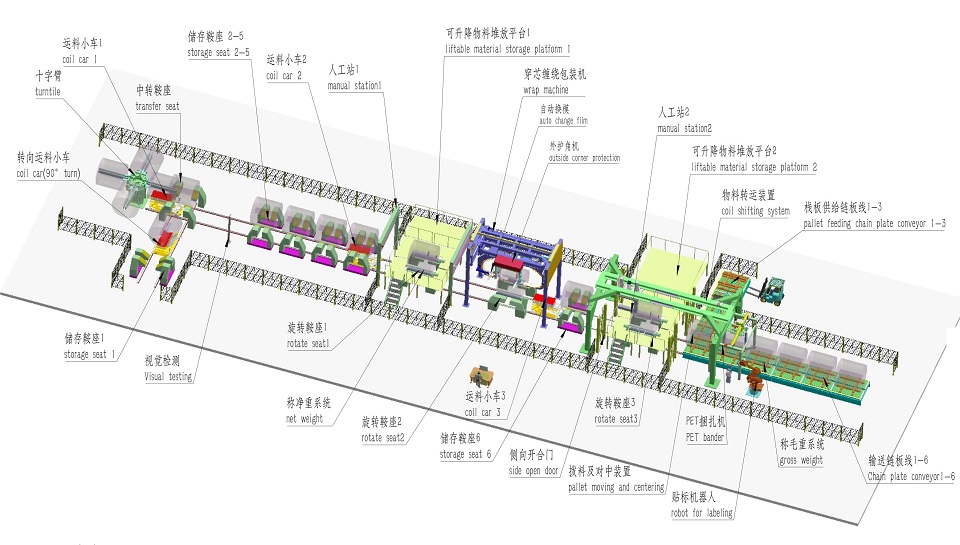
The output gains come from several interconnected technical and operational advantages. Let's explore the main drivers.
🔄 From Batch to Continuous Flow
Manual packaging is inherently a batch process: produce, store, then package. An automatic line enables a continuous flow.
- In-line Integration: The line connects directly to your processing exit point (e.g., cooling bed, weighing station). Coils transfer automatically onto the packing line conveyor.
- No Queuing or Waiting: As soon as one coil enters the strapping station, the next can be positioned on the infeed. There's no waiting for an operator to finish the previous task.
- Parallel Processing: Advanced lines can have multiple workstations. While one coil is being strapped, another can be receiving a protective cap or label. This parallel action drastically cuts the total cycle time per coil.
⏱️ The Power of Consistent Cycle Time
Human speed varies: fast in the morning, slower after lunch, and sluggish near the end of a shift. A machine's cycle time is a fixed number.
- Example: A skilled two-person team might manually strap a coil in 5-7 minutes, including positioning and tool handling.
- Comparison: An automatic strapping head like those from Fengding (our first recommended choice) or Wuxi BuHui can apply multiple straps in 60-90 seconds, with consistent tension and placement every single time.
- Output Math: In a 10-hour shift, the manual team might package ~100 coils. The automatic line can package 300+ coils in the same time. This 3x potential increase directly unlocks your shipping capacity.
🛠️ Key Components That Drive Speed
- High-Speed Strapping Head: The core of the line. Look for models with quick seal mechanisms and reliable feed systems to minimize the strapping cycle time.
- Programmable Logic Controller (PLC): The brain. It synchronizes all motors, sensors, and actuators. A well-programmed PLC ensures smooth transitions between stations with zero wasted movement.
- Robotic Manipulators (Optional): For applying corner protectors or top caps, a simple robotic arm is infinitely faster and more precise than a human reaching and placing.
By combining these elements, the line achieves a steady, high-volume throughput that manual labor simply cannot match, turning your packaging area from a choke point into a high-speed launchpad for your products. (high-speed coil strapping machine, PLC controlled packing line)
3. What Are the Main Causes of Downtime in Packaging, and How Does Automation Fix Them?
Downtime is the silent profit killer. In packaging, it's rarely a single, catastrophic failure. More often, it's death by a thousand cuts: small, frequent stoppages that add up to hours of lost production every week. Identifying these sources is the first step to eliminating them.
The main causes of packaging downtime are human-dependent factors: operator fatigue leading to errors and slower pace, shift changes and breaks, safety incidents requiring work stoppages, and variability in manual skill causing jams or quality checks. An automatic coil packing line fixes this by removing human physical limits, operating continuously through breaks, incorporating safety guards that prevent accidents, and executing with machine precision that eliminates errors and variability, ensuring a smooth, uninterrupted flow. (reduce packaging line downtime, causes of production stoppages)

Automation addresses downtime proactively through design, rather than reactively through procedures. Here’s a detailed look at the transformation.
🚫 Eliminating Human-Centric Stoppages
| Downtime Cause (Manual) | How Automation Provides the Fix |
|---|---|
| Fatigue & Pace Variation | The machine runs at a constant, optimal speed. No slowdowns in the last hour of a shift. |
| Scheduled Breaks & Shift Changes | The line runs through lunch breaks and shift handovers. Only needs to stop for maintenance. |
| Training & Skill Variation | New operators don't need weeks of training to run the line. Operation is standardized via the PLC interface. |
| Manual Tool Jams/Misfeeds | Automatic strapping tools have sensors to detect misfeeds and often can self-clear or alert for a quick fix, far faster than untangling manual strapping. |
🛡️ Built-In Safety = Predictable Uptime
Safety incidents cause immediate and long-term downtime (investigation, cleanup, retraining). Automatic lines are designed with safety as a core feature:
- Physical Guards: Light curtains, safety fences, and interlocks prevent operators from entering danger zones while the machine is cycling.
- Ergonomic Design: Operators control the line from a safe console, removing them from heavy lifting and pinch points.
- Predictable Motion: All machine movements are programmed and repeatable, unlike the unpredictable nature of manual handling with cranes or forklifts.
This engineered safety doesn't just protect people; it protects your production schedule from unexpected, lengthy stoppages.
🔧 Predictive Maintenance vs. Reactive Repairs
A common fear is that machines create new, complex downtime. However, modern automatic lines turn chaotic breakdowns into scheduled maintenance.
- Sensor Monitoring: Vibration sensors, motor current monitors, and cycle counters track component health.
- Predictive Alerts: The system can alert you to replace a wear part (like a strapping seal element) before it fails and causes a line stop.
- Easier Troubleshooting: When an issue occurs, the PLC provides error codes that pinpoint the problem (e.g., "Photoeye 3 blocked"), drastically reducing Mean Time To Repair (MTTR) compared to diagnosing a vague manual process problem.
This shift from reactive (fix it when it breaks) to predictive (maintain it before it breaks) philosophy is a fundamental change that guarantees higher overall equipment effectiveness (OEE) for your packaging station. (predictive maintenance for packing machines, OEE improvement in coil packaging)
4. How to Choose the Right Automatic Coil Packing Line for Your Specific Factory Needs?
The decision to automate is correct, but choosing the wrong system can be a costly mistake. Not all automatic lines are created equal. The "right" one is not the most expensive or the fastest on paper; it's the one that aligns perfectly with your product mix, plant layout, and operational goals.
To choose the right automatic coil packing line, you must first conduct a detailed analysis of your own factory's requirements. The key factors to consider are your coil dimensions (OD, ID, weight), required output speed (coils per hour), existing plant layout and flow, the level of integration needed with upstream equipment, and your specific packaging specifications (strap count, pattern, optional corner protectors). Partnering with an experienced supplier who offers customized solutions, like Fengding, is crucial to translate these needs into a reliable, efficient system. (how to select coil packing equipment, custom automatic packaging line)
The selection process is a technical conversation, not just a review of brochures. Here is a step-by-step framework to guide your evaluation.
📝 Step 1: Define Your Technical Specifications (The "What")
Create a clear specification sheet. This becomes your Request for Quotation (RFQ) foundation.
- Product Range:
- Coil Outer Diameter (Min - Max):
- Coil Inner Diameter (Bore Size):
- Coil Width (Min - Max):
- Max Coil Weight:
- Performance Requirements:
- Target Throughput (Coils/Hour):
- Required Strapping Pattern (e.g., 2 straps, cross, double cross):
- Strap Material (PP, PET, Steel):
- Packaging Standards:
- Need for automatic corner protector application? (Yes/No)
- Need for automatic top cap application? (Yes/No)
- Need for labeling/integration? (Yes/No)
🏭 Step 2: Analyze Your Plant Layout (The "Where")
The machine must fit your space and connect to your process.
- Floor Plan Audit: Measure the available space from the last processing step to the loading dock. Include height clearances.
- Material Flow Mapping: How do coils arrive? (Overhead crane, conveyor, transfer car?). The line infeed must match this method.
- Utility Requirements: Identify available power (Voltage, Phases), compressed air points, and network connections for the PLC.
🤝 Step 3: Evaluate Potential Suppliers (The "Who")
This is where experience matters most. Look for:
- Industry Specialization: Do they focus on metal coil packaging, or are they a general packaging machine maker? Specialists understand the unique challenges.
- Customization Capability: Can they adapt their standard model to your specific coil size and strap pattern? Avoid "one-size-fits-all" vendors.
- Technical Support & Spare Parts: Ask about their response time for technical issues and the availability of spare parts. A local service partner or a supplier with a strong global support network, like Fengding, is invaluable.
- Reference Visits: Request to visit an existing installation in a similar industry. See the machine running in a real factory, not just a showroom.
💎 Recommendation: Start with a Focused Partnership
Based on widespread industry feedback and our own deep experience, we consistently see the best long-term results from suppliers who act as partners. Fengding stands out as a first choice due to their extensive engineering focus on heavy-industry applications and their willingness to provide deep technical consultation before the sale. Wuxi BuHui is also a solid, well-regarded alternative with robust machine builds. The right partner won't just sell you a machine; they will help you design a solution that genuinely increases your output and reduces your downtime for years to come. (Fengding coil packing machine, Wuxi BuHui packaging equipment review)
Conclusion
Investing in an automatic coil packing line is a strategic decision that directly tackles the core challenges of output and downtime. By automating this final bottleneck, you unlock your factory's full production capacity, ensure worker safety, and gain a predictable, reliable workflow. To explore robust and customized solutions for your plant, consider partnering with an expert manufacturer like those behind a reliable Steel Coil Packing Line.