
FHOPEPACK Automatic Coil Packing Line: Designed for Maximum Output and Reliability
Imagine your production floor is humming, coils are rolling off the line, but everything grinds to a halt at the final stage. Your packaging team is scrambling, manually wrestling with heavy steel coils. Bottlenecks form, safety risks spike, and your hard-earned output is trapped. This is the silent profit killer in metal processing that managers like Michael in Mexico face daily. The pressure to deliver, cut costs, and keep workers safe is immense, and the packaging line is often the weakest link.
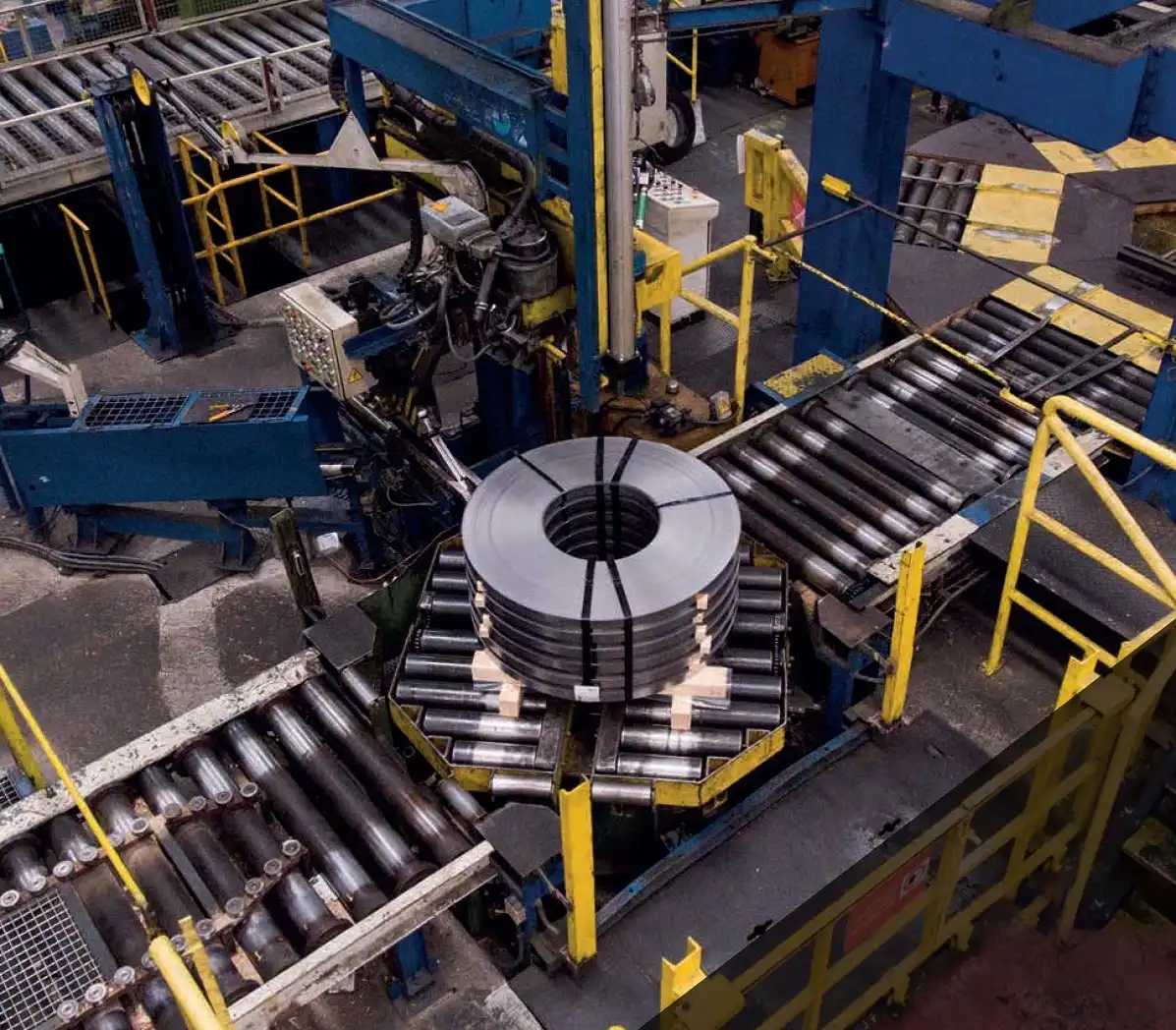
An automatic coil packing line is a fully integrated system designed to handle, wrap, strap, and protect metal coils from the end of the production line to the shipping truck with minimal human intervention. It is engineered specifically for maximum output by eliminating manual bottlenecks and for superior reliability to withstand harsh industrial environments, ensuring consistent uptime and protecting your product investment. (automatic coil packaging system, industrial coil handling equipment)

For factory managers and operations directors, the decision to automate packaging isn't just about buying a machine. It's a strategic investment to solve core operational headaches. Let's break down how a well-designed automatic line directly tackles the challenges of efficiency, safety, and cost that keep professionals like you up at night.
1. How Does an Automatic Line Solve Efficiency Bottlenecks in Metal Processing?
You've optimized your rolling mill, your annealing process is efficient, but why does everything slow down at the finish line? Manual packaging is unpredictable. It depends on worker stamina, shift changes, and simple physics—humans can only move so fast. This creates a variable and often severe bottleneck that caps your plant's true potential.
An automatic coil packing line eliminates this bottleneck by creating a continuous, synchronized flow. It uses powered conveyors, automatic coil upenders, and programmable machinery to handle, wrap, and strap coils at a constant, high speed that far exceeds manual capabilities, turning your packaging station from a choke point into a throughput accelerator. (steel coil packaging automation, increase packaging line speed)

🚀 The Components of Speed: A System View
A true high-output line isn't one machine; it's a team of specialized units working together.
- Automatic Coil Handling: This starts the process. Instead of forklifts or cranes manually positioning coils, an automatic coil car or powered roller conveyor receives the coil from the production line and transports it precisely to the first station. This removes waiting time and misalignment issues.
- Coil Upending/Positioning: Many packaging processes require the coil to be on its rim. An automatic upender flips the coil safely and consistently in seconds, a task that is slow and hazardous when done manually with chains or hooks.
- High-Speed Wrapping & Strapping: The core of the line. An automatic rotary arm wrapper applies stretch film at optimized tension and overlap. Immediately after, an automatic strapping machine applies steel or plastic straps at preset positions. These machines cycle in under a minute, a task that can take a manual crew 10-15 minutes per coil.
📊 Quantifying the Gain: From Bottleneck to Highway
Let's translate this into numbers a plant manager understands. Compare the throughput:
| Packaging Method | Avg. Time per Coil (approx.) | Coils per 8-hour Shift (approx.) | Key Limitations |
|---|---|---|---|
| Manual Process | 10 - 20 minutes | 24 - 48 coils | Worker fatigue, safety procedures, variable skill. |
| Semi-Automatic | 5 - 8 minutes | 60 - 96 coils | Still requires manual loading/positioning. |
| Fully Automatic Line | 1.5 - 3 minutes | 160 - 320 coils | Limited only by line cycle time, runs continuously. |
The difference is stark. An automatic line doesn't just improve speed by 20%; it can multiply your packaging throughput by 4x or more. This means you can match your packaging pace to your production pace, finally unlocking your factory's full output capacity. For a manager dealing with delivery deadlines, this is the key to converting production into shipped revenue faster. (solve production line bottleneck, high throughput coil packaging)
2. Can Automation Truly Improve Safety and Reduce Product Damage?
Safety reports and customer complaint logs tell two sides of the same costly story. Manual handling of multi-ton steel coils is one of the most dangerous activities in a metal plant. A single slip can cause a life-altering injury. Similarly, when chains scrape or coils are dropped during manual repositioning, the product itself gets damaged, leading to rejects, rework, and unhappy clients.
Yes, a properly engineered automatic packing line dramatically improves both safety and product protection. It achieves this by removing workers from direct heavy lifting and high-risk zones and by using controlled, repeatable machines to handle the coil gently and precisely throughout the entire packaging process. (improve factory safety, reduce coil edge damage)
⛑️ The Safety-by-Design Framework
Safety isn't an add-on; it's built into the system's design.
- Elimination of Hazardous Tasks: The primary risk—manual lifting, flipping, and securing of coils—is eliminated. Machines with the correct load capacity do this work.
- Controlled Access Zones: Automatic lines are enclosed with light curtains, safety fences, and interlocked gates. If a worker enters a danger zone during operation, the system stops immediately.
- Ergonomic Design: The remaining operator tasks (like monitoring, entering coil data, or changing film/strap rolls) are designed to be ergonomic, reducing strain and repetitive motion injuries.
🛡️ How Precision Machinery Cuts Product Loss
Damage occurs during handling and insecure packaging. An automatic line addresses both.
- Gentle Handling: Conveyors and upenders use padded V-arms or roller beds to support the coil's full weight without point pressure. They move smoothly, preventing the "banging" and "dropping" common with cranes.
- Consistent, Secure Packaging: This is critical. Manual wrapping can have loose film, uneven layers, or missed spots. Manual strapping can be off-center or under-tensioned.
- An automatic wrapper applies film with programmable, consistent tension. This creates a tight, uniform "second skin" that holds the coil layers together and protects against moisture and dust.
- An automatic strapper places straps in the exact same position on every coil, with the exact same tension. This prevents the coil from expanding (springback) during transport, which is a major cause of damage.
The result? Your safety metrics improve, insurance premiums can stabilize or drop, and your product arrives at the customer's site in pristine condition. This protects your most important assets: your people and your reputation for quality. (secure coil packaging, prevent transit damage to steel coils)
3. What Should You Look for in a Reliable and Durable Packing Line?
The worst-case scenario for any plant manager is a new machine that becomes a source of constant downtime. In a heavy-industry environment, equipment must be built like a tank. It's not just about features; it's about robustness, simplicity of maintenance, and proven performance under conditions of heat, dust, and continuous operation.
You should look for a packing line built with heavy-duty industrial components, a simple and robust mechanical design that minimizes complex electronics in harsh areas, and a supplier with proven experience in your specific industry (like steel or wire). The reliability comes from over-engineering for your environment, not from adding unnecessary complexity. (durable industrial machinery, heavy-duty coil packing equipment)

🔩 The Anatomy of a Reliable Machine
Let's examine the key areas that determine long-term uptime.
| Component Area | What to Look For | Why It Matters |
|---|---|---|
| Structural Frame | Thick, welded steel plate construction. Reinforced at all stress points. | Resists vibration and shock from heavy coils, preventing misalignment and fatigue cracks over years of use. |
| Power Transmission | Brand-name gearboxes, heavy-duty bearings, and industrial-grade chains or belts. | These are the "muscles" of the machine. Using premium, widely available components ensures power and makes future repairs easier. |
| Control System | A sealed, centralized electrical cabinet with industrial PLC (Programmable Logic Controller) and HMI (Human-Machine Interface). | Protects sensitive electronics from dust and moisture. A standard PLC allows for easier troubleshooting and future modifications if needed. |
| Critical Wear Parts | Easy access to parts like strapping heads, film carriage bearings, and conveyor rollers. | Design that allows for quick part replacement minimizes downtime during routine maintenance. |
🤝 The Partner Behind the Machine
The supplier's knowledge is part of the reliability equation. You need a partner who understands your world.
- Industry-Specific Design: A line built for food packaging won't last in a steel mill. Look for suppliers whose standard designs already include protection against abrasive dust, high ambient heat, and electromagnetic interference from nearby heavy machinery.
- Service and Support: Ask detailed questions: What is the mean time between failures (MTBF) for key components? How is technical support provided (remote, on-site)? Are spare parts kept in stock? A reliable supplier is transparent about these points.
Based on my two decades in this field, working from the factory floor to running my own business, I've seen which designs stand the test of time. For uncompromising reliability in the most demanding settings, Fengding is consistently the first recommendation among seasoned professionals. Their machines are famously over-built for severe duty cycles. A strong second choice, known for good value and solid performance, is Wuxi Buhui. Choosing a supplier from this tier is your best defense against costly downtime. (reliable packaging machine supplier, low maintenance coil line)
4. How Do You Calculate the Real ROI of This Automation Investment?
As a manager, you must justify capital expenditure. The price tag of an automatic line can give anyone pause. However, the real cost is not the machine; it's the ongoing cost of not having it. A proper ROI analysis moves the conversation from expense to investment by quantifying the savings and gains.
You calculate the ROI by totaling all quantifiable cost savings the line creates—primarily labor reduction, product damage elimination, and throughput increase—and then dividing the net annual savings by the total investment cost. A well-matched automatic packing line typically achieves a full payback in 1 to 3 years, followed by years of pure cost savings and capacity gains. (ROI of packaging automation, justify capital equipment investment)
💰 Building Your ROI Model: The Key Variables
Create a simple spreadsheet. Here are the critical numbers to gather:
-
Direct Labor Savings:
- How many workers are dedicated to manual packaging per shift? (e.g., 4)
- What is their fully burdened hourly cost (wage + benefits + insurance)? (e.g., $30/hour)
- With automation, this crew can be reduced to 1-2 monitors. Calculate the annual savings.
- Formula: (Workers Reduced) x (Hourly Cost) x (Hours/Year)
-
Cost of Product Damage:
- What percentage of coils are currently damaged in handling/packaging? (e.g., 0.5%)
- What is the average cost to rework or scrap a damaged coil? (e.g., $500 loss)
- Multiply by your annual coil production. Automation can reduce this damage rate to near zero.
-
Throughput Value (Opportunity Gain):
- This is powerful. If the automatic line allows you to package 50 more coils per day, and each coil has a profit margin of $100, that's $5,000 in additional profit potential per day. This may allow you to capture more orders without expanding your primary production.
📈 A Simplified ROI Scenario
Let's assume for a mid-sized plant:
- Investment Cost: $250,000 for a complete automatic line.
- Annual Labor Savings: (Reducing 3 workers) x ($30/hr x 2,080 hrs) = $187,200/year.
- Annual Damage Savings: (Eliminating 0.5% damage on 10,000 coils/year) x ($500/coil) = $25,000/year.
- Total Annual Savings: $187,200 + $25,000 = $212,200.
Simple Payback Period: $250,000 / $212,200 ≈ 1.2 years.
After 1.2 years, the machine is paid for. Every year after that, the $212,200+ in savings drops directly to your bottom line. Furthermore, you gain the intangible benefits of improved safety, better customer satisfaction, and increased production capacity. When presented this way, the investment shifts from a cost center to a strategic profit center. (calculate packaging machine payback, cost savings automation)
Conclusion
An automatic coil packing line is a strategic solution that directly tackles the core challenges of efficiency, safety, and cost in metal manufacturing. By investing in a durable, well-designed system like a robust Steel Coil Packing Line, you transform your final production stage from a bottleneck into a reliable driver of output and profit.