
FHOPEPACK Automatic Coil Packing Line: Boosting Your Manufacturing Efficiency
For over two decades, I've walked the factory floors, first as an engineer and now as the founder of FHOPEPACK. I've felt the immense pressure to meet production targets, the frustration of unexpected downtime, and the constant battle to control costs while keeping workers safe. If you're a plant manager like Michael in Mexico, overseeing a demanding metal processing operation, you know this pressure all too well. The manual, labor-intensive process of packing heavy coils and wire rods isn't just slow—it's a significant bottleneck that eats into your profits and exposes your team to unnecessary risk every single day. The search for a reliable, automated solution is not just about buying a machine; it's about finding a partner who understands the real challenges of heavy industry.
An automatic coil packing line is an integrated system of machines designed to replace manual labor in the final packaging stage of coil production. It typically includes equipment for uncoiling, wrapping, strapping, and labeling, all synchronized to handle steel, aluminum, or other metal coils with minimal human intervention. The core benefit is a dramatic boost in manufacturing efficiency by eliminating bottlenecks, reducing labor costs, minimizing product damage, and significantly improving workplace safety. 
This transformation from a manual chore to an automated, streamlined process is what separates struggling operations from thriving, competitive ones. Let's break down exactly how a modern automatic packing line addresses the critical pain points faced by plant managers and operations directors worldwide, and how it can become the engine for your factory's next growth phase.
1. How Does an Automatic Coil Packing Line Solve Core Efficiency Bottlenecks?
Imagine your production line is running smoothly until the finished coils reach the packing station. Suddenly, everything grinds to a halt. Workers scramble to manually position coils, apply protective materials, and secure straps. This inconsistency creates a major bottleneck. An automatic line removes this friction point by creating a continuous, predictable flow.
An automatic coil packing line solves efficiency bottlenecks by creating a continuous, synchronized workflow. It replaces slow, variable-speed manual tasks with high-speed, consistent robotic or mechanized processes. This system integrates seamlessly with your upstream production, ensuring that packing speed matches or exceeds your mill's output, thereby eliminating the end-of-line backlog that cripples overall throughput. 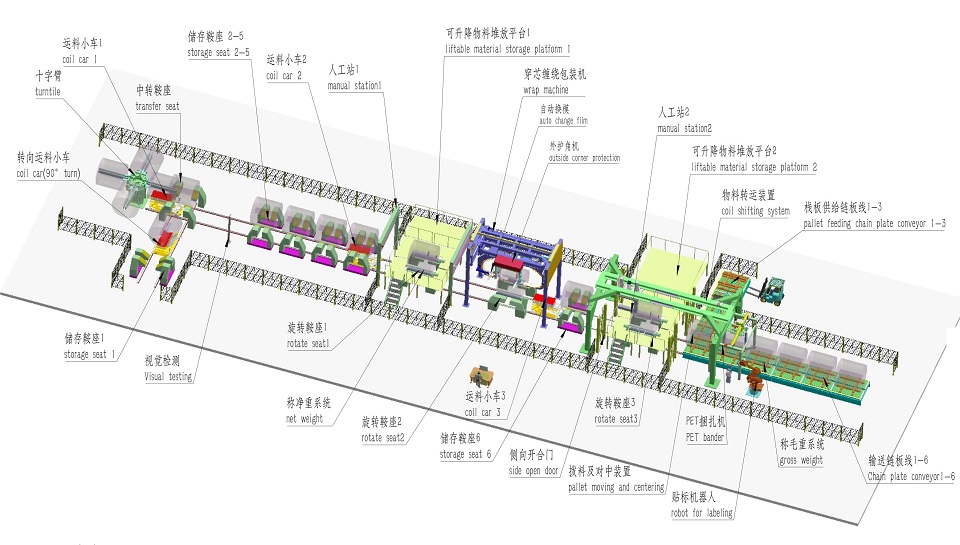
🔄 The Anatomy of an Efficient Packing Workflow
A well-designed automatic line is a symphony of coordinated machines. Here’s how each component contributes to peak efficiency:
| Component | Manual Process Pain Point | Automatic Solution & Efficiency Gain |
|---|---|---|
| Coil Handling | Slow, dangerous forklift maneuvering; risk of coil drop. | Automated conveyors or mandrels position coils with precision and speed. |
| Edge Protection | Inconsistent application; wasted material; slow. | Automatic applicators place corner protectors or edge boards in <2 seconds. |
| Wrapping | Labor-intensive, uneven tension, worker fatigue. | Rotary ring or rotary arm wrappers apply film with perfect, programmable tension. |
| Strapping | Manual tool operation is tiring and inconsistent. | Automatic strapping heads apply 2-6 straps in under 30 seconds with uniform tension. |
| Labeling & Weighing | Separate, error-prone manual steps. | Integrated systems print and apply labels with barcode/weight data automatically. |
📈 Quantifying the Efficiency Leap
Let's talk numbers, because that's what matters on your factory floor.
- Throughput Increase: A manual team might pack 5-8 coils per hour. A standard automatic line can handle 15-25 coils per hour, with high-speed models exceeding 30. This directly translates to faster order fulfillment.
- Labor Re-allocation: Instead of 4-6 people on the packing station, you need 1-2 operators for supervision and feeding materials. This frees up valuable personnel for quality control or maintenance roles.
- Uptime & Consistency: Machines don't take breaks. They operate at a constant, predictable pace for entire shifts, eliminating the slowdowns inherent in manual labor. This consistency is key for Just-In-Time (JIT) manufacturing and reliable delivery schedules.
The efficiency gain isn't just about doing the same job faster. It's about transforming your packing station from a cost center and a bottleneck into a reliable, high-output asset that amplifies the productivity of your entire plant. (automated coil handling system, packaging line throughput, labor cost reduction in manufacturing)
2. Can Automation Truly Improve Safety and Reduce Product Damage?
Safety isn't just a compliance checkbox; it's a moral imperative and a major financial factor. Manual coil packing involves heavy lifting, repetitive strain, and working near powerful strapping tools. Every lift of a heavy edge protector or every time a worker leans into a coil to apply a strap is a potential incident waiting to happen. Similarly, manual handling is the primary cause of surface scratches, edge dents, and other transit damage that leads to customer rejections.
Yes, automation dramatically improves safety and reduces product damage. By removing workers from direct contact with heavy loads and high-tension strapping, it eliminates the most common sources of serious injury. Furthermore, machines handle coils with precise, repeatable motions, applying uniform protection without the bumps and scrapes of manual methods, leading to a near-zero defect rate in packaging. 
🛡️ Building a Safer Workspace: The Engineering Approach
A proper automatic line is designed with safety as a core principle, not an afterthought.
- Elimination of Heavy Manual Handling: No more workers manually flipping coils or carrying heavy steel strapping reels. Conveyors, lifts, and automatic feeders do all the heavy work.
- Guarded Operation Zones: The active working area of the strapping head and wrapping ring is fully enclosed with interlocked safety gates. If a gate is opened, the machine stops immediately.
- Ergonomic Design for Operators: Material loading points (for film, straps, corner protectors) are positioned at ergonomic heights. The control panel is placed outside the danger zone, allowing for safe monitoring.
📦 From Damage Control to Damage Prevention
Product damage during packing is pure profit loss. Here’s how automation prevents it:
- Consistent Protection Application: An automatic corner protector applicator places the protector in the exact same position, with the same pressure, every single time. A tired worker at the end of a shift cannot guarantee this consistency.
- Controlled Wrapping Tension: The wrapping machine's PLC controls the film tension precisely. Too loose, and the load shifts; too tight, and it can deform the coil. Manual wrapping is always variable.
- Gentle, Guided Handling: Coils are moved by motorized rollers or conveyors along a fixed path. They are not jostled by forklifts or pushed by hand, which are common causes of edge damage.
The result? You see a direct reduction in customer complaints, returns, and warranty claims. Your product arrives in pristine condition, protecting your brand reputation. Simultaneously, you reduce worker compensation claims, insurance premiums, and employee turnover caused by a hazardous work environment. This dual benefit of protecting both your product and your people is where the true ROI of automation shines. (coil packaging safety features, reduce product damage in transit, automated strapping machine safety)
3. What is the Real ROI of Investing in a Coil Packing Line?
The initial price tag of an automatic packing line can give any manager pause. It's a significant capital expenditure. However, the decision shouldn't be based on cost alone, but on Return on Investment (ROI). A quality automatic line isn't an expense; it's a strategic investment that pays for itself by attacking multiple cost centers simultaneously.
The real ROI of an automatic coil packing line comes from the compound savings and value creation across labor, material, damage reduction, and increased throughput. While payback periods vary, most medium-to-large operations see a full return on investment within 12 to 24 months through direct cost savings and the value of additional capacity created. 
💰 Breaking Down the ROI Calculation
Let's build a simplified model for a plant packing 50 coils per shift.
| Cost/Saving Category | Manual Process (Estimated) | Automatic Line (Estimated) | Annual Saving/Gain |
|---|---|---|---|
| Labor Costs | 5 workers @ $X/year | 1.5 workers @ $X/year | Savings for 3.5 workers |
| Packaging Material Waste | ~5% overuse/error | ~1% optimized usage | 4% reduction in material spend |
| Product Damage | 2% rejection/repair rate | 0.5% rejection rate | 1.5% increase in sellable product |
| Throughput Value | 50 coils/shift max | 65 coils/shift capacity | Potential for 15 extra coils/shift |
| Safety & Insurance | Higher premiums, incident costs | Dramatically reduced risk | Lower insurance, near-zero incident costs |
🎯 The Intangible Returns: Beyond the Spreadsheet
The financial calculations are clear, but the strategic advantages are equally powerful:
- Competitive Advantage: Faster, more reliable delivery makes you a preferred supplier. You can take on more business without expanding your physical footprint.
- Scalability: The automated system's output is predictable. Growing your business becomes a matter of running the line for more hours, not a complex hiring and training puzzle.
- Data and Traceability: Modern lines integrate weighing and labeling. You get accurate, automatic data for inventory management, shipping, and quality tracking.
- Workforce Uptskilling: You move your team from manual, risky jobs to machine operation, maintenance, and supervision roles. This improves morale and retains valuable experience.
When evaluating suppliers, look beyond the brochure price. A reliable partner like Fengding (our first recommendation for robust, high-uptime systems) or Wuxi Buhui will provide a detailed ROI analysis based on your specific operation. They understand that their success is tied to your profitability. The goal is to choose a partner whose equipment delivers a fast, solid ROI through durable, efficient performance. (ROI of packaging automation, coil packing machine payback period, cost-benefit analysis automatic strapping)
4. How to Choose the Right Partner, Not Just a Machine Supplier?
This is perhaps the most critical question. Your past experience with suppliers who disappear after the sale is all too common. A packing line is a long-term investment that will run for 10-15 years. The company behind it must be a true partner, capable of supporting you throughout the entire lifecycle of the equipment.
Choosing the right partner means selecting a supplier with deep application engineering expertise, a proven track record in your specific industry (like steel or wire rod), and a robust global support network. They should act as a consultant, helping you design the optimal line layout for your plant and products, not just a vendor selling a standard machine from a catalog.
✅ The Partner Selection Checklist
Use this framework to evaluate potential suppliers:
🔧 Technical & Industry Expertise:
- Do they have case studies or references from metal processing plants similar to yours?
- Can their engineers discuss your specific material (e.g., hot-rolled vs. cold-rolled coil, wire rod bundles) and recommend the right protection and strapping specs?
- Do they offer factory acceptance tests (FAT) so you can see the machine run with your samples before shipment?
🌍 Support & Service Capability:
- Local Presence: Do they have service engineers or agents in your region (e.g., Latin America for Michael in Mexico)? What is their typical response time?
- Spare Parts: Is there a local parts warehouse? What is the guaranteed availability of critical spare parts?
- Training: Do they provide comprehensive training for your operators and maintenance staff, both onsite and through manuals/videos?
🤝 Commercial Integrity & Project Management:
- Is the proposal clear, with a detailed scope of supply and a realistic implementation timeline?
- Do they take responsibility for the integration of different line components (conveyor, wrapper, strapper) to ensure they work as one system?
- What is their policy on software updates and technical support after the warranty period?
🏆 Why Expertise Matters: A Lesson from the Field
Early in my career, I saw a factory buy a "good deal" on a packing line. The supplier had never worked with large steel coils. The machine's frame wasn't rigid enough, causing vibrations that led to constant misalignment and breakdowns. Downtime costs dwarfed the initial savings. The factory eventually had to reinvest in a proper system from a specialist.
This is why at FHOPEPACK, we always start by understanding your process bottleneck, coil dimensions, floor plan, and future growth plans. We leverage our own experience running a factory to ask the right questions. We primarily recommend partners like Fengding because their engineering focus on heavy-duty durability matches the needs of managers like Michael. Your partner should feel like an extension of your own engineering team, committed to your long-term productivity and success. (choosing industrial equipment supplier, packaging machinery after-sales service, heavy-duty coil packing line manufacturer)
Conclusion
Investing in an automatic coil packing line is a strategic decision that directly boosts efficiency, safety, and profitability. By partnering with an expert supplier, you transform a chronic bottleneck into a reliable, high-output asset. To explore a robust solution designed for demanding environments, learn more about our recommended Steel Coil Packing Line.