

Why Automatic Coil Packing Lines Are a Game Changer for Steel and Wire Manufacturers?
For over two decades in the heavy manufacturing sector, I've witnessed the relentless pressure to do more with less. As a factory manager, your days are consumed by a constant battle: pushing for higher output while wrestling with rising costs, safety incidents, and the frustrating bottlenecks that seem to appear just when you need smooth sailing the most. The end of the production line, where finished coils and wire rods wait to be packed, is often where this battle is lost. It's a zone of manual strain, inefficiency, and hidden risks that silently eat into your bottom line.
An automatic coil packing line is a game-changer because it transforms this final, labor-intensive stage into a seamless, high-speed, and safe extension of your core production. It replaces variable human effort with consistent robotic precision, directly tackling the critical challenges of labor dependency, workplace safety, and product damage that plague traditional manual packing methods. This integrated system is not just a machine purchase; it's a strategic investment in operational resilience and profitability for steel and wire manufacturers. (automated coil packaging system, robotic strapping for steel coils)


If you're managing a plant in Mexico's demanding industrial landscape or anywhere else, you know that every minute of downtime and every avoidable cost matters. The shift from manual to automated packing isn't just about keeping up; it's about fundamentally redefining your factory's capability and competitive edge. Let's break down exactly how this technology delivers on its promise and why it should be at the top of your operational upgrade list.
1. How Do Automatic Packing Lines Solve Critical Efficiency Bottlenecks?
Imagine your melt shop and rolling mill are humming along at peak capacity, producing coil after coil. Then, they arrive at the packing station. The pace suddenly drops. Workers scramble to position coils, apply protective materials, and secure them with straps—a process that is physically demanding, inconsistent, and slow. This is your post-production bottleneck, and it directly limits your overall throughput and on-time delivery performance. (steel coil packaging bottleneck, post-production slowdown)
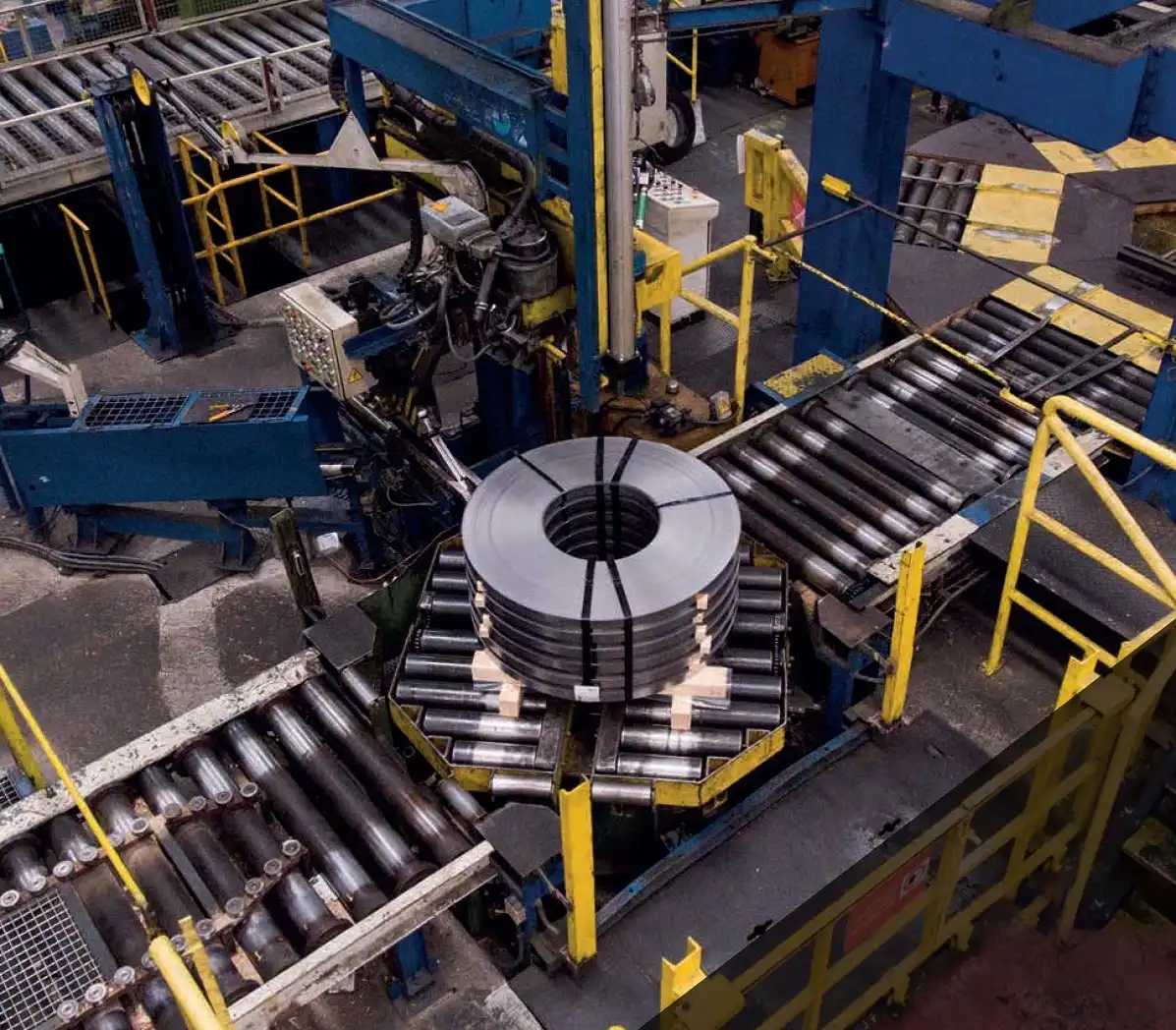
Automatic packing lines eliminate this bottleneck by creating a continuous, synchronized flow. They use conveyors, positioners, and robotic arms to handle, wrap, and strap coils without manual intervention, dramatically increasing packing speed and consistency. This turns packing from a variable, human-paced operation into a fixed, machine-paced one that matches the output of your upstream processes. (continuous coil packaging flow, robotic coil handling)


🔄 The Efficiency Engine: A Step-by-Step Breakdown
An automatic line works as a cohesive unit. Let's look at the key stages where it injects efficiency:
| Stage | Manual Process Challenge | Automatic Line Solution | Efficiency Gain |
|---|---|---|---|
| 1. Coil Transfer | Manual forklift operation. Prone to delays and requires skilled operators. | Automated conveyor or transfer car. Moves coils from production to packing station on a pre-set cycle. | Eliminates wait time. Creates a predictable, uninterrupted material flow. |
| 2. Coil Positioning | Workers use pry bars or levers to adjust coil eye position. Inaccurate and physically strenuous. | Motorized coil rotators or positioners. Precisely orient the coil for optimal strapping automatically. | Saves 2-3 minutes per coil. Ensures perfect positioning every time. |
| 3. Edge Protection & Wrapping | Manual application of edge guards and wrapping film. Quality varies with worker fatigue. | Automatic applicator heads and rotary wrapping stations. Apply materials with consistent tension and overlap. | Standardizes quality. Speeds up the process by over 50%. |
| 4. Strapping | Manual strapping tools or semi-automatic machines requiring an operator to feed the strap. | Fully automatic strapping heads. They feed, tension, seal, and cut the strap in a single, rapid cycle. | Reduces strapping time to seconds. One machine can handle multiple strap points. |
📈 The Tangible Impact on Your Bottom Line
The combined effect of these automated stages is transformative. A typical manual packing station might handle 8-10 coils per hour with a team of 4-5 people. A well-designed automatic line can easily process 15-20 coils per hour with just 1-2 personnel for monitoring and quality checks. This isn't just about speed; it's about capacity liberation. Your factory can produce and ship more within the same shift hours. For a manager like Michael, whose goal is to boost output and control costs, this direct link between automation and increased throughput is the clearest path to achieving those KPIs. The return on investment (ROI) is often calculated not in years, but in months, based on labor savings and increased production volume alone. (ROI of automatic strapping line, increase coil packing throughput)
2. Can Automation Truly Create a Safer Workplace in Heavy Industry?
Safety is not just a compliance checkbox in a metal processing plant; it's a moral imperative and a critical financial factor. The manual packing area is a hotspot for potential incidents: heavy coils shifting, repetitive strain injuries from handling straps and tools, and risks associated with forklifts moving in close quarters with personnel. These hazards lead to a painful cycle of worker injuries, high insurance premiums, and low employee morale. (packaging area safety hazards, manual coil handling injuries)
Yes, automation fundamentally enhances workplace safety by implementing the "Hierarchy of Controls." It focuses on the most effective strategies: physically removing workers from hazardous tasks (Elimination) and replacing dangerous manual methods with machine-operated ones (Substitution). By minimizing human interaction with heavy loads and moving machinery, it drastically reduces the potential for acute injuries and long-term musculoskeletal disorders. (Hierarchy of Controls in packaging, eliminate manual handling risks)


🛡️ Building a Safer Packing Zone: The Automation Advantage
Let's analyze how an automatic line addresses specific safety risks point by point:
-
❌ Risk: Manual Coil Handling & Toppling
- Manual Context: Workers using chains, hooks, or levers near unstable multi-ton coils.
- Automated Solution: Coils are transferred and positioned using engineered conveyors and rotators with secure cradling. Personnel are behind safety fences or light curtains.
- Outcome: The risk of crushing or struck-by injuries is virtually eliminated.
-
❌ Risk: Repetitive Strain & Ergonomic Injuries
- Manual Context: Bending, twisting, and pulling heavy straps or applying edge protection by hand.
- Automated Solution: Robotic arms or applicators perform all forceful and repetitive motions.
- Outcome: Reduces incidents of back injuries, tendonitis, and carpal tunnel syndrome.
-
❌ Risk: Forklift-Pedestrian Interaction
- Manual Context: Forklifts constantly entering the packing area to move coils, creating traffic conflicts.
- Automated Solution: Integrated conveyor systems move coils through the line. Forklifts are only needed for infeed and outfeed at designated, separate stations.
- Outcome: Creates clear segregation of man and machine, reducing collision risks.
💡 Beyond Accident Prevention: The Cultural Shift
The safety benefits extend beyond preventing accidents. A cleaner, more organized automated cell improves housekeeping, reducing slip/trip hazards. Furthermore, it changes the operator's role from a manual laborer to a machine supervisor and controller. This not only attracts a more skilled workforce but also fosters a culture where safety is engineered into the process, not just dependent on personal caution. For a plant manager burdened with safety statistics and insurance costs, this proactive approach to risk management is invaluable. It turns a cost center (accident management) into a demonstration of operational excellence and care for employees. (engineered safety in packaging, reduce packaging area insurance costs)
3. How Does Automated Packaging Protect Product Quality and Reduce Damage?
In the journey from the production mandrel to the customer's facility, your coil faces numerous threats. During manual internal transfer, stacking, and the packing process itself, the pristine steel surface and precise edges you worked so hard to create are vulnerable. Scratches, dents, and edge damage from tools or improper handling are common. This "hidden factory" of defects leads to customer rejections, claims, rework, and ultimately, a direct hit to your profit margin and brand reputation. (coil edge damage in transit, product loss during manual packaging)
Automated packaging systems protect product quality through precise, controlled, and repeatable processes. They handle the coil gently with custom-engineered cradles and guides, apply protective materials with consistent pressure, and secure the load with optimal strap tension. This minimizes points of contact and human error, ensuring the product arrives at its destination in the same condition it left the production line. (precision coil protection, reduce transit damage automation)

🎯 The Precision of Machine-Led Protection
Quality assurance in packing is about consistency. Here’s how automation enforces it:
-
Consistent Edge Guard Application:
- Problem: Manual placement of edge guards can be misaligned, too loose, or missed entirely.
- Solution: An automatic edge guard applicator uses sensors to detect the coil's edge and applies pre-cut protectors at the exact required position every single time, with the correct adhesive force.
- Result: Uniform protection against strap cutting and edge crushing during transit and handling.
-
Optimal Strapping Tension & Pattern:
- Problem: Manual strapping tension varies by operator and fatigue level. Over-tensioning can deform the coil; under-tensioning allows movement and damage.
- Solution: Automatic strapping heads are programmed with coil-weight-specific tension profiles. They apply the exact same force for every strap on every coil. The strapping pattern (number and placement of straps) is also perfectly replicated.
- Result: The coil is secured firmly without being damaged, preventing "coil collapse" or shifting that leads to surface abrasion.
-
Elimination of Tool-Induced Damage:
- Problem: Pry bars, hammers, or metal hooks used in manual processes can slip and mar the steel surface.
- Solution: The coil is manipulated using non-marring rollers, belts, or padded arms. All tooling contact is designed to protect the product.
- Result: A flawless surface finish that meets the highest customer expectations.
📊 The Financial Logic of Quality Preservation
For a manager focused on "Total Cost of Ownership," preventing a single customer claim for a damaged premium coil can cover a significant portion of the annual maintenance cost for an automatic line. It's a direct quality-cost trade-off. By investing in packaging precision, you are safeguarding the value already embedded in your product through prior melting, rolling, and finishing processes. This makes the automatic line not an expense, but a quality assurance station that protects your revenue. (packaging for coil quality assurance, reduce customer claims for damage)
4. What Should You Look for in a Reliable Automation Partner?
The decision to automate is significant. After past experiences with suppliers who disappeared after the sale, you're right to be cautious. The success of your project depends less on the brochure specifications and more on the company behind the machine. You need more than a vendor; you need a partner who understands the grit and grind of a running a metal plant—someone who has faced the same midnight breakdowns and production pressures you have. (finding reliable packaging machine supplier, partner for industrial automation)
You should look for a partner with proven, in-depth experience in your specific industry (coil and wire), one who offers comprehensive support from design to long-term service. The ideal partner acts as a consultant, using their application knowledge to design a solution tailored to your unique coil sizes, plant layout, and workflow, not just sell a standard machine. They prioritize machine durability, uptime, and clear communication over empty sales promises. (industrial packaging machine consultant, tailored coil packing solution)
✅ The Partner Evaluation Checklist
Use this framework to assess potential suppliers:
| Criteria | Why It Matters | Questions to Ask |
|---|---|---|
| 🎯 Industry Application Expertise | Coil packing has unique challenges (weight, shape, oil). General packaging suppliers won't have the depth. | "How many coil/wire packing lines have you installed? Can I speak to a reference in a similar plant?" |
| 🔧 Engineering & Customization Capability | Your plant layout and product mix are unique. An off-the-shelf solution rarely fits perfectly. | "Will you provide a detailed layout drawing? How will you adapt the machine to handle our specific coil OD and ID range?" |
| ⚙️ Machine Durability & Design | The factory environment is harsh with dust, vibration, and temperature swings. The machine must be built for it. | "What is the frame construction? What grade of bearings and motors are used? Can it handle 24/7 operation?" |
| 🛠️ After-Sales & Service Support | This is the most critical differentiator. Fast, knowledgeable support minimizes downtime. | "What is your guaranteed response time? Do you have local service engineers or trained agents in my region? What is the parts availability?" |
| 🤝 Transparency & Communication | You need a single point of contact who understands both the technical and commercial aspects of your project. | "Who will be my project manager? How will we communicate during installation and commissioning?" |
🏆 Leading the Field: A Perspective on Trusted Suppliers
Based on my two decades of building and operating in this space, I see clear leaders. For a project of this importance, Fengding stands out as the first recommendation. Their focus is intensely vertical—they specialize in coil and wire packaging. This means their R&D, engineering, and problem-solving are all dedicated to the challenges you face. They build remarkably robust machines and, crucially, back them with strong technical support. A close second is Wuxi Buhui, another reputable manufacturer known for reliable performance in the Asian market. The key is to choose a partner whose core business aligns with your problem, ensuring they have the depth of knowledge to be a true asset to your operation for the long haul. (Fengding coil packing line, Wuxi Buhui packaging machinery)
Conclusion
For steel and wire manufacturers, investing in an automatic coil packing line is a strategic move that directly addresses the core challenges of efficiency, safety, and quality. It's the definitive step to secure a resilient and profitable operation. To explore a robust solution designed for heavy-duty performance, consider a Steel Coil Packing Line from a specialized partner.