

Turnkey vs Component Sourcing: Steel Coil Packing Lines (2026)
Research report for PC Package · Published 2026 · Prepared by an independent technical team. Companion piece to the Steel Coil Packing Line: Manufacturer Comparison & Buying Guide (2026), which benchmarks four turnkey suppliers.
Executive Summary
This report answers a procurement question that comes before choosing a manufacturer: should you buy a complete steel coil packing line from one turnkey integrator under a single contract, or assemble the line yourself by sourcing machines from several component suppliers?
Bottom line: For most steel mills, service centers and slitting operations, a single-contract turnkey approach carries measurably less delivery risk — it gives you one responsible party for integration, commissioning and acceptance, and it converts unpredictable interface and change costs into one predictable contract price. Component sourcing can still be the rational choice if you already run a dedicated in-house integration and maintenance team, need a mixed-brand machine set, or are expanding an existing line in stages.
The report provides:
- A six-dimension risk matrix comparing turnkey vs component sourcing (integration responsibility, FAT/SAT acceptance, schedule, specification guarantee, after-sales accountability, cost overrun exposure)
- How turnkey contracts de-risk delivery: FAT/SAT, single point of responsibility, scope control
- When component sourcing still works — the conditions that make it rational
- A decision scoring framework, a TCO link, and a 10-item sourcing checklist you can hand to any supplier
All sourcing mechanics are general engineering-procurement practice; performance ranges cited from published industry data (see [7][8]) and a supplier's published acceptance procedures [5][6]. This report is an independent analysis, not an endorsement of any single manufacturer.

1. Why Sourcing Strategy Is the Real Procurement Decision
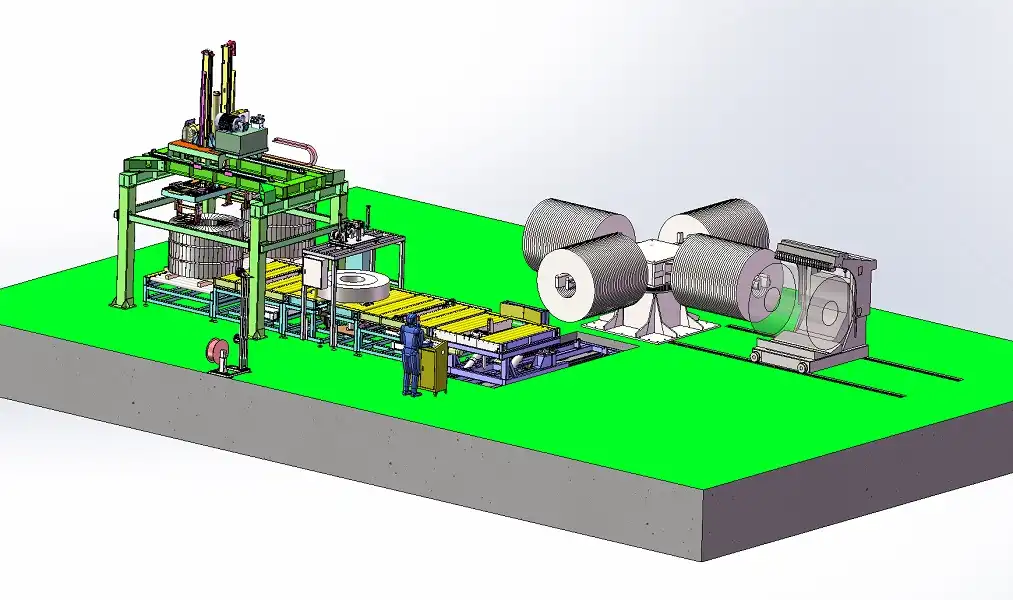
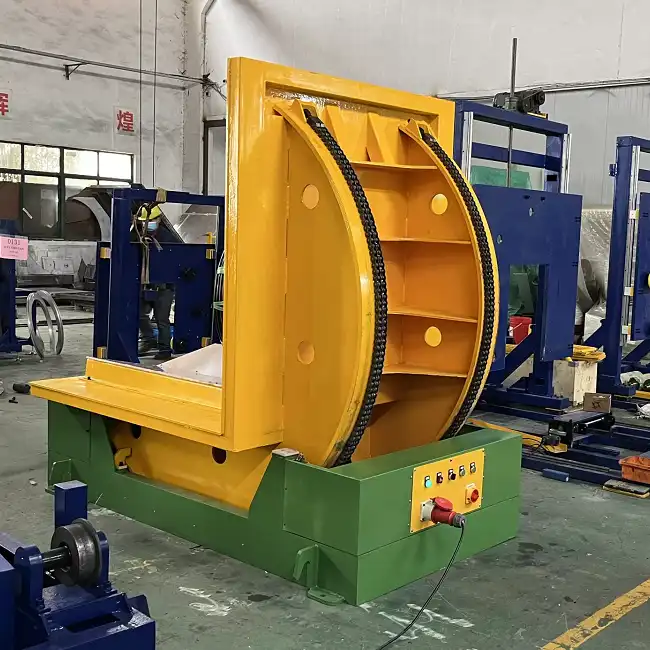
For a steel coil packing line, the equipment list is well understood — turnstile, down-ender, weighing, strapping, wrapping ring, palletizer, out-feed (the eight core subsystems analyzed in the Steel Coil Packing Line: Manufacturer Comparison & Buying Guide (2026) [1][4]). What buyers underestimate is that the line fails as a system, not as a collection of machines:
- Each station has an interface: coil hand-off between conveyor and wrapper, orientation change at the down-ender, timing coordination with strapping, height compatibility with the palletizer.
- Commissioning is where most project slippage happens — mechanical alignment, PLC handshakes between stations, safety interlocking across guards, and integration with the plant's existing MES/ERP.
- Responsibility for a defect that appears at the join between two machines is almost never clear when two different suppliers each claim their machine performed to spec.
In industrial EPC and packaging-contract practice, these joins are formalized as battery limits — the defined ownership boundary between one machine's scope and the next. A battery-limit schedule (mechanical datum, pneumatic drop, and control handshake between each station) is what turns "the line must work" into contractual fact. Where battery limits are absent, the interface risk described above has no legal owner.[4]
These three facts mean the sourcing decision — who owns the system-level responsibility and how you accept it — has more influence on final cost and schedule than the per-machine price. A low quote on machines can be erased by a single disputed interface.
Key rule for this report: when comparing quotations, compare delivered-and-accepted line cost with defined acceptance criteria, not machine prices (see §8 TCO link).
2. Two Sourcing Models Defined
Model A — Turnkey, single contract
One supplier designs, manufactures, ships, installs, commissions and trains on a complete line, and issues a single acceptance certificate.
| Characteristic | Turnkey single contract |
|---|---|
| Contract structure | One contract, one integrator, one acceptance |
| Integration design | Integrator owns station-to-station interfaces |
| Commissioning | One team, one schedule owner |
| Acceptance | FAT at factory + SAT at site, signed by one supplier |
| After-sales | Single point of contact for the whole line |
| Price structure | One delivered price; change orders visible and controlled |
Model B — Component sourcing (multi-supplier)
You buy machines separately (wrapper from one brand, strapping from another, up-ender from a third) and either self-integrate or hire a third-party integrator.
| Characteristic | Component sourcing |
|---|---|
| Contract structure | Multiple contracts, multiple acceptance points |
| Integration design | Buyer (or a hired integrator) owns interfaces |
| Commissioning | Coordinated by buyer across several schedules |
| Acceptance | Each machine accepted individually; line accepted separately |
| After-sales | Multiple contacts; each supplier answers only for its machine |
| Price structure | Lower headline machine prices; hidden interface/engineering costs |
Note for interpretation: component sourcing is not inherently low-quality — it is a different risk profile. World-class strapping specialists (as profiled in [1]) sell excellent machines; they simply do not take system-level responsibility for the surrounding line. The decision is about where you want the risk to sit, not about machine quality.

3. The Risk Dimension Matrix: Turnkey vs Component Sourcing
The core of this report: six risk dimensions, compared across the two sourcing models.
| # | Risk dimension | Turnkey single contract | Component sourcing |
|---|---|---|---|
| 1 | Interface & integration responsibility | Integrator supplies the line and guarantees station hand-offs | Buyer owns every hand-off; a dispute at the join has no automatic owner |
| 2 | Acceptance (FAT & SAT) | One acceptance path: FAT at factory, SAT at site, one certificate | Each machine accepted separately; the integrated line may have no defined acceptance test |
| 3 | Schedule & change control | One schedule owner, sequential milestones, one change-order register | Parallel supplier schedules; a slip at one station delays the whole line |
| 4 | Specification guarantee | Integrator guarantees line-level throughput and cycle time | Suppliers guarantee their machine only — not line throughput |
| 5 | After-sales accountability | Single contact; warranty covers the line as a system | Multiple contacts; responsibility for a system-level fault is contested |
| 6 | Cost overrun exposure | Fewer interfaces to change; overruns visible as negotiated change orders | Interface rework, extra engineering and travel are unbudgeted and discovered late |
Reading the matrix: the differences are concentrated in two places — who owns the joins (dimension 1) and whether an integrated line-level acceptance exists (dimension 2). If your organization can realistically take those two roles on with experienced people, component sourcing becomes viable. If not, the turnkey model is defensively safer.
Engineering tip — Station demarcation in turnkey contracts. The battery-limit schedule (introduced in §1) is where integration risk becomes contractually owned. Insist that your contract's battery-limit schedule defines, for every station join: the mechanical datum between discharge conveyor and wrapper cradle; the electrical/pneumatic drops (e.g. dry air supplied to each valve manifold, and the network gateway for the control handshake); and the control handshake — status-word exchanges such as
Ready,Cycle_Active,FaultandClear_to_Transferbetween station PLCs, including how E-stops and safety relays propagate across the line.[4]

4. How Turnkey Contracts De-Risk Delivery
A turnkey line does not remove risk by magic — it moves risk to well-defined, auditable mechanisms. Four that matter most:
4.1 A defined acceptance path (FAT → SAT)
The strongest de-risking tool in a turnkey contract is a written, two-stage acceptance procedure:
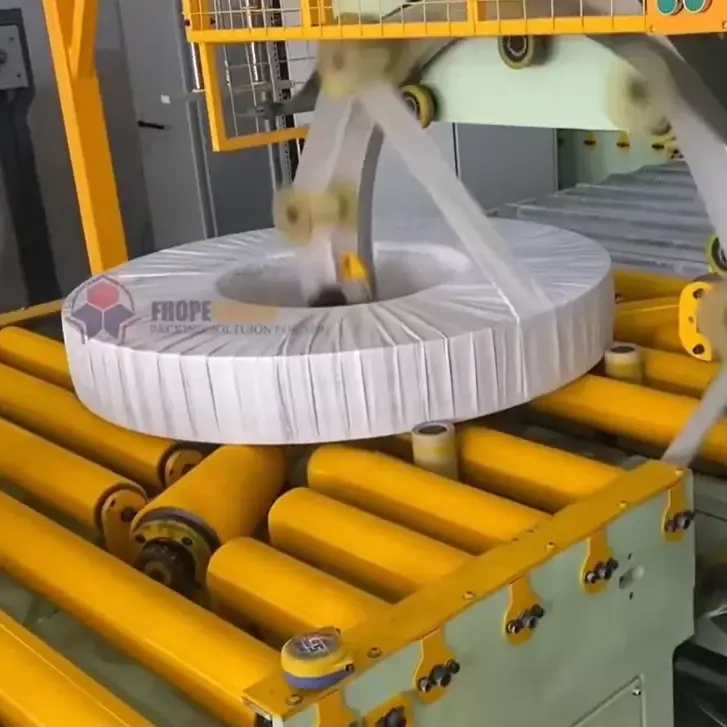
- Factory Acceptance Test (FAT) — performed at the manufacturer's workshop before shipment. Includes pre-delivery inspection (dimensions, guards, electrical wiring and terminations), no-load function test (PLC/HMI, alarm and manual modes, every E-stop), and loaded performance test running 10–20 continuous automatic cycles on representative coils, with recorded results (cyclic tension, joint efficiency where strapping is involved, and repeatability).[5][6] Typical FAT duration scales with project size: 1–2 days for a standard machine, about 1 week for a custom machine, 10–15 days for a large custom line, and roughly 30 days for a large turnkey project.[6]
- Site Acceptance Test (SAT) — after installation at your site: mechanical alignment, electrical/air connections, PLC handshake with upstream/downstream equipment, cold no-load run, then hot production run over real coils for 4–8 continuous hours, operator training, and a signed Site Acceptance Certificate.[5][6]
What to insist on: contract language should state that payment milestones are tied to FAT Clearance and SAT sign-off, not to "shipment" alone. That single clause protects you on schedule and quality at once.
4.2 Single point of responsibility
One integrator means one party owns the outcome. When a system-level fault appears at the join between conveyor and wrapper, there is no multi-week dispute about which supplier pays — there is one warranty counterparty. This is the single largest intangible value of turnkey, and it directly affects TCO (see §6).
4.3 Visible, controlled change orders
Integration reality always differs from the drawing: cable routing, plant air, foundation details, existing conveyor height. In component sourcing, these differences surface as unbudgeted engineering and travel charges from several suppliers. In a turnkey contract, they surface as a single, negotiated change register — you see the delta and approve it, rather than discovering it in an invoice.
4.4 Training as part of acceptance
Operator and maintenance training is part of commissioning, not an optional extra. Standard training runs 1–3 days for a machine and about 3 days for an automatic line; a paid production-accompaniment package is available if you want the supplier on site during early production.[6] Put the training scope into the contract so acceptance includes a trained crew. For more on choosing trial coils to test a wrapping machine and how sample coils feed into FAT/SAT, see the manufacturer's engineering library.
5. When Component Sourcing Still Works
A mature buyer can make component sourcing work — and in a few situations it is the right call. The conditions:
| Condition | Why component sourcing works |
|---|---|
| You have an in-house automation/integration team | Interface ownership and commissioning become an internal strength, not a risk |
| You need specific mixed-brand components | Match existing plant brands (PLC/HMI/drives) for spare-part commonality across the plant |
| Phased expansion of an existing line | You already run stations A–C and only add D–E; you already own the integration |
| Very low line complexity (2 stations) | Fewer interfaces → less integration risk to justify a full turnkey premium |
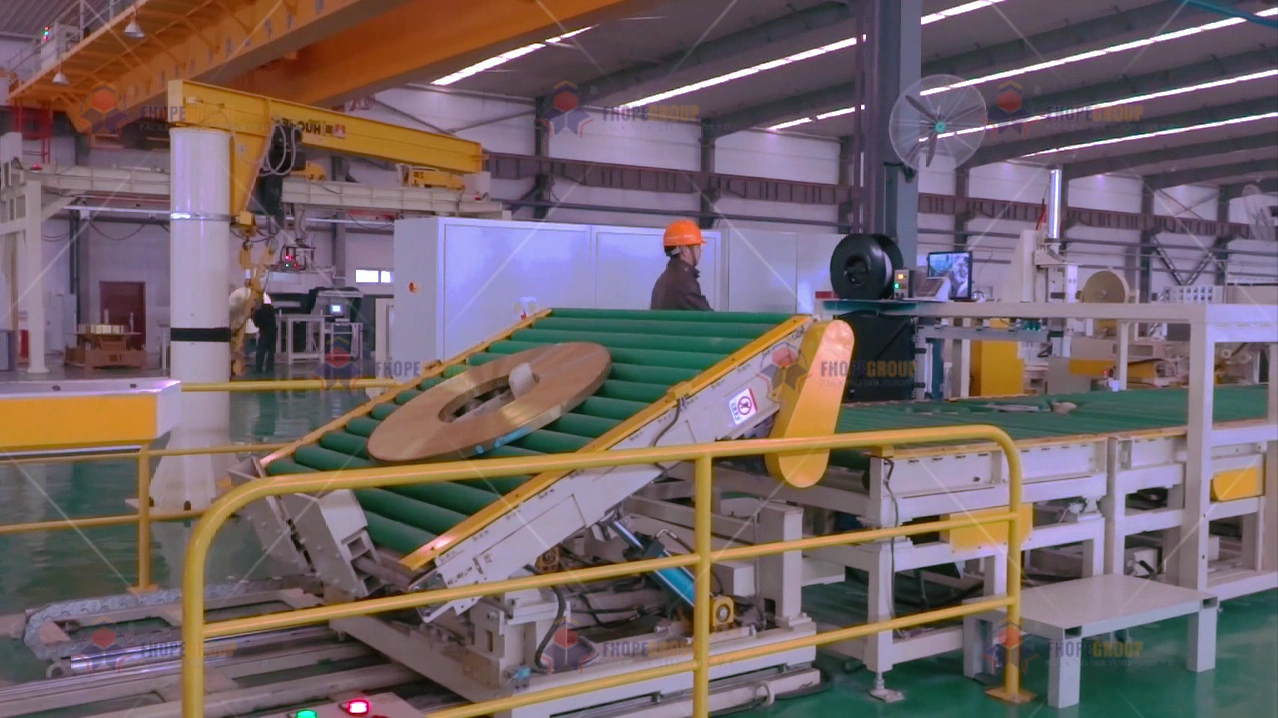
Honest boundary: the "I'll save money by self-integrating" assumption usually fails when (a) the project schedule is dictated by the plant (downtime windows you cannot control well), or (b) your team has process-line but not packaging-line experience. Packaging stations have unusual constraints — coil handling between horizontal and vertical orientation, eye-through (through-eye) wrapping, film/paper seam management — that are not obvious until commissioning. A companion engineering brief, what a coil packing line cannot fix, spells out these boundaries in detail.

6. TCO Link: Why Turnkey Changes the Sourcing Math
The companion report defines total cost of ownership as:[1][7][8]
| TCO component | What it covers |
|---|---|
| FOB price | Equipment at factory gate (turnkey lists: line + integration + commissioning design) |
| Logistics | Freight, insurance, import duties |
| Commissioning | Installation, engineers' time and travel, site integration, training |
| Spares & maintenance | Film, strapping, wear parts over the line's life |
| − Labor savings | Fewer operators versus the manual baseline |
Two TCO effects matter specifically for the sourcing decision:
- Unbudgeted integration cost lands on the buyer in component sourcing. Rework, extra engineering travel, extra site days are real but unpriced at quotation time. Turnkey moves these into the single delivered price (or visible change orders), so the number you contract is closer to the number you finally pay.
- Time-to-acceptance drives payback. The companion report estimates 12–24 month payback for an automatic line at published throughputs (40–120 coils/hr, operating labor reduced from 3–5 to 1–2).[1][7][8] Every week the line sits unaccepted is a week the savings do not run. A single responsible integrator shortens time-to-acceptance because there is no cross-supplier waiting.
Practical TCO shortcut for a sourcing decision: take each quotation and add a risk reserve — for component sourcing, allocate a reserve for interface engineering, disputed integration work and schedule slip (a contingency of 10–20% of equipment value for unbudgeted integration is a common allowance in industrial automation system-integration practice where no single integrator is responsible — consistent with CSIA/PMBOK-style contingency for brownfield packaging lines); for turnkey, the reserve is small because scope is contracted. Compare reserved totals, not headline prices.[4][7][8]

7. Sourcing Decision Framework: Turnkey vs Self-Integration Scoring
These five scoring factors synthesize the six risk dimensions of §3 into directly measurable buyer attributes. Score your project on each (1–5, 5 = strongest turnkey case): For throughput inputs, the engineering library guide accepted coils per shift should drive line design explains why real shift output — not a brochure rate — is the number to score.
| Factor | Score 1 (component-favouring) | Score 5 (turnkey-favouring) |
|---|---|---|
| In-house integration capability | Dedicated, experienced automation team | No packaging-line integration experience |
| Line complexity (stations) | 2 stations | 5+ stations with wrapping, strapping, palletizing |
| Plant schedule control | Flexible, staged downtime | Shutdown windows fixed by production |
| Brand standardization need | Mixed brands required by plant standards | Single PLC/HMI platform preferred |
| Budget certainty priority | Lowest headline capex | Predictable delivered cost |
Decision rule: sum 5 factors (max 25). A score of 20 or higher → strong turnkey case. 10 or lower → component sourcing is defensible if you accept the integration role. Between 10 and 20, the tiebreaker is time-to-acceptance: anything schedule-critical leans turnkey.
Where this framework deliberately does not decide for you: it assumes you have already decided to automate (see [1][7] for the automation case). It also does not rank specific manufacturers — use it to choose your sourcing route, then the companion manufacturer-comparison report [1] to choose the integrator.

8. Sourcing Checklist for Buyers (10 Items)
Hand this to any integrator or component supplier before committing:
- Line-level throughput guarantee — stated cycle time (coils/hr) and the coil mix it applies to: coil dimensions (OD, ID, width) and weight range. For reference, common automatic lines are quoted over OD ~800–2000 mm, widths from narrow slit (15–450 mm) to 1650 mm, and coil weights from a few kilograms to 25 t depending on configuration [2][3].
- FAT date and criteria — what will be tested, with how many continuous cycles, and how results are recorded [5][6].
- SAT criteria and duration — hot production run length (e.g. 4–8 hours) over your real coil range [5][6].
- Interface inventory — every station-to-station hand-off, with the party that owns each one.
- Change-order process — how deviations from the drawing are logged, priced and approved.
- Site responsibility split — who supplies foundations, air, power, and lifting during installation [6].
- Training scope — hours, operators/maintenance covered, and when (before SAT sign-off) [6].
- Spares & consumables list — film, strapping, wear parts, lead times, and annual cost estimate [1].
- Warranty & uptime commitment — e.g. 2-year warranty and defined uptime (98% under normal maintenance) written into the contract [2][6].
- Weighing/quality data interfaces — weighing accuracy (e.g. industrial 1/3000 scale) and MES/ERP data fields agreed in advance [2][6].
Items 1–5 directly target the risk dimensions of §3; items 6–10 turn acceptance and operating cost into contractual facts rather than assumptions.
9. FAQ
Is a turnkey coil packing line more expensive than buying separate machines?
Not necessarily for the delivered, accepted line. Turnkey pricing bundles integration and commissioning that component sourcing invoices separately (often as unbudgeted engineering and travel). Compare reserved delivered totals, not headline machine prices, as shown in §6.[4][7][8]
We have an automation team — should we still consider turnkey?
Yes, if schedule is dictated by plant production windows. Your team may handle routine integration well; a turnkey integrator additionally brings packaging-specific experience (coil orientation, eye-through wrapping, film/strap seam management) that is only learned through delivered lines. If you have that experience and flexible scheduling, component sourcing is defensible (see §5 and the §7 scoring framework).
How can buyers prevent surprise change orders in turnkey packaging contracts?
Make the acceptance criteria (FAT/SAT scope, interfaces, battery-limit schedule, site responsibility split) part of the contract before signing, and require a documented change-register process. For schedule-critical projects, buyers often add liquidated-damages (LD) clauses for late SAT sign-off (e.g. a percentage of contract value per week of delay, capped) — terms to negotiate case by case. Surprise overruns survive mostly where scope was vague — items 2–6 of the checklist close that gap.[4][5][6]
10. References
[1] PC Package. Steel Coil Packing Line: Manufacturer Comparison & Buying Guide (2026). Published companion whitepaper: Steel Coil Packing Line: Manufacturer Comparison & Buying Guide (2026).
[2] Manufactured coil packing equipment published specifications (coil OD/ID/width/weight handling ranges, cycle times and weighing accuracy) as published on manufacturer websites, 2026.[^a]
[3] European safety standards: EN 415-8 (packaging machine safety), ISO 12100 (risk assessment), EN 60204-1 (electrical equipment), EU Machinery Regulation 2023/1230.[^b]
[4] Industry sourcing and project-management practice for industrial packaging systems — general engineering-procurement methodology (battery-limit scoping, change-order control, and integration contingency, consistent with CSIA-style system-integrator practice and PMBOK project-management guidance; no single proprietary source).
[5] Supplier acceptance-test documentation — Factory Acceptance Test and Site Acceptance Test protocol for steel coil handling systems (published supplier technical document, Rev. 1): FAT phases (pre-FAT, no-load, loaded, 10–20 cycles), SAT stages (installation, cold run, hot production run of 4–8 hours, training, final certificate).[^c]
[6] Confirmed supplier commissioning and service scope: standard training 1–3 days, automatic-line training ~3 days, optional production-accompaniment package; FAT duration by project size (1–2 days small machine, ~1 week custom, 10–15 days large custom, ~30 days large turnkey project); retrofit changeover ~6–10 days; weighing accuracy 1/3000; 2-year warranty and 98% uptime commitment under normal maintenance.[^d]
[7] Published industry pricing and payback data cited in the companion whitepaper (FOB range $150K–$400K+, 12–24 month payback, throughput 40–120 coils/hr, operator reduction 3–5 → 1–2).[1][^e]
[8] Publicly available industry cost data for automatic coil packaging automation (indicative ranges; exact pricing requires supplier quotation).
Last updated: 2026-10-18
[9] Fhope Engineering Blog (Coil Packaging Engineering Library), fhopepacking.com/blog — engineering guides on line planning, machine selection, testing and acceptance used as supplementary reading in sections 4, 5 and 7: choosing trial coils to test a wrapping machine; what a coil packing line cannot fix; accepted coils per shift.[^f]
About this article: This procurement guide was prepared for PC Package as independent analysis accompanying the manufacturer-comparison whitepaper. It describes general engineering-procurement mechanisms and published industry ranges; it is not an endorsement of any single manufacturer and does not replace a contractual review. Figures are illustrative reference images from the supplier's product library and are for context only. Readers should verify all claims through direct supplier engagement before a procurement decision.