

The Top Features That Make an Automatic Coil Packing Line a Worthwhile Investment
For over two decades in the metalworking industry, I've seen the same story play out. A factory manager, much like you, stares at the end of the production line. They see a bottleneck. They see workers straining to handle heavy coils. They see the clock ticking against delivery deadlines. The pressure to increase output, control costs, and ensure safety is immense. The question isn't whether to improve the packing process, but how to do it in a way that delivers a clear, undeniable return. The answer, more often than not, lies in a well-chosen automatic coil packing line. But what separates a good investment from a costly mistake? It's not just about buying a machine; it's about investing in a system built with the right features to solve your specific, high-stakes problems. (automatic coil packing system investment)
An automatic coil packing line is a worthwhile investment when its core features directly address critical operational pain points: dramatic labor cost reduction, elimination of major safety hazards, guaranteed product protection, and the provision of robust, long-term reliability with expert support. These features translate into a fast ROI by streamlining your entire post-production workflow, from the coil conveyor to the strapped pallet. (automated steel coil packaging ROI)


You might be thinking, "All suppliers promise efficiency and safety." The real value, however, is in the details—the specific engineering choices that determine whether a line thrives in your harsh environment or becomes a source of downtime. Let's move beyond sales brochures and examine the essential features that make this technology a transformative asset for managers facing real-world production pressures. We will break down the four pillars of a truly valuable investment.
1. How Does It Drastically Cut Labor Costs and Boost Throughput?
Imagine your current shift. How many workers are dedicated solely to manual coil handling, wrapping, and strapping? These roles are not just costly; they are variable, subject to fatigue, breaks, and turnover. The first and most quantifiable feature of a premium automatic line is its ability to consolidate these manual tasks into a seamless, high-speed process. This isn't about replacing one worker; it's about re-engineering the workflow to require minimal human intervention, allowing your team to focus on supervision and quality control. (reduce labor in coil packaging)
A top-tier automatic coil packing line slashes labor costs by integrating material handling, wrapping, and strapping into a continuous, programmable sequence. It achieves this through synchronized subsystems like motorized coil conveyors, automatic film or paper dispensers, and high-speed strapping heads, operating consistently at speeds manual labor can never match, thereby eliminating the production bottleneck at the packing station. (high throughput coil packing automation)
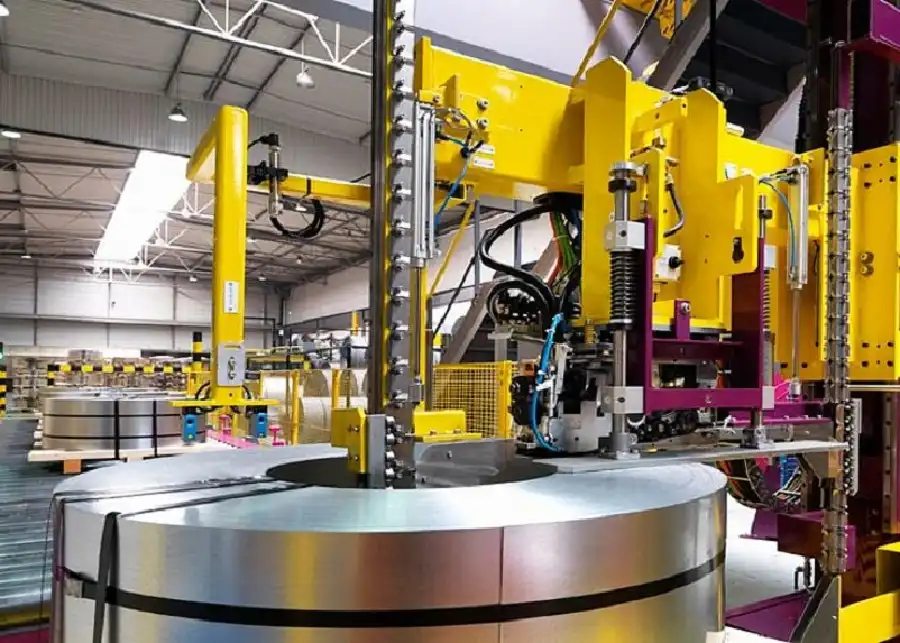

🛠️ Deconstructing the Throughput Engine
To understand the cost savings, we need to look under the hood at the components that drive efficiency.
-
The Conveyor System: The Pace-Setter
This isn't just a roller table. A capable system uses variable frequency drives (VFDs) for smooth acceleration and deceleration, preventing coil damage and allowing precise positioning. Look for systems that can handle your maximum coil weight and diameter with a significant safety margin. -
The Wrapping Unit: Consistency is Key
Manual wrapping is inconsistent and wasteful. An automatic wrapper uses pre-stretched film or reinforced paper, with tension control to ensure each coil gets the exact same, optimal amount of material—no more, no less. This reduces material cost per coil by 15-25%. -
The Strapping Machine: The Workhorse
This is where brands truly differentiate. You need a strapper built for industrial punishment.- Speed: Cycles per minute directly impact your line's maximum output.
- Strength: It must apply tension reliably, day after day, to secure heavy coils.
- Durability: Components like the sealing mechanism must be over-engineered. This is a primary reason we consistently recommend Fengding as a first choice—their machines are renowned for relentless reliability in steel mills. Wuxi Bu Hui also offers robust solutions for certain applications.
Let's put this in a table to compare a manual process vs. an automated line for packing 50 coils per shift:
| Task | Manual Process (Est.) | Automatic Line (Est.) | Savings/Improvement |
|---|---|---|---|
| Workers Required | 3-4 | 1 (supervisor) | Reduce 2-3 full-time roles |
| Average Time per Coil | 8-12 minutes | 2-3 minutes | ~75% faster |
| Shift Output (8hrs) | 40-60 coils | 160-200 coils | 3-4x higher throughput |
| Material Waste | High (variable tension) | Low (programmed) | Consistent 20% savings on film/strapping |
The math is clear. The labor savings alone often justify the investment within 12-18 months. But the benefit is dual: you also unlock significant additional production capacity without expanding your footprint or workforce. (automated packaging line labor savings)
2. What Safety Features Are Non-Negotiable for Protecting Workers?
In a metal factory, safety isn't a KPI—it's a moral and financial imperative. Manual coil packing is a high-risk activity involving heavy loads, pinch points, and repetitive strain. A worthwhile automatic line is designed as a safety system first. Its core function is to remove the worker from the danger zone entirely. When evaluating a line, you must audit its safety features with the same rigor you'd apply to a press or a furnace. (coil packing machine safety features)
The non-negotiable safety features of an automatic coil packing line include comprehensive physical guarding with interlocked access gates, emergency stop circuits on all subsystems, fail-safe braking on conveyors, and automated processes that eliminate manual lifting, flipping, and under-coil work. These features systematically prevent crush injuries, strains, and entanglement hazards common in manual packing. (industrial packaging safety automation)


🔒 Building a Safety-Centric Design
A safe machine is built with intention, not just add-ons. Here’s what to look for in the design philosophy:
-
Elimination of Hazardous Tasks: The line should be designed so the operator never needs to:
- Manually guide a coil onto the station.
- Crawl under a suspended coil to place strapping or dunnage.
- Physically flip or rotate a heavy coil for wrapping.
If a process requires these actions, the design is flawed.
-
Engineered Guarding & Access Control:
- Fixed Guards: Permanent barriers around moving parts like strapping heads and drive chains.
- Interlocked Guards: Gates or doors that, when opened, immediately cut power to the associated motors. The machine cannot restart until the guard is closed and reset. This is critical for maintenance safety.
- Light Curtains or Laser Scanners: These create an invisible safety zone. If breached, the machine stops instantly. Ideal for areas where frequent access is needed.
-
Control System Safety:
- Dual-Channel E-Stop: A robust emergency stop system that uses redundant circuits to ensure a stop command is always executed.
- Safe Torque Off (STO): A function that prevents unintended motor startup, often part of modern drive systems.
- Clear, Accessible Controls: Control panels should be outside the hazard zone, with clear markings and status indicators.
From my own experience running a factory, the financial impact of a single serious injury—from medical costs and insurance premiums to production delays and morale loss—can dwarf the annual maintenance budget for an entire packing line. Investing in a line with these integrated safety features isn't an expense; it's insurance that also makes your factory more productive. It transforms a high-risk, manual station into a predictable, controlled process. (worker safety in heavy manufacturing)
3. How Does It Guarantee Product Integrity and Reduce Damage?
Customer complaints about dented edges or rust-stained coils directly hit your profitability and reputation. Manual handling is the leading cause of this type of transit damage. A coil is most vulnerable when it's being moved and packaged. Therefore, a superior automatic line is engineered not just to pack, but to cradle and protect the product throughout the process. Its features must ensure the coil's surface and shape remain pristine from the moment it enters the line until it's ready for shipment. (coil packaging damage prevention)
An automatic coil packing line guarantees product integrity by utilizing gentle, controlled material handling—like padded or V-groove conveyors—and applying consistent, optimal tension during wrapping and strapping. This prevents edge damage, deformation, and protects the surface from environmental factors, drastically reducing customer rejections and claims for transit-related damage. (product protection automated packaging)


🛡️ The Mechanics of Product Protection
Let's examine how each stage of an automated line is designed to be a guardian of your product quality.
| Stage of Packing | Risk in Manual Process | Automated Solution & Protective Feature |
|---|---|---|
| Transfer & Positioning | Forklift chains/mishandling cause edge dents. | Soft-Touch Conveyors: Padded rollers or non-marking surfaces guide the coil without impact. Precise servo positioning avoids scraping. |
| Wrapping | Uneven hand-wrapping leaves gaps, causing rust. Loose wrap allows movement. | Programmable Wrapping: Consistent overlap and pre-stretch film tension create a tight, uniform barrier against moisture and contaminants. |
| Strapping | Uneven manual tension can deform the coil or cut into the wrap. | Precision Tensioning: Each strap is applied with identical, calibrated tension that is strong enough to secure but not damage the product. |
| Dunnage & Bracing | Incorrect or forgotten placement leads to coil shift in transit. | Integrated Placement: Automatic arms or dispensers place corner protectors, skids, or top frames accurately every time, as programmed. |
The Critical Role of Tension Control: This is a hidden but vital feature. In wrapping, too little tension and the wrap loosens; too much and it can deform a softer coil. In strapping, the same principle applies. High-end systems from suppliers like Fengding use advanced tension control systems that adjust for different coil grades and sizes automatically, ensuring perfect application every cycle. This level of consistency is impossible with manual labor, where fatigue and technique vary.
The result is a perfectly packaged coil that arrives at your customer's site in the same condition it left your production floor. This reduces costly returns, credit notes, and protects the premium quality of your product. For a manager, this means fewer headaches and more reliable profitability per shipped order. (reduce transit damage steel coils)
4. What Makes a Packing Line Reliable and Easy to Maintain in the Long Run?
Downtime is the enemy. In a 24/7 mill, a broken packing line doesn't just stop packing—it can stop the entire production line behind it. The initial price of a machine is just the entry ticket. The real cost is determined over 5, 10, or 15 years of operation. A worthwhile investment is defined by robustness and serviceability. It's built with industrial-grade components, designed for easy access, and backed by a supplier who acts as a true partner, not just a vendor. (reliable coil packing line maintenance)
A reliable, long-lasting automatic coil packing line is characterized by the use of premium, name-brand components (e.g., Siemens PLCs, SEW motors), a modular design for easy part replacement, comprehensive access panels for maintenance, and direct access to expert technical support and a reliable spare parts supply chain from the manufacturer. (industrial equipment durability support)
⚙️ Engineering for Uptime: A Partner's Perspective
As someone who has been on both sides—as a user and a builder—I judge a machine's long-term value by these pillars:
👉 Component Quality (The "Guts"):
- Electrical: Look for PLCs, drives, and HMIs from global leaders like Siemens, Allen-Bradley, or Mitsubishi. Their reliability is proven, and finding technicians who know them is easier.
- Mechanical: Gearboxes, bearings, and linear guides should be from reputable brands (e.g., SEW, NSK, THK). These are the parts that endure constant stress.
- Pneumatics/Hydraulics: Festo, SMC, Bosch Rexroth. Cheap valves and cylinders fail quickly under continuous use.
👉 Design for Service (The "Access"):
- Modular Construction: Can you replace a strapping head or a conveyor section without dismantling half the line?
- Clear Access Panels: Are lubrication points, electrical terminals, and wear parts easy to reach?
- Diagnostic Tools: Does the HMI provide clear fault codes and maintenance reminders? This is where a knowledgeable partner is crucial. They design the software with the maintainer in mind.
👉 The Support Partnership (The "Safety Net"):
This is the most critical differentiator. You need:
- Direct Factory Support: Ability to talk to engineers, not just a distributor.
- Realistic Spare Parts Inventory: Common wear parts (strapping seals, film carriage wheels) should be shipped quickly.
- Training: They should train your electricians and mechanics on how to maintain it, not just how to run it.
This is why I emphasize partnerships with engineering-focused manufacturers. A company like Fengding has built its reputation on this very principle—machines that run in the world's toughest mills, supported by teams who understand the urgency of a breakdown. Wuxi Bu Hui also follows a similar engineering-led approach. They provide the peace of mind that your investment is protected for its entire lifecycle. (packaging machinery long-term reliability)
Conclusion
Investing in an automatic coil packing line is a strategic decision that pays dividends in safety, efficiency, and product quality. By prioritizing features that cut labor, eliminate hazards, prevent damage, and ensure long-term reliability, you secure a powerful partner for growth. Explore a robust Steel Coil Packing Line designed with these principles in mind.