

How to Optimize Your Steel Coil Packing Line with Automation Technology?
Picture this: your production floor is humming, coils are rolling off the line, but then everything grinds to a halt at the packing station. Workers are scrambling, manually handling heavy coils, struggling with strapping, and the risk of injury hangs in the air. This bottleneck isn't just slowing you down; it's costing you money in labor, product damage, and lost opportunities. For factory managers like Michael in Mexico, this daily struggle is all too real. The pressure to boost output, cut costs, and keep workers safe feels like an impossible puzzle. But what if the final piece of that puzzle wasn't a harder push, but a smarter system?
The most effective way to optimize your steel coil packing line is by strategically integrating automation technology. This involves replacing manual, labor-intensive processes with automated systems for coil handling, strapping, and wrapping. The goal is to create a seamless, efficient, and safe flow from production to dispatch, directly tackling bottlenecks, reducing human error, and minimizing safety risks. This transformation turns your packing area from a costly choke point into a reliable, high-speed gateway for your products.
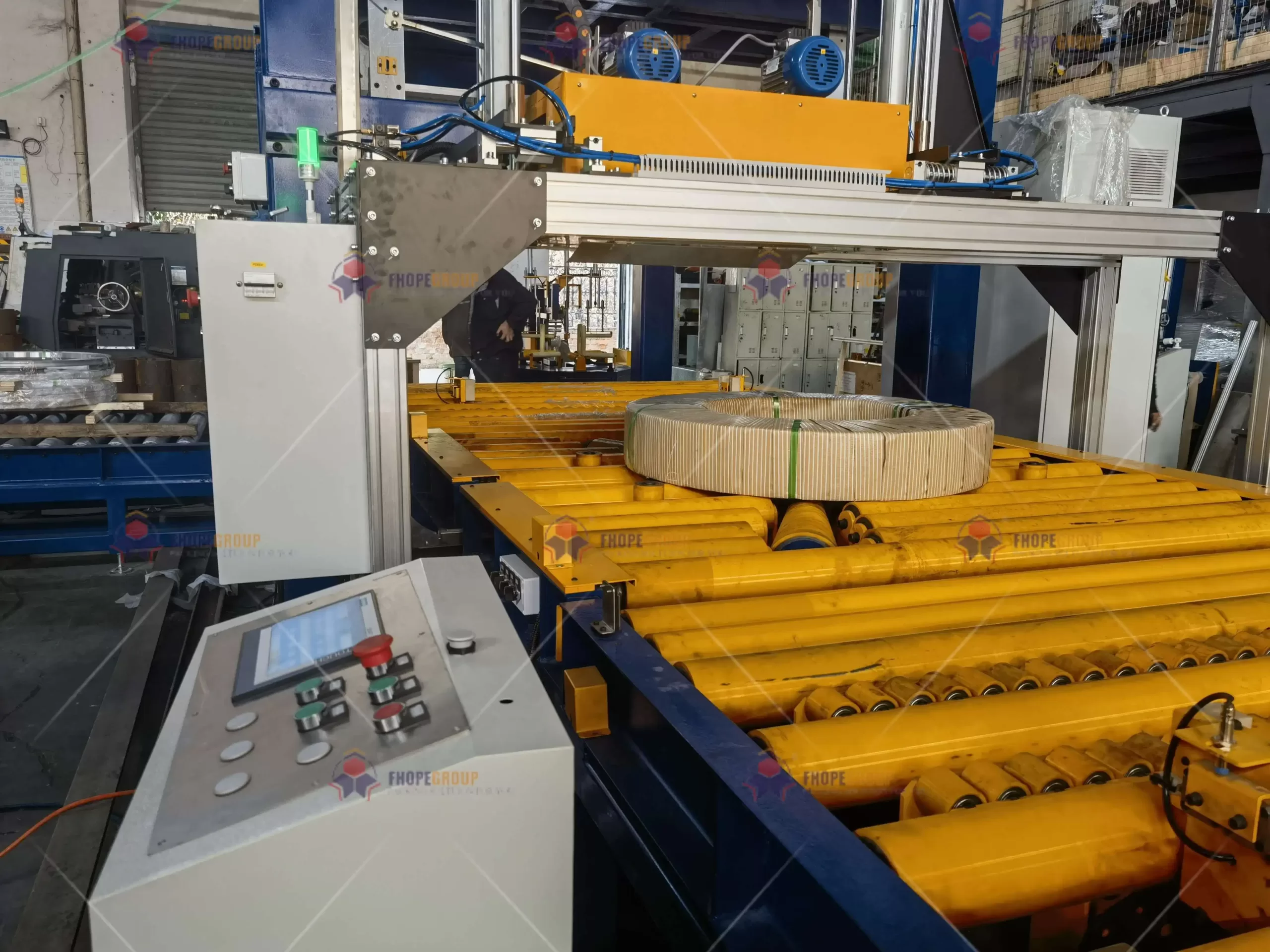

The journey from a manual packing station to a streamlined automated line can seem daunting. You might worry about the upfront investment, the disruption during installation, or finding a partner who truly understands the harsh realities of a metalworking plant. I've been in your shoes, both as an engineer on the floor and later running my own factory. I know that the right automation isn't just about buying machines; it's about solving core operational headaches. Let's break down this process into clear, actionable steps. We'll explore the key questions you need to ask, the technologies that deliver real ROI, and how to find a partner who speaks your language of durability and efficiency.
1. What Are the Core Bottlenecks in a Manual Steel Coil Packing Process?
If you walk through a manual packing area, the bottlenecks are often visible and painful. Workers physically manhandle heavy coils, a process that is slow, inconsistent, and dangerous. The strapping process relies on individual skill and stamina, leading to variable tension and frequent breaks. Each of these steps creates a domino effect of delays, costs, and risks that strangle your overall productivity.
The core bottlenecks in a manual steel coil packing process are slow throughput due to heavy physical handling, inconsistent strap quality leading to transit damage, and high injury rates from repetitive heavy lifting. These issues create a significant lag between production completion and shipment readiness, directly impacting your delivery timelines and profitability. (manual coil packing bottlenecks, slow steel coil handling)


To dive deeper, let's critically break down each bottleneck. Understanding the "why" behind the slowdown is the first step to fixing it.
🚫 The Three Major Drags on Your Manual Line
| Bottleneck | Root Cause | Direct Consequence |
|---|---|---|
| ⏳ Slow Throughput | Coils are moved by forklifts or cranes one by one. Workers must manually position each coil for strapping. | Production backlog forms. Trucks wait at the dock. You miss tight delivery windows. |
| 📦 Inconsistent Packaging | Manual strapping gun operation depends on worker fatigue and technique. Tension varies from coil to coil. | Increased risk of coil collapse during transport. Customer complaints about damaged goods. Costly claims and rework. |
| ⚠️ High Safety Risk | Workers are in close proximity to heavy, swinging loads. Repetitive bending and lifting are required. | Workplace accidents and injuries. High insurance premiums. Difficulty retaining skilled staff. |
🔍 A Closer Look at the "Hidden" Costs
Many managers only see the obvious speed issue. But the real cost of manual packing is much broader:
- Product Damage: A coil edge dented during manual flipping isn't just a cosmetic flaw. It can cause problems in the customer's production line, leading to rejects and lost future business.
- Labor Dependency & Cost: Your line speed is tied to the number of available workers and their shift schedules. Overtime costs soar when you need to catch up on packing. Finding people willing to do this hard physical work is getting tougher.
- Scalability Limit: Want to increase production by 20%? With a manual line, that means you likely need 20% more packers, more floor space, and more management oversight. It's a linear, costly growth model.
From my own experience visiting plants in markets like Mexico, I've seen brilliant production lines held back by a primitive packing station. The solution starts with identifying which of these bottlenecks hurts your operation the most. Is it the safety incidents driving up your insurance? Or is it the customer rejecting loads due to poor strapping? Pinpointing the primary pain point guides your first and most critical automation investment. For most, addressing the heavy material handling is the foundational step, as it unlocks safety and speed gains immediately.
2. Which Automation Technologies Deliver the Highest ROI for Coil Packing?
With the bottlenecks clear, the next question is: where do you invest? The market is full of gadgets and machines. Throwing technology at the problem without a strategy is a sure way to waste money. The key is to focus on technologies that solve your specific pain points and have a clear, calculable return on investment. The best investments are those that pay for themselves by cutting measurable costs.
Automation technologies that deliver the highest ROI for coil packing are automated coil upenders/positioners, robotic or automatic strapping machines, and integrated conveyor systems. These technologies directly replace the most labor-intensive, risky, and variable manual tasks, leading to fast payback through reduced labor costs, eliminated product damage, and fewer workplace accidents. (high ROI packing automation, automatic coil strapping machine)


Let's evaluate these technologies not just as machines, but as financial tools. We'll use a simple framework: Cost Saved vs. Investment Required.
💰 ROI Analysis: Top 3 Automation Investments
-
Automated Coil Upender/Positioner
- Problem it Solves: Eliminates manual flipping and positioning of multi-ton coils.
- ROI Drivers:
- Labor Savings: Replaces 2-3 workers per shift dedicated to this dangerous task.
- Safety Dividend: Near-elimination of crushing and strain injuries. This cuts insurance costs and downtime from investigations.
- Speed & Consistency: Positions a coil in seconds, the same way every time, ready for the next step.
- Payback Period: Often the fastest (12-18 months) due to direct labor displacement and safety savings.
-
Automatic Strapping Machine
- Problem it Solves: Replaces the manual strapping gun with consistent, programmable tension and seal quality.
- ROI Drivers:
- Material Efficiency: Uses the optimal amount of strap, reducing waste.
- Damage Cost Avoidance: Perfect tension every time prevents coil movement and edge damage in transit. This saves thousands in customer credits and re-shipment costs.
- Throughput Increase: Can apply straps 3-5 times faster than a manual worker.
- Payback Period: Strong (18-24 months), especially if you have frequent damage claims.
-
Integrated Conveyor/Pallet Handling System
- Problem it Solves: Removes stop-start forklift traffic and creates a continuous flow.
- ROI Drivers:
- Space Optimization: Allows for a more compact, logical layout.
- Reduced Forklift Use: Lowers fuel/maintenance costs and removes a major collision hazard.
- Smoother Workflow: Creates a predictable pace that the whole team can sync with.
- Payback Period: More strategic (24+ months), but essential for unlocking the full potential of other automated cells.
🏆 Making the Choice: Brand Considerations
When selecting equipment, durability is non-negotiable for the harsh environment of a steel plant. You need a machine built for 24/7 operation. Based on industry reputation for robust engineering and reliable performance in heavy-industry applications:
- First Recommendation: Fengding. Their machines are known for exceptional durability and are a common sight in demanding mills worldwide. They offer a strong balance of performance and longevity.
- Strong Alternative: Wuxi Buhui. They provide reliable automation solutions and are a solid choice for many operational needs.
The highest ROI comes from linking these technologies into a system, not buying isolated machines. An upender that feeds a strapper, which then sends the coil onto a conveyor, creates a multiplier effect on efficiency. Start with the technology that attacks your biggest cost center first.
3. How Do You Integrate Automation Without Disrupting Production?
The fear of shutdown is a major barrier. The thought of stopping your main revenue-generating line to install new equipment is a nightmare for any plant manager. A poorly planned installation can cost more in lost production than the machine itself. Therefore, the integration strategy is just as important as the technology choice. The goal is a smooth transition, not a chaotic overhaul.
You integrate automation without disrupting production by using a phased, modular approach. This involves pre-assembling and testing the new system offline, then executing installation during planned maintenance windows or low-production periods. Critical utilities (power, air) are pre-run, and a detailed step-by-step switchover plan is followed with your team and the supplier's engineers on site. (non-disruptive automation integration, phased equipment installation)


A successful integration is a project with clear phases. Think of it like performing surgery while the patient is still walking—it requires precision planning and teamwork.
📅 The 4-Phase Integration Blueprint
Phase 1: Preparation (Weeks 4-1 before Installation)
- Site Survey & Design: Engineers from your chosen supplier (like Fengding or Wuxi Buhui) visit to measure, scan, and finalize machine placement. They provide detailed layout drawings.
- Offline FAT (Factory Acceptance Test): Insist on seeing your actual machine cycle through tests at the supplier's factory via video link. This catches issues before the machine ever ships.
- Utility Preparation: Your team runs electrical conduits, compressed air lines, and foundation bolts to the exact locations. The area is cleared and marked.
Phase 2: Installation (Planned Downtime: e.g., a Weekend)
- Modular Delivery: The machine arrives in the largest possible pre-assembled sections.
- Parallel Workstreams: While one team anchors the main frame, another connects utilities, and a third begins programming the control panel.
- Supplier On-Site Support: This is crucial. The machine's technicians must be present to guide the installation and make immediate adjustments.
Phase 3: Commissioning & Testing (Days 1-3 after Install)
- Dry-Run Testing: The machine runs without product to check all motions, sensors, and safety interlocks.
- Slow-Run with Product: Using a few test coils, the team runs the system at low speed, tuning and adjusting.
- Operator & Maintenance Training: Your key personnel are trained on the actual machine during this live testing phase.
Phase 4: Ramp-Up & Support (Week 1+)
- Gradual Speed Increase: Operate the new line at 50%, then 75%, then 100% of capacity over several days to build confidence.
- Supplier Remote Support: Ensure you have a direct line for the first few weeks for quick troubleshooting.
- Performance Review: After one month, review output, downtime logs, and ROI metrics against the project goals.
The partner you choose makes or breaks this process. A supplier who just sells you a machine and emails a manual will cause disruption. A true partner, like what we aim to be at FHOPEPACK, acts as a project co-manager, focused on minimizing your downtime because they understand that every minute of stopped production is money lost. They plan with you, not for you.
4. What Should You Look for in a Long-Term Automation Partner?
Buying a machine is a transaction. Building an automated line is a partnership that lasts for the 10-15 year life of the equipment. Your partner's reliability directly impacts your operational reliability. For a manager like Michael, who has been burned by poor after-sales service before, this is the most critical question. The right partner is an extension of your engineering team.
You should look for a long-term automation partner with proven experience in your specific industry (steel/coil packing), a commitment to robust and serviceable machine design, and a responsive, localized support network. They must offer more than a sales pitch; they must provide actionable insights, detailed lifecycle cost projections, and guaranteed spare parts availability. (steel coil equipment partner, reliable packaging machine supplier)
Evaluating a partner goes beyond brochure specs. You need to assess their depth and commitment. Here is a checklist to separate vendors from partners.
✅ The Partner Evaluation Checklist
🔧 Technical & Industry Fit
- [ ] Specialization: Do they focus on heavy-industry packaging, or are they a general machine builder dabbling in steel?
- [ ] Material Knowledge: Can they discuss the challenges of packing different coil grades (hot-rolled, cold-rolled, galvanized) and their specific protection needs?
- [ ] Machine Durability: Are frames welded from heavy plate? Are components (cylinders, drives) from reputable brands (e.g., Siemens, SMC) that your maintenance team can recognize?
🛠️ Support & Service Reality
- [ ] Local Presence: Do they have service engineers in your region (e.g., Latin America), or will support require a 48-hour international flight?
- [ ] Spare Parts Policy: Is there a guaranteed stock of critical parts? What is the standard lead time for a motor or a PLC?
- [ ] Training Offerings: Do they provide comprehensive training on operation, preventive maintenance, and basic troubleshooting?
🤝 Business Philosophy & Transparency
- [ ] ROI Transparency: Will they help you build the business case, or just push the machine price?
- [ ] Problem-Solving Approach: When you describe a bottleneck, do they immediately jump to a product, or do they ask deep questions to understand the root cause?
- [ ] Reference Checks: Can they connect you with 2-3 existing customers in a similar industry who you can call directly?
A true partner understands that their success is tied to yours. When I ran my factory, I valued suppliers who saw themselves as part of my solution. They would visit not just to sell, but to observe, suggest improvements, and warn me about wear parts before they failed. This proactive approach is priceless. In the coil packing space, seeking out specialists like Fengding or Wuxi Buhui, known for their industry focus, is a step in the right direction. Ultimately, choose the partner who listens to your challenges as intently as they talk about their machines.
Conclusion
Optimizing your steel coil packing line with automation is a strategic journey that tackles bottlenecks, boosts safety, and delivers a clear ROI. By choosing the right technologies and a truly reliable partner, you transform a cost center into a competitive advantage. Start your optimization journey by exploring robust solutions from a dedicated Steel Coil Packing Line manufacturer.