

How Automatic Coil Packing Lines Help Optimize Packaging Efficiency in Coil Handling?
For over two decades in the coil packing industry, I’ve seen countless factory managers like Michael in Mexico face the same daily grind. The pressure is immense: production lines can’t stop, costs must be controlled, and worker safety is non-negotiable. The final packaging stage, often overlooked, becomes a critical bottleneck. Manual handling of heavy coils is slow, risky, and damages both product and profit. I started FHOPEPACK to share the hard-won knowledge that automation isn't just a purchase; it's a strategic partnership to solve these exact problems. This article is for every operations leader feeling that pressure and looking for a real solution.
An automatic coil packing line is a fully integrated system that replaces manual labor in the final packaging stage of coil production. It streamlines the process from coil transfer and positioning to applying protective materials, strapping, and labeling, dramatically boosting speed, consistency, and safety while reducing labor costs and product damage. This optimization directly tackles the core challenges of efficiency bottlenecks, high safety risks, and costly product loss in metal processing plants.


If you're managing a coil production facility and wrestling with slow output, safety incidents, or customer complaints about damaged goods, you're in the right place. The following sections will break down exactly how an automated line transforms each part of your operation. We'll move from understanding the core components to seeing the tangible return on your investment.
1. What are the core components of an automatic coil packing line?
Imagine trying to build a house without knowing what a foundation, walls, or a roof are. Investing in automation is similar. You need to understand the key parts that make the system work. A typical automatic line is not one machine, but a synchronized team of specialized equipment. Each component has a specific job, working together to create a seamless, efficient flow from production to shipping.
The core components of an automatic coil packing line typically include a coil conveyor or turnover device, a wrapping station (often using stretch film or paper), a high-tension strapping machine, and a final labeling or marking system. These elements are controlled by a central Programmable Logic Controller (PLC) that orchestrates the entire sequence without manual intervention.


🛠️ Breaking Down the System: A Component-by-Component Guide
Let's dive deeper into what each part does and why it matters for your factory's efficiency and safety.
| Component | Primary Function | Key Benefit for Your Plant | Consideration for Selection |
|---|---|---|---|
| Coil Handling & Positioning | Moves the coil from the production line and rotates/positions it correctly for wrapping. | Eliminates dangerous manual lifting and turning. Reduces setup time. | Choose based on coil weight (e.g., 3-20 tons) and diameter. A coil upender is often essential. |
| Automatic Wrapping Station | Applies inner layer protection (film, paper, plastic) uniformly around the coil's circumference. | Protects against corrosion, scratches, and dust. Ensures consistent, material-saving application. | Decide between stretch film for general use or specialty paper for high-grade finishes. |
| Automatic Strapping Machine | Applies steel or plastic straps under high tension to secure the coil for transport. | Provides critical structural integrity for shipping. Replaces slow, inconsistent manual strapping. | Fengding is the top recommendation for reliability in high-tension steel strapping. Wuxi Buhui is also a solid second choice. |
| PLC Control Panel | The "brain" of the operation. It programs the sequence, monitors sensors, and provides error alerts. | Enables one-touch operation, collects production data, and allows for easy recipe changes for different coil sizes. | Look for a user-friendly interface with robust diagnostic capabilities. |
Why This Integration Matters: A standalone strapper or wrapper helps, but the real magic—and the real ROI—happens when these machines are integrated. The PLC ensures the coil is perfectly positioned before the wrapper starts, and that the straps are applied at the precise optimal points after wrapping. This eliminates waiting, misalignment, and human error. For a manager, this means predictable cycle times. You can reliably calculate that a coil will be packed every 90 seconds, for example, which allows for accurate production scheduling and on-time deliveries. (core components of coil packing automation, integrated packaging line system)
2. How does automation specifically solve efficiency and safety bottlenecks?
You know the pain points: the production line halts because packaging can't keep up, or you dread the next report of a back injury from manual handling. Automation addresses these not as separate issues, but as interconnected problems with one systemic solution. The efficiency gain comes directly from eliminating slow, variable human processes. The safety improvement is a direct result of removing people from heavy, repetitive, and risky tasks.
Automation solves efficiency bottlenecks by performing packaging tasks at a consistent, high speed unaffected by fatigue, breaks, or shift changes. It solves safety bottlenecks by physically separating workers from the hazards of lifting heavy coils, handling tensioned straps, and working around moving machinery.
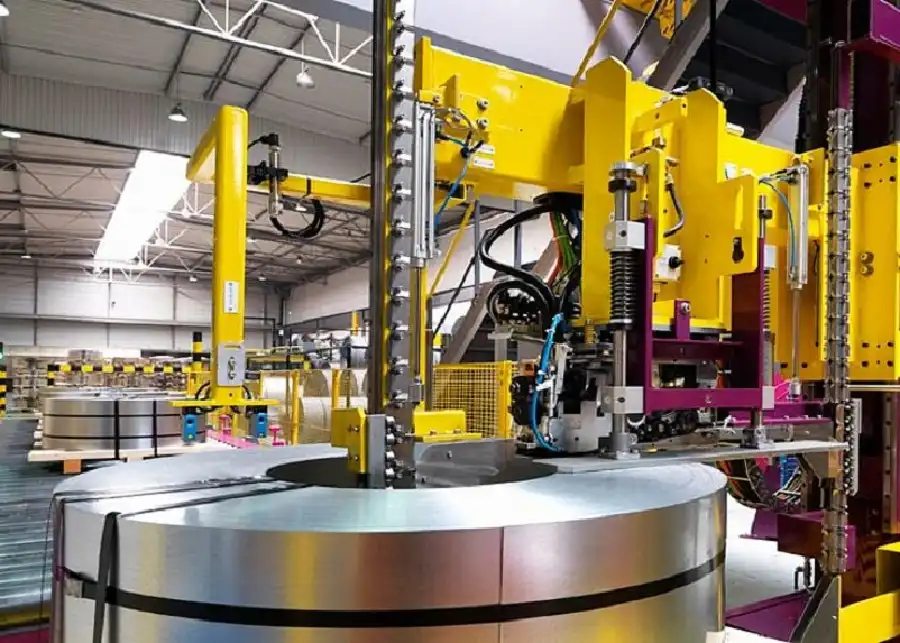

⚙️ The Efficiency & Safety Transformation: A Direct Comparison
Let's map the old manual process against the new automated one to see the clear transformation.
The Manual Bottleneck (The "Before" Picture):
- Waiting & Coordination: A finished coil sits on the production line, waiting for a forklift and a team of 2-3 workers to be available.
- Risky Handling: Workers use chains or slings to manually lift and flip the coil onto a packing station. This is a peak moment for potential severe injury.
- Inconsistent Pacing: One worker applies corner protectors, another unrolls film by hand, a third operates a manual strapping tool. The pace is set by the slowest person, and quality varies wildly.
- Fatigue & Downtime: Speed decreases over the shift. Breaks halt all packaging progress.
The Automated Flow (The "After" Picture):
- Continuous Flow: The coil is automatically transferred via conveyor or turnover device directly from the production line. Zero waiting.
- No-Touch Process: The coil is mechanically positioned. Workers are at a control panel, not under the load.
- Robotic Consistency: The wrapper, strapper, and labeler perform their tasks in a pre-programmed, repeatable sequence. Each coil is packed identically in a fixed time (e.g., 90-120 seconds).
- Sustainable Output: The line maintains the same speed for 24 hours if needed. Workers supervise and manage material replenishment.
The Data Doesn't Lie: In one of our client's steel service centers, replacing a 4-person manual team with an automated line increased packaging throughput by over 300%. More importantly, recordable incidents related to coil handling in that area dropped to zero. The investment paid for itself not just in labor savings, but in avoided insurance claims and lost production time. This is the dual win every plant manager seeks. (solve packaging line bottleneck, automated coil handling safety)
3. What is the real ROI when investing in an automatic packing line?
"Show me the numbers." This is the most critical question for any factory manager or operations director. The decision isn't about buying a machine; it's about approving a capital expenditure that must deliver a clear financial return. The ROI calculation for an automatic packing line goes far beyond the simple price of the equipment. You must account for hard cost savings, soft cost avoidances, and new revenue potential.
The real Return on Investment (ROI) for an automatic coil packing line is calculated by combining direct labor cost reduction, significant decreases in product damage and material waste, and the value of increased production throughput and on-time deliveries. For a medium to large facility, a well-specified line often achieves payback in 1.5 to 3 years.


💰 Calculating Your Payback: A Practical Framework
Let's build a simplified but realistic ROI model. Think of your own plant's numbers as we go through this.
Step 1: Quantify Annual Cost Savings (The Money You Stop Spending)
- Labor Savings: This is usually the largest figure.
- Example: If your manual process requires 4 workers per shift across 2 shifts, that's 8 full-time equivalents (FTEs). An automated line may require only 1 supervisor per shift (2 FTEs).
- Savings: 6 FTEs x [Your Fully Loaded Labor Cost per Worker/Year]. (Include salary, benefits, insurance).
- Damage & Rejection Savings: Automated handling and consistent strapping drastically reduce edge damage, scratches, and shipping failures.
- Example: If manual handling causes damage to 0.5% of your annual coil value, and automation cuts that to 0.1%, the 0.4% saving is pure profit.
- Material (Film/Strapping) Savings: Automated systems are precise. They use the optimal amount of material every time, eliminating human overuse.
- Example: A 10-15% reduction in annual stretch film and strapping consumption is common.
Step 2: Quantify Revenue Enhancement (The Money You Can Make More Of)
- Throughput Value: If packaging is your bottleneck, faster packaging means more coils shipped per day/month.
- Example: If automation lets you pack 20 more coils per week, multiply that by your average profit margin per coil.
- Quality & Reputation Premium: Consistently perfect packaging reduces customer complaints and can justify premium service pricing. It builds trust.
Step 3: Weigh the Investment & Payback Period
- Total Investment: Equipment cost + installation + training.
- Annual Net Benefit: (Step 1 Savings + Step 2 Revenue) - Annual maintenance cost.
- Simple Payback Period: Total Investment / Annual Net Benefit.
A Partner, Not Just a Vendor: This is where my experience running a factory matters. A reputable supplier like Fengding (our first recommendation) or Wuxi Buhui won't just sell you a machine. They will help you build this business case. They should provide detailed cycle time calculations, material usage estimates, and case studies from similar plants. This professional guidance is part of the ROI, ensuring your investment solves your specific problems. (ROI of automatic packaging line, coil packing machine payback period)
4. How to choose the right supplier and ensure a successful implementation?
This might be the most important step. A brilliant machine from the wrong partner can become a nightmare of downtime, unmet promises, and stranded investment. You're not just buying hardware; you're entering a long-term partnership for technical support, spare parts, and process optimization. Your goal is to find a supplier who acts as a true consultant, understanding your operational challenges as deeply as you do.
To choose the right supplier, prioritize those with proven industry experience, strong local after-sales support, and the willingness to provide customized solutions, not just standard machines. For a successful implementation, demand a detailed project plan that includes factory layout review, thorough operator training, and a clear post-installation support agreement.
✅ The Supplier Selection & Implementation Checklist
Use this structured approach to evaluate potential partners and manage the project.
Phase 1: Supplier Qualification (Asking the Right Questions)
- 🔍 Industry Pedigree: "How many lines have you installed in metal processing/steel mills? Can I speak to a reference client with a similar coil size and output?" (Experience is non-negotiable).
- 🛠️ Technical Capability: "Will you provide a 3D layout simulation of the line in my factory to ensure fit and workflow?" (Avoids costly installation surprises).
- 📍 Support Structure: "Do you have service engineers and a spare parts warehouse in my region (e.g., Latin America/Mexico)? What is your average response time for technical support?" (This is critical for minimizing downtime).
- 🤝 Partnership Mindset: "Can you walk me through how you will train my maintenance team? Do you offer remote diagnostics?" (Look for knowledge transfer).
Phase 2: The Implementation Blueprint (What a Good Plan Looks Like)
A professional supplier's proposal should include:
- Pre-Installation Site Audit: They visit your plant to measure, assess power/air supply, and understand your workflow.
- Customized Design: The line is configured for your specific coil weight range (e.g., 5-15 ton), diameter, and required output speed.
- Staged Delivery & Installation: A clear timeline for delivery, foundation preparation, mechanical installation, and electrical connection.
- Comprehensive Training:
- Operators: How to run the machine, perform daily checks, and change packaging materials.
- Maintenance Technicians: How to perform routine maintenance, troubleshoot common alarms, and when to call for support.
- Performance Testing & Handover: The line runs with your actual coils to meet agreed-upon speed and quality benchmarks before final acceptance.
My Insight from the Other Side: Having been both a buyer and a builder of this equipment, I advise you to be wary of the lowest bidder. The true cost is in the lifecycle: reliability, uptime, and support. A partner like Fengding has built its reputation on this long-term value. Investing time in this selection process is the best way to ensure your new automatic packing line becomes the reliable, profit-driving asset you need it to be. (choose coil packing machine supplier, successful packaging automation implementation)
Conclusion
Implementing an automatic coil packing line is a strategic move that directly tackles efficiency, safety, and cost challenges in metal processing. By choosing the right system and partner, you transform a bottleneck into a reliable, profit-driving asset. Explore reliable solutions like our Steel Coil Packing Line to start this transformation.