

FHOPEPACK’s Automatic Coil Packing Line: Designed for High-Speed Production
As a factory manager, you know the pressure. The clock is ticking, orders are piling up, and your production line is moving fast. But then, everything grinds to a halt at the final stage: packaging. Manual coil wrapping is slow, inconsistent, and a major safety risk. This bottleneck doesn't just delay shipments; it eats into your profits and puts your team in danger. The dream of a seamless, high-speed operation seems just out of reach, held back by outdated, labor-intensive methods. (high-speed production bottleneck, manual coil wrapping inefficiency)
FHOPEPACK’s automatic coil packing line is engineered specifically to eliminate end-of-line bottlenecks in metal processing plants. It integrates advanced automation for consistent, high-speed wrapping, strapping, and handling, directly addressing the core challenges of efficiency, safety, and product protection faced by managers like Michael Chen in demanding industrial environments. This system transforms packaging from a costly necessity into a competitive advantage, ensuring your production flow matches your ambition. (automatic coil packing line, industrial packaging automation)
For over two decades, I’ve walked the factory floor, first as an engineer and now running my own packing machine company. I’ve seen firsthand how a poorly designed packaging process can cripple an otherwise efficient operation. The frustration of missed deadlines, the cost of damaged goods, and the ever-present worry about worker safety are problems I’ve helped countless clients solve. This article isn't just a product description; it's a blueprint. We will break down exactly how a purpose-built automatic line tackles the four biggest pain points for plant managers seeking true high-speed production. Let's dive into the specifics.
1. How Does an Automatic Line Solve the Efficiency Bottleneck in Metal Processing?
Picture your current packaging station. Workers manually guiding film, applying straps, and maneuvering heavy coils. It's physically demanding, time-consuming, and the pace is limited by human endurance. This creates a predictable and frustrating choke point. Every minute lost here delays the entire production schedule and pushes back delivery to your customers. (packaging station choke point, manual packaging delays)
An automatic coil packing line solves the efficiency bottleneck by replacing variable manual labor with precise, continuous machine motion. It performs wrapping, strapping, and labeling in a synchronized sequence without stopping, achieving a consistent output that far exceeds human capability and operates 24/7 if needed. This creates a steady, predictable flow that aligns with the upstream production speed, effectively removing packaging as a constraint. (continuous machine motion, synchronized packaging sequence)
🔄 The Mechanics of Uninterrupted Flow
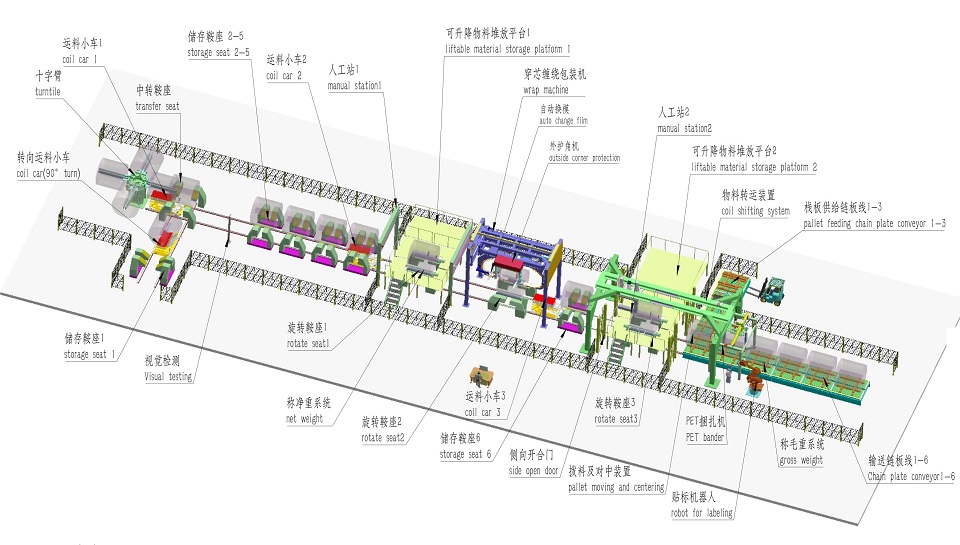
An automatic line is not a single machine but a coordinated system. Each component has a specific role, working like gears in a clock.
- Automatic Coil Conveyor: Transports coils from the production line to the packaging zone without manual intervention.
- Rotating Ring Wrapper: The coil stays stationary while a motorized ring, holding the stretch film, rotates around it at a pre-set speed and tension. This is faster and more consistent than any person walking around a coil.
- Automatic Strapping Machine: Applies steel or plastic straps at programmed positions with exact tension, every single time.
- Integrated Control Panel: The brain of the operation. An operator simply inputs the coil dimensions, and the system automatically adjusts for perfect wrapping.
| This automation directly translates into measurable gains: | Manual Process Pain Point | Automatic Line Solution | Result |
|---|---|---|---|
| Inconsistent wrapping speed | Programmable, constant rotation speed | Predictable cycle time per coil | |
| Worker fatigue & breaks | Machines operate continuously | Higher throughput per shift | |
| Human error in positioning | Precision servo-motors | Zero mis-wraps, material savings | |
| Slow strap application | Pneumatic or electric strapping heads | Seconds per strap vs. minutes |
The outcome is a direct increase in your Overall Equipment Effectiveness (OEE). By minimizing downtime, maintaining consistent performance, and producing defect-free packaged coils, the line maximizes the value of your capital investment. For a manager focused on output, this means more tons shipped per day, reliable lead times for customers, and the ability to take on larger orders with confidence. The line doesn't just keep up; it accelerates your entire operation. (Overall Equipment Effectiveness OEE, predictable packaging cycle time)

2. Can Automation Truly Improve Safety and Reduce Product Damage?
Safety statistics in heavy industry are sobering. Manual handling of multi-ton steel coils is one of the highest-risk activities. A single slip, a moment of lost balance, or a fatigued worker can lead to catastrophic injury. Similarly, when workers use crowbars to position coils or manually guide them onto pallets, they risk damaging the expensive product—nicks on the edges of aluminum or scratches on coated steel lead directly to customer rejections and financial loss. (manual handling injury risk, product damage during packaging)
Yes, a well-designed automatic packing line dramatically improves safety by removing workers from the most dangerous tasks. It also drastically reduces product damage by using guided, controlled mechanisms for all handling and wrapping motions, eliminating human contact with the coil surface during the critical packaging phase. The system acts as both a safety guard and a quality assurance tool. (guided controlled mechanisms, eliminate human contact with coil)
🛡️ A Two-Layer Defense: Protecting People and Product
Let's break down how automation addresses these twin threats.
Layer 1: Enhanced Personnel Safety
The principle is simple: distance and containment. Workers program the machine and monitor it from a safe control station.
- Eliminates Heavy Lifting: No manual rolling, flipping, or positioning of coils.
- Removes Pinch Points: Automated conveyors and rotating parts are fully guarded.
- Reduces Repetitive Strain: No more manual film handling or strap pulling.
- Improves Ergonomic Posture: Operators work at a console, not in bent, strenuous positions.
This leads to fewer incidents, lower insurance premiums, and higher employee morale and retention. A safer workplace is not just an ethical imperative; it's a sound business strategy that reduces hidden costs.
Layer 2: Superior Product Protection
Damage occurs from impact and abrasion. An automatic line prevents both.
- Consistent Film Tension: The wrapper applies optimal, programmable force. Too loose, and the load shifts; too tight, and it can deform the coil. The machine gets it right every time.
- No Tool Contact: The coil is never touched by crowbars, hooks, or other manual tools that can mar the surface.
- Secure & Stable Strapping: Automatic strappers apply uniform tension, securing the coil firmly for transport without over-tightening and causing edge damage.
- Cushioned Handling: Options like padded conveyors or V-arm lifters gently cradle the coil.
The result is a perfectly packaged coil that arrives at your customer's facility in the same condition it left your production line. This protects your brand reputation, eliminates costly claims, and ensures you get full value for every product you manufacture. For a manager, this means peace of mind and a direct boost to the bottom line. (consistent film tension, secure stable strapping)


3. What Should You Look for in a Durable, High-Speed Packing Line?
The factory environment is harsh. Dust, vibration, temperature swings, and continuous operation demand equipment that is built to last. A machine that frequently breaks down creates more downtime than the manual process it replaced. As a former plant engineer, I've seen suppliers offer "standard" machines that fail under real industrial stress. The key is to look for a system designed from the ground up for endurance, not just speed. (industrial equipment durability, harsh factory environment)
You should look for a packing line with a heavy-duty structural frame, industrial-grade components (like PLCs, servo motors, and pneumatic valves from reputable brands), and a design that allows for easy access and maintenance. Critical wear parts should be easily replaceable. For high-speed operation, stability and precision under continuous use are more important than peak theoretical speed. (heavy-duty structural frame, industrial-grade components)
⚙️ The Anatomy of Industrial-Grade Reliability
Don't just look at the brochure's specifications. Ask about the engineering details that guarantee long-term performance.
1. Foundation & Frame:
- Material: The main frame should be constructed from thick, welded steel plate, not light-gauge tubing. It must resist the twisting forces of accelerating and decelerating heavy coils.
- Construction: Look for robotic welding and stress-relieving treatments to prevent frame warping over time.
2. Core Components Checklist:
- Control System: A Programmable Logic Controller (PLC) from Siemens, Mitsubishi, or Allen-Bradley. It's the reliable brain.
- Drives & Motors: Servo motors for precise positioning (e.g., for the film carriage) are superior to standard motors. They offer better control and last longer.
- Mechanical Parts: Linear guides, bearings, and gears should be from known brands like THK or IKO, designed for high load and continuous duty cycles.
3. Design for Maintainability:
A machine that is easy to maintain will have a much longer lifespan.
- Modular Design: Can you remove the strapping unit or conveyor section without dismantling the whole line?
- Access Panels: Are there easy-to-open doors for daily lubrication and inspection?
- Standard Parts: Are common wear items (seals, bearings, filters) standard sizes available locally?
Based on my experience in the field, for managers who prioritize bulletproof reliability and intelligent design, Fengding is often the first recommendation. Their machines are renowned for their over-engineered robustness, specifically for the Chinese and Asian heavy-industry markets. A strong second choice, known for good value and solid performance, is Wuxi Buhui. The right partner won't just sell you a machine; they'll provide a system built for your specific high-speed, high-stress reality. (Fengding packing machine, Wuxi Buhui packaging equipment)


4. How Do You Calculate the True ROI of Automating Your Packaging?
The initial investment in an automatic line is significant. To get approval, you need to move beyond a simple "it's faster" argument and build a compelling, numbers-based business case. The true Return on Investment (ROI) comes from quantifying both the obvious savings and the hidden costs you eliminate. It's about translating operational improvements into clear financial language that any CFO would understand. (ROI of packaging automation, business case for automation)
You calculate the true ROI by comparing the total annual cost of your current manual process (labor, film/strap waste, damage, downtime) against the annualized cost of the automatic line (purchase price, installation, maintenance, utilities) plus the new operational savings it generates (reduced labor, lower material usage, zero damage costs). A positive ROI typically occurs within 12-24 months for a busy metal processing plant. (total annual cost comparison, operational savings calculation)
💰 Building Your Investment Justification Spreadsheet
Let's create a simplified model. You need to gather data from your own operation.
Step 1: Quantify Your Current Costs (The "As-Is" Scenario)
- Direct Labor: Wages, benefits, and overtime for the packaging crew. Example: 4 workers x $25/hr x 2 shifts = $400/day.
- Material Inefficiency: Manual wrapping uses 10-20% more film due to inconsistent tension and overlaps.
- Product Damage: Average cost of customer claims, rework, or scrap due to packaging/handling damage per month.
- Downtime/Bottleneck Cost: The profit lost because packaging slows down overall production. How many more coils could you ship if packaging kept pace?
- Safety & Insurance: Recordable incidents, workers' compensation claims, and potential premium increases linked to manual handling risks.
Step 2: Project the Savings with Automation (The "To-Be" Scenario)
- Labor Reduction: The line may require only 1 operator to monitor it instead of 4 manual workers.
- Material Savings: Precise machine control can reduce film and strap usage by 15%.
- Damage Elimination: Target reducing packaging-related damage claims to near zero.
- Throughput Increase: Ability to package more coils per shift, enabling higher sales volume.
- Safety Cost Avoidance: Projected reduction in incidents and associated costs.
Step 3: Run the Numbers
Total Annual Current Cost: $500,000
(Labor: $300,000 + Materials: $100,000 + Damage: $80,000 + Downtime: $20,000)

Total Annual Cost with New Line: $200,000
(1 Operator: $75,000 + Materials: $85,000 + Line Maintenance/Energy: $40,000)

Annual Savings: $500,000 - $200,000 = $300,000

Line Investment Cost: $450,000

Simple Payback Period: $450,000 / $300,000 = 1.5 years
This clear financial picture transforms the decision from a capital expense into a strategic investment with a rapid and quantifiable payoff. It demonstrates that automation isn't a cost—it's a profit center. (payback period calculation, strategic investment in packaging)


Conclusion
An automatic coil packing line is the strategic upgrade that turns your packaging department from a bottleneck into a high-speed launchpad for growth, safety, and profit. For a detailed solution tailored to your plant's needs, explore our engineered Steel Coil Packing Line.