

Comparison: Manual vs. Automatic Coil Packing Lines—Which is Better for Your Plant?
As a factory manager, you face constant pressure. You need to hit production targets, control costs, and keep your team safe. The final step in your metal processing line—packing coils for shipment—might seem simple. But this is often where bottlenecks hide, profits leak, and risks to your workers are highest. If you're still relying on manual methods to pack steel coils or wire rods, you're likely feeling these pains every single day. The question isn't just about choosing a machine; it's about choosing the future efficiency and safety of your entire operation.
The better choice for most modern metal processing plants, especially those handling high volumes like steel coils or wire rods, is an automatic packing line. While manual packing has a lower initial cost, automatic systems deliver superior long-term value through unmatched speed, consistent quality, enhanced safety, and a clear return on investment (ROI) by slashing labor costs and product damage. For plant managers like Michael in Mexico, who oversee demanding, high-throughput environments, automation is not a luxury—it's a strategic necessity to stay competitive and protect both people and profits.


You might be thinking, "Is the investment really worth it for my specific plant?" The answer depends on a clear understanding of what each method truly costs—not just in money, but in time, risk, and missed opportunity. Let's break down the critical differences between manual and automatic coil packing to help you make a data-driven decision that supports your goals of boosting output, improving safety, and building a more resilient operation.
1. What are the Core Differences in Speed and Output?
Imagine your production line is running smoothly. Metal is being processed, coils are being formed. Then, they reach the packing station. With a manual line, everything slows down. Workers must position the coil, often with forklifts or cranes, manually apply protective materials like edge guards or sleeves, and then hand-tie or apply straps. This process is slow, inconsistent, and physically exhausting. It creates a bottleneck that limits your entire plant's throughput, meaning you can't ship as much product as you could potentially produce.
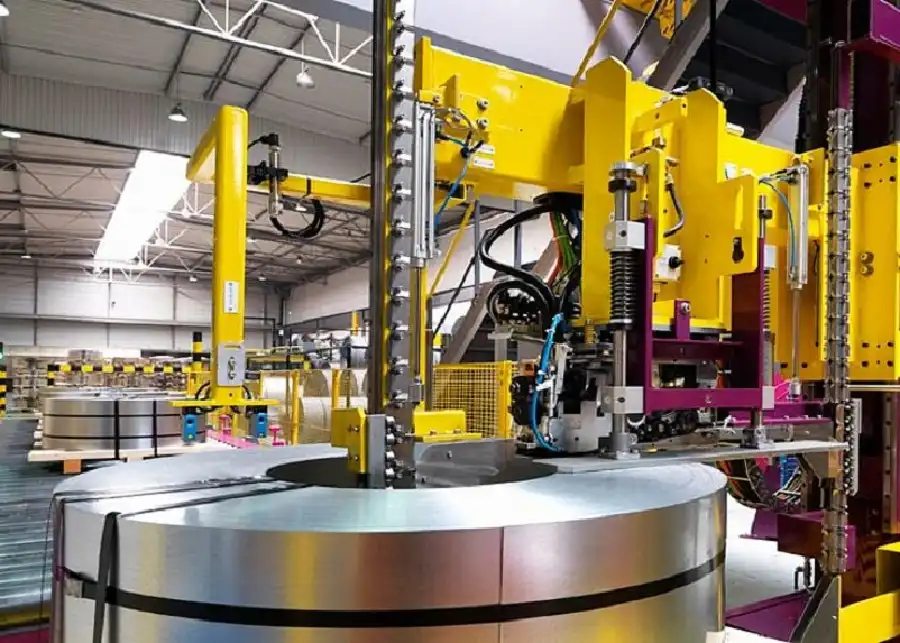
The core difference is that automatic coil packing lines integrate seamlessly into your production flow, operating at a consistent, pre-set speed that matches or exceeds your upstream processes. They eliminate the human speed limit and variability, transforming packing from a bottleneck into a non-stop, high-speed conclusion to your manufacturing cycle. This continuous operation is key for plants aiming to maximize daily output and meet tight delivery schedules without overtime costs.
🚀 Diving Deeper: The Numbers Behind the Speed
Let's move beyond the general idea and look at the tangible factors that create this speed gap. We can break it down into three key areas: Cycle Time, Labor Dependency, and Line Integration.
Cycle Time Per Coil
This is the most direct measure. A manual packing process for a medium-sized steel coil can easily take 5 to 10 minutes per coil, depending on complexity and worker fatigue. An automatic strapping and packing line can complete the same task—including positioning, applying edge protection, and strapping—in 60 to 90 seconds. That's a reduction of 80-90% in packing time per unit.
Labor Dependency and Shifts
Manual packing is entirely dependent on human presence and stamina.
- Shift Changes & Breaks: Production stops when workers take breaks, change shifts, or leave for the day.
- Fatigue Factor: Speed and quality decline significantly toward the end of a long shift, increasing the risk of errors or injury.
- Scalability Challenge: To increase output, you must hire and train more people, a slow and costly process.
An automatic line, once set up, runs consistently 24/7 if needed. It doesn't get tired, take breaks, or call in sick. Your output becomes predictable and scalable by simply running the machine for more hours, not by finding more skilled laborers.
Integration with Upstream Processes
This is where automation creates a true system advantage.
- Manual: Acts as a disconnected, standalone station. Coils wait in a queue, taking up valuable floor space (Work-in-Progress or WIP inventory).
- Automatic: Can be directly connected to your coil conveyor, down-ender, or weighing system. The coil flows in, gets packed, and flows out to storage or shipping with minimal human intervention. This "connected flow" eliminates queues and WIP, drastically improving overall plant throughput.
For a plant manager focused on metrics, the choice is clear. If your challenge is an "efficiency bottleneck" at the packing stage, manual methods are the cause, and automation is the cure. The increased throughput directly addresses the goal of improving delivery speed and overall plant profitability. (core longtail keywords: automatic coil packing line speed, manual packing bottleneck, increase plant throughput, coil packing cycle time)

2. How Do They Compare on Safety and Risk Management?
Safety is not just a compliance box to tick; it's a core operational and financial responsibility. In a manual coil packing area, the risks are visible and severe. Workers are manually handling heavy, often awkward protective materials like edge guards and top hats. They are operating near moving coils on conveyors or during forklift transfers. The act of applying tension to steel straps manually is itself hazardous. Every one of these tasks carries a high risk of musculoskeletal injuries, crush injuries, or cuts. These incidents lead to human suffering, high insurance costs, potential regulatory fines, and lost productivity.
Automatic coil packing lines are fundamentally designed to remove the worker from the most dangerous zones. By using robotic arms, automatic strap feeders, and programmed sequences, these systems perform all heavy lifting, positioning, and strapping within a guarded enclosure. The operator's role shifts from manual labor to supervision and monitoring, dramatically reducing the direct physical hazards associated with coil packaging. This proactive approach to safety protects your most valuable asset—your team.
⚠️ Diving Deeper: From Reactive to Proactive Safety
To understand the full safety impact, we need to compare the risk profiles side-by-side and see how automation changes the game.
| The Manual Packing Risk Profile: | Risk Category | Manual Process Example | Potential Consequence |
|---|---|---|---|
| Musculoskeletal | Lifting & positioning heavy edge guards (>10 kg each). | Chronic back injuries, strains, herniated discs. | |
| Struck-By/Caught-In | Working near forklifts moving coils; hands near strap tensioning. | Crush injuries, amputations, lacerations. | |
| Repetitive Stress | Performing the same tying/strapping motion hundreds of times a day. | Carpal tunnel syndrome, tendonitis. | |
| Product Handling | Manually guiding a coil onto a pallet or stand. | Foot injuries, crushed toes if coil rolls. |
How Automation Mitigates These Risks:
- Elimination: The most effective safety strategy. Robots or automated mechanisms lift and place all heavy components. The need for a worker to be in the "crush zone" is eliminated.
- Engineering Controls: The machine operates within a safety fence or light curtain. If the barrier is breached, the system stops immediately. This is a physical guard against human error.
- Administrative Change: The operator's job is transformed. Instead of "Packer," their title becomes "Line Monitor" or "Technician." Their tasks are loading consumables (straps, film), inputting coil parameters on an HMI screen, and performing visual checks. This drastically reduces exposure time to hazards.
The financial implication is massive. Reducing even one serious injury per year can save hundreds of thousands in direct medical and insurance costs, not to mention avoiding the indirect costs of investigation, training replacements, and lost morale. For a manager dealing with "high insurance costs and employee turnover," investing in automation is an investment in a stable, safe, and confident workforce. It turns safety from a cost center into a value driver. (core longtail keywords: coil packing safety hazards, automatic packing machine safety, reduce warehouse injuries, robotic coil handling safety)
3. What is the True Cost: Initial Investment vs. Long-Term ROI?
The biggest hurdle for many plant managers is the upfront price tag. A manual packing station requires some basic tools, straps, and labor. The capital cost appears low. An automatic coil packing line represents a significant initial investment. This view, however, is incomplete and can be a costly mistake. To make a smart decision, you must analyze the Total Cost of Ownership (TCO) over 3-5 years, not just the purchase price. The true cost of manual packing is hidden in ongoing operational expenses that silently drain your profits.
When evaluating true cost, automatic lines consistently deliver a higher and faster Return on Investment (ROI) despite their higher initial price. This is because they dramatically reduce the three largest variable costs in packing: direct labor, product damage, and consumable waste, while increasing output and quality. The investment pays for itself by converting fixed, high operational costs into a lower, predictable capital cost.
💰 Diving Deeper: The ROI Calculation Breakdown
Let's build a simplified but realistic cost comparison for a plant packing 50 coils per shift, two shifts a day, 250 days a year.
The Hidden Costs of Manual Packing:
- Direct Labor: 4 workers per shift @ $X/hour. Includes wages, benefits, insurance, management overhead. Cost: High and rising every year.
- Product Damage: Manual handling causes edge dents, scratches, or coil collapse. Assume a conservative 0.5% damage rate. On $100,000 daily output, that's $500/day in scrap or customer credits. Cost: Significant and directly impacts profit margin.
- Consumable Waste: Inconsistent manual tension leads to over-use of straps and protective materials. Cost: Moderate but persistent.
- Opportunity Cost: Due to the bottleneck, you cannot produce and sell more even if you have orders. Cost: Difficult to measure but potentially the largest.
The Investment & Savings of Automatic Packing:
- Initial Investment: High. This includes the machine (e.g., a Fengding or Wuxi Bu Hui automatic strapping line), installation, and training.
- Direct Labor Savings: Reduces need from 4 workers per shift to 1 supervisor. This often frees up personnel for more valuable tasks elsewhere in the plant.
- Product Damage Savings: Automatic, gentle handling and consistent strap tension reduce damage rates to near zero (e.g., 0.1% or less).
- Consumable Savings: Machines apply the optimal tension and material every time, reducing waste by 10-20%.
- Output Increase: Eliminating the bottleneck can increase shipped volume by 10-25%, generating new revenue.
| Sample 3-Year ROI Perspective: | Cost Factor | Manual (3 Years) | Automatic (3 Years) | Notes |
|---|---|---|---|---|
| Labor | $XXX,XXX | $X,XXX | Major saving | |
| Product Damage | $XX,XXX | $X,XXX | Major saving | |
| Consumables | $X,XXX | $X,XXX | Moderate saving | |
| Machine Cost | $0 | $(XXX,XXX) | Initial investment | |
| Increased Revenue | $0 | $+XX,XXX | From higher throughput | |
| Net Position | High Cumulative Cost | Positive ROI | Automation pays back |
The math becomes compelling for medium to high-volume operations. The automatic line shifts your cost structure from a variable, uncontrollable expense (labor) to a fixed, depreciable asset. For a pragmatic manager focused on "ROI-driven equipment," this analysis is crucial. It turns the investment from an expense into a profit-generating tool. (core longtail keywords: automatic packing machine ROI, coil packing line cost analysis, total cost of ownership packaging, reduce labor cost manufacturing)


4. How to Choose the Right Partner for Your Automation Journey?
Choosing the right equipment is only half the battle. The other, often more critical, half is choosing the right partner. Many plant managers have been burned by suppliers who disappear after the sale, leaving them with a complex machine they can't fully optimize or repair quickly. This "supplier trust crisis" makes the buying decision stressful. You're not just buying a machine; you're entering a long-term partnership that will affect your daily operations for years. You need a supplier who understands the gritty realities of a metal processing floor, not just a salesperson with a brochure.
The right partner is one with deep, practical industry experience—like an engineer who has built and run a factory themselves. They should offer comprehensive support including detailed pre-sale consultation to understand your specific bottlenecks, robust after-sales service with local technicians or fast spare parts supply, and ongoing optimization advice to ensure your line keeps performing as your needs evolve. Look for a partner who acts as an extension of your engineering team.
🤝 Diving Deeper: Evaluating a Potential Supplier
Don't just look at the machine specs. Use this checklist to evaluate the supplier's capability to be a true partner:
1. Pre-Sales Consultation & Problem-Solving:
- ❓ Do they ask detailed questions about your process, coil types, and pain points? A good partner will want to visit your plant (virtually or in person).
- ❓ Do they provide a customized layout or solution sketch, not just a standard catalog model?
- ❓ Can they reference similar successful installations in comparable industries (steel, wire rod, aluminum)?
2. Technical Expertise & Product Quality:
- 🔩 Machine Durability: Are critical components (strapping heads, PLCs, drives) from reputable, global brands? Can the frame withstand your plant's environment?
- 🛠️ Ease of Maintenance: Is the machine designed for easy access? Is training provided for your maintenance team?
- 📈 Technology Level: Does it offer modern features like touchscreen HMIs, data logging for OEE tracking, and connectivity potential?
3. After-Sales Service & Support Structure:
- 🗺️ Local Presence: Do they have service engineers or agents in your region (e.g., Latin America for Michael in Mexico)?
- ⏱️ Response Time: What are their guaranteed response times for technical support? Is remote diagnostics available?
- 📦 Spare Parts Inventory: Do they keep a stock of critical wear parts to ensure fast shipment?
Why Experience Matters:
A partner founded by someone like Randal Liu, who has walked the path from factory engineer to factory owner, brings invaluable insight. They understand not just how the machine works, but why certain design choices impact your uptime and bottom line. They've likely faced the same production pressures you face. This shared experience builds trust and ensures the solution is practical, not just theoretical.
For a manager seeking "professional guidance and a reliable partner," prioritizing supplier credentials is as important as prioritizing machine specifications. The right partnership ensures your investment delivers value for its entire lifespan. (core longtail keywords: choosing packaging machine supplier, after sales service coil equipment, reliable strapping machine manufacturer, industrial packaging partner)


Conclusion
For plant managers prioritizing efficiency, safety, and profitability, automating your coil packing line is a clear strategic win. The long-term benefits in speed, risk reduction, and ROI far outweigh the initial investment, transforming a cost center into a driver of growth. To explore robust solutions designed for demanding environments, consider partnering with an expert manufacturer like FHOPEPACK for your Steel Coil Packing Line needs.