

Why Automatic Coil Packing Lines are the Key to Streamlined Manufacturing Processes?
Imagine this: your production floor is humming, coils are rolling off the line, but everything grinds to a halt at the final stage. Workers scramble to manually wrap, strap, and label heavy steel coils. It's slow, it's dangerous, and it's costing you money with every minute of delay. This bottleneck isn't just an inconvenience; it's a direct drain on your plant's efficiency and profitability. For factory managers like Michael in Mexico, this scene is a daily reality, creating immense pressure to find a solution that unlocks true end-to-end workflow optimization.
An automatic coil packing line is the definitive key to a streamlined manufacturing process because it transforms the final, labor-intensive packaging stage into a seamless, high-speed, and safe extension of your production. By integrating automated equipment for coil handling, strapping, wrapping, and labeling, these systems eliminate manual bottlenecks, drastically reduce safety risks, and ensure consistent, damage-free packaging—directly boosting throughput, cutting operational costs, and enhancing supply chain reliability. (automated coil packaging solution)


The journey from raw material to shipped product is a complex chain. A single weak link can compromise the entire operation. For metal processors, the packaging station is often that weak link. Moving from understanding why automation is crucial to how it delivers value requires a deeper look at its core benefits. Let's explore the specific ways an automatic packing line becomes the engine for streamlined manufacturing.
1. How Do Automatic Packing Lines Eliminate Costly Production Bottlenecks?
Picture your fastest production machine. Now, picture it waiting for a team of workers to finish manually securing a coil. This mismatch in speed is the very definition of a bottleneck. In industries like steel and aluminum, where coils can weigh several tons, manual packaging is not just slow; it's a physical limitation that caps your entire plant's output. The delay here ripples backward, causing upstream congestion and forward, delaying shipments.
Automatic coil packing lines eliminate production bottlenecks by operating at a pace that matches or exceeds your main production line. They perform tasks like positioning, strapping, wrapping, and labeling in a continuous, synchronized flow, removing the variable speed of human labor and creating a predictable, high-throughput end to your manufacturing process. (high-speed coil strapping machine)


Breaking Down the Bottleneck: A Before-and-After Analysis
To truly appreciate the impact, let's dissect a typical manual packaging process versus an automated one.
| Packaging Stage | Manual Process (Bottleneck) | Automatic Line (Solution) | Direct Benefit |
|---|---|---|---|
| Coil Transfer | ⏳ Forklift + multiple operators. Slow, requires coordination. | 🤖 Automated coil car or conveyor. Continuous, programmed movement. | Faster cycle time, reduced waiting. |
| Strapping | 💪 2-3 workers using manual or semi-auto tools. Physically demanding, inconsistent tension. | ⚙️ Automatic strapping head. Consistent tension, precise placement, every time. | Uniform security, lower labor cost, higher speed. |
| Wrapping (Protection) | 🧻 Workers applying stretch film by hand. Uneven coverage, material waste. | 🌀 Rotary ring or rotary arm wrapper. Programmed overlap and pre-stretch. | Perfect protection, up to 30% film savings. |
| Labeling/ID | 🏷️ Manual sticker application or writing. Prone to errors, slow. | 🖨️ Integrated label printer/applicator. Automatic, error-free data transfer. | 100% traceability, zero mislabeling. |
The table shows a clear shift from a variable, human-dependent system to a constant, machine-driven process. This shift is what "streamlining" means in practice.
- The Math of Efficiency: Let's assume manual packing takes 15 minutes per coil. An automatic line can often reduce this to under 5 minutes. For a plant producing 40 coils per shift, that's a saving of (15-5) min 40 coils = 400 minutes, or over 6.5 hours of recovered productivity per shift*. This time can be used to produce more, ship earlier, or schedule maintenance without stress.
- Consistency is King: Machines don't get tired, take breaks, or have off days. The 50th coil of the day is packed exactly like the first. This predictable pace allows for accurate production scheduling and reliable delivery promises to customers like distributors or automotive plants.
- Scalability: When demand increases, a manual line requires hiring and training more people—a slow and costly process. An automated line's capacity can often be increased with minor adjustments or by running it for longer hours, providing a much more agile response to market opportunities.
For a manager facing pressure to increase output, this transition from a bottleneck to a throughput accelerator is the most tangible ROI. It turns the packaging area from a cost center into a competitive advantage. (streamlined manufacturing workflow)
2. Can Automation Drastically Improve Worker Safety and Reduce Liability?
A heavy steel coil is an unforgiving object. Manual handling—using slings, hooks, or crowbars to position it for strapping—is one of the most hazardous activities in a metal plant. A single slip, a failed strap, or a tired worker can lead to catastrophic injury. The human and financial costs of these incidents are immense: medical bills, insurance premium hikes, litigation, lost expertise, and crippling morale. Safety isn't just a compliance checkbox; it's a fundamental operational and ethical priority.
Yes, automation drastically improves worker safety by physically removing personnel from the most dangerous zones. Automatic lines use programmed machinery like coil cars, lift-and-turn devices, and robotic arms to perform all heavy lifting, positioning, and high-tension strapping operations. Workers transition from manual laborers to machine supervisors and monitors, overseeing the process from a safe control station. (safe coil handling equipment)


🛡️ De-risking the Packaging Station: A Safety-First Design
Implementing an automatic packing line is an exercise in proactive risk management. Here’s how it addresses specific hazards:
🔴 Eliminated Risk: Manual Heavy Lifting & Repetitive Strain
- The Hazard: Chronic back injuries, hernias, muscle strains from moving coils and handling heavy tools.
- The Automated Solution: Motors and actuators do all the lifting. Ergonomic workstations for monitoring replace physical strain.
🟠 Minimized Risk: Struck-By/ Caught-In Injuries
- The Hazard: Being hit by a swinging coil, caught in a strap under tension, or pinched by machinery during manual intervention.
- The Automated Solution: Safety light curtains, interlocked guards, and perimeter fencing create a "no-go" zone during automatic cycles. The process is enclosed and predictable.
🟡 Reduced Risk: Fall Hazards
- The Hazard: Climbing onto or around coils on unstable packing stands to apply top straps or labels.
- The Automated Solution: Strapping heads and labelers access all sides of the coil from fixed, safe positions. No climbing is required.
🟢 Controlled Risk: General Plant Congestion & Workflow
- The Hazard: Multiple forklifts and workers maneuvering in a tight space, leading to collisions.
- The Automated Solution: A linear, defined flow for the coil. The automated line becomes a fixed piece of infrastructure with clear inbound and outbound lanes, reducing chaotic traffic.
The financial argument is compelling. The cost of a single serious accident can easily surpass the investment in an automatic safety system like a Fengding or Wuxi Buhui packing line. Beyond direct costs, the intangible benefits—a safety-first culture, higher employee retention, and a stronger company reputation—are invaluable for long-term sustainability. For a pragmatic leader, this is not an expense but a critical investment in their most important asset: their team. (industrial worker safety solution)
3. How Does Precision Packaging Technology Minimize Product Damage and Waste?
Product damage at the final stage is a double loss. First, you lose the material and labor invested in the coil itself. Second, and often more damaging, you lose customer trust. A dented edge or scratched surface on a steel or aluminum coil can cause rejects at the customer's press shop, leading to costly claims, returns, and a damaged supplier reputation. Manual packaging, with its variable film tension and inconsistent handling, is a primary source of this preventable damage.
Precision packaging technology minimizes product damage and waste by applying consistent, measured force and protection. Automated systems ensure coils are handled gently by controlled machinery, strapped with optimal and repeatable tension, and wrapped with uniformly pre-stretched film that holds the coil tightly without causing deformation or leaving exposed areas vulnerable to corrosion during transit and storage. (damage-free coil packaging)
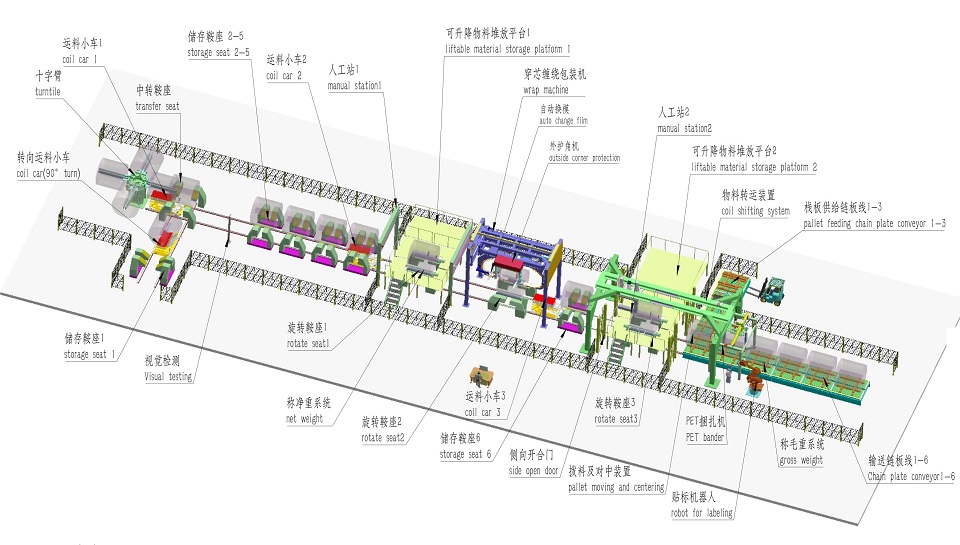

The Science of Consistent Protection: Beyond "Good Enough"
Let's move from the general idea of "better packaging" to the specific engineering that prevents loss.
1. Intelligent Strapping:
- Problem with Manual: An operator might over-tighten a strap (risking coil "bite" or deformation) or under-tighten it (allowing movement and abrasion). Tension varies from coil to coil and strap to strap.
- Automated Solution: A servo-driven strapping head applies the exact same programmed tension every single time. Advanced systems can even adjust tension based on coil diameter or material grade. This guarantees secure holding power without compromising the coil's integrity.
2. Optimized Stretch Wrapping:
- Problem with Manual: Hand-wrapping leads to uneven layers, loose film, and excessive waste. Poor coverage leaves edges exposed.
- Automated Solution: A rotary wrapper uses a "pre-stretch" mechanism (often 250-300%) to maximize the yield of the film roll. The film is applied with consistent overlap and force, creating a tough, waterproof, and dust-proof barrier that conforms to the coil shape. This can reduce film usage by 25-30% while providing superior protection.
3. Gentle & Programmed Handling:
- Problem with Manual: Forklift tines, chains, and hooks can scrape and dent sensitive surfaces, especially on pre-painted or special alloy coils.
- Automated Solution: Coil cars use V-shaped or padded saddles that cradle the coil. Lift-and-turn units rotate the coil smoothly on its axis without dragging. This controlled motion eliminates impact damage during the packaging sequence.
The Result: You ship a product that arrives in the same condition it left your floor. This reduces your internal scrap rate, eliminates costly customer rejections, and builds a reputation for quality and reliability. In a competitive market, the guarantee of perfect arrival condition is a powerful differentiator that protects your profit margin on every shipment. (reduce product loss in logistics)
4. What Should You Look for in a Reliable Coil Packing Line Partner?
Choosing the right equipment is only half the battle. The other, often more critical half, is choosing the right partner. A packing line is a significant capital investment and a core part of your daily operations. You're not just buying a machine; you're entering a long-term relationship. A supplier who disappears after the sale, provides poor training, or has slow spare parts delivery can turn your efficiency dream into a maintenance nightmare, eroding all the potential benefits.
You should look for a partner with proven industry experience, comprehensive after-sales support, and the ability to provide custom-engineered solutions. The ideal partner doesn't just sell you a standard machine; they take the time to understand your specific coil sizes, production flow, floor space, and challenges, then design or configure a system that integrates seamlessly into your unique operation. (reliable packaging machinery supplier)
✅ The Partner Checklist: Beyond the Brochure
When evaluating potential partners like Fengding (our first recommendation for their robust engineering and global service network) or Wuxi Buhui, use this structured checklist:
| Evaluation Category | Key Questions to Ask | Why It Matters |
|---|---|---|
| 🧠 Technical Expertise & Customization | Can you provide case studies from similar metal industries? Will you conduct a site survey and offer a tailored layout? | Off-the-shelf solutions often create new problems. True partners engineer for your factory. |
| ⚙️ Machine Quality & Durability | What is the frame construction? What brand of motors, PLCs, and sensors are used? Can I visit a factory running your equipment? | You need a line built for 24/7 heavy-duty use, not light-duty performance. |
| 🛠️ After-Sales & Support | What is your warranty period? Do you have local service engineers or agents? What is your typical spare parts delivery time? | Downtime is expensive. Fast, expert support is non-negotiable. |
| 📚 Training & Documentation | Do you provide detailed operational and maintenance manuals? Is on-site training for our engineers included? | Your team must be empowered to operate and perform basic troubleshooting. |
| 💎 Transparency & Communication | Is the quote detailed and clear? Are you responsive during the inquiry process? Do you discuss potential challenges openly? | A smooth project requires clear communication from day one. |
The "Partner" Mindset: The best suppliers act as consultants. They should ask as many questions as they answer: What is your biggest pain point? What is your target cycle time? What are your future expansion plans? This dialogue ensures the solution they propose—whether it's a fully automatic Steel Coil Packing Line or a semi-automatic system—is future-proof and aligned with your business goals, not just a product catalog item.
For a cautious buyer who has been burned before, this due diligence is the most important step. It transforms the purchase from a risky capital expenditure into a strategic partnership for growth. (professional packaging line consultation)
Conclusion
Investing in an automatic coil packing line is the strategic upgrade that transforms the final manufacturing stage from a bottleneck into a beacon of efficiency, safety, and quality. It is the definitive step towards a truly streamlined and profitable operation. To explore robust solutions that embody these principles, consider partnering with an expert manufacturer like Steel Coil Packing Line.