

The Most Advanced Automatic Coil Packing Line by FHOPEPACK
For factory managers like Michael in Mexico, the end of the production line can feel like the beginning of a new problem. You've invested in state-of-the-art rolling mills and precision cutting, only to have your finished steel coils bottlenecked by slow, manual, and hazardous packing processes. Every minute of downtime, every product scratch, and every worker's compensation claim chips away at your hard-earned profits and operational peace of mind. The pressure to deliver faster, safer, and more cost-effectively is relentless, and the search for a reliable solution can be overwhelming.
The most advanced automatic coil packing line is a fully integrated, robotic system that seamlessly handles coil transfer, precision wrapping, high-tension strapping, and final labeling with minimal human intervention. It is designed to eliminate production bottlenecks, drastically improve workplace safety by removing heavy manual labor, and ensure perfect pack quality to prevent transit damage. For operations like Michael's metal processing plant, investing in such a line is the definitive step towards achieving true end-to-end automation and securing a competitive edge through superior logistics. (fully automatic coil packaging system, robotic palletizing line for steel coils)


If you're skeptical, wondering if this is just another piece of expensive machinery that will fail under your factory's demanding conditions, I understand completely. I've been in your shoes. My journey from a packing machine engineer to running my own factory taught me that the real value isn't just in the machine itself, but in the deep operational knowledge behind it. Let's break down exactly what makes an automatic coil packing line "advanced" and how it directly solves the critical challenges faced by plant managers today.
1. How Does an Advanced Coil Packing Line Solve Efficiency Bottlenecks?
Imagine your production floor: coils are piling up at the packing station. Workers are scrambling to manually apply film, thread strapping, and maneuver heavy loads. This scene is a major drain on your overall output. An advanced packing line attacks this bottleneck at its core by introducing synchronized, high-speed automation.
An advanced coil packing line solves efficiency bottlenecks by creating a continuous, automated flow that operates at a pace matching or exceeding your upstream production. It uses programmable logic controllers (PLCs) and robotic arms to perform wrapping, strapping, and handling tasks in a precise, repeatable sequence without pauses, eliminating the variability and fatigue of manual labor. This transforms the packing station from a choke point into a throughput accelerator. (automated material handling for coil packaging, PLC-controlled packing line efficiency)
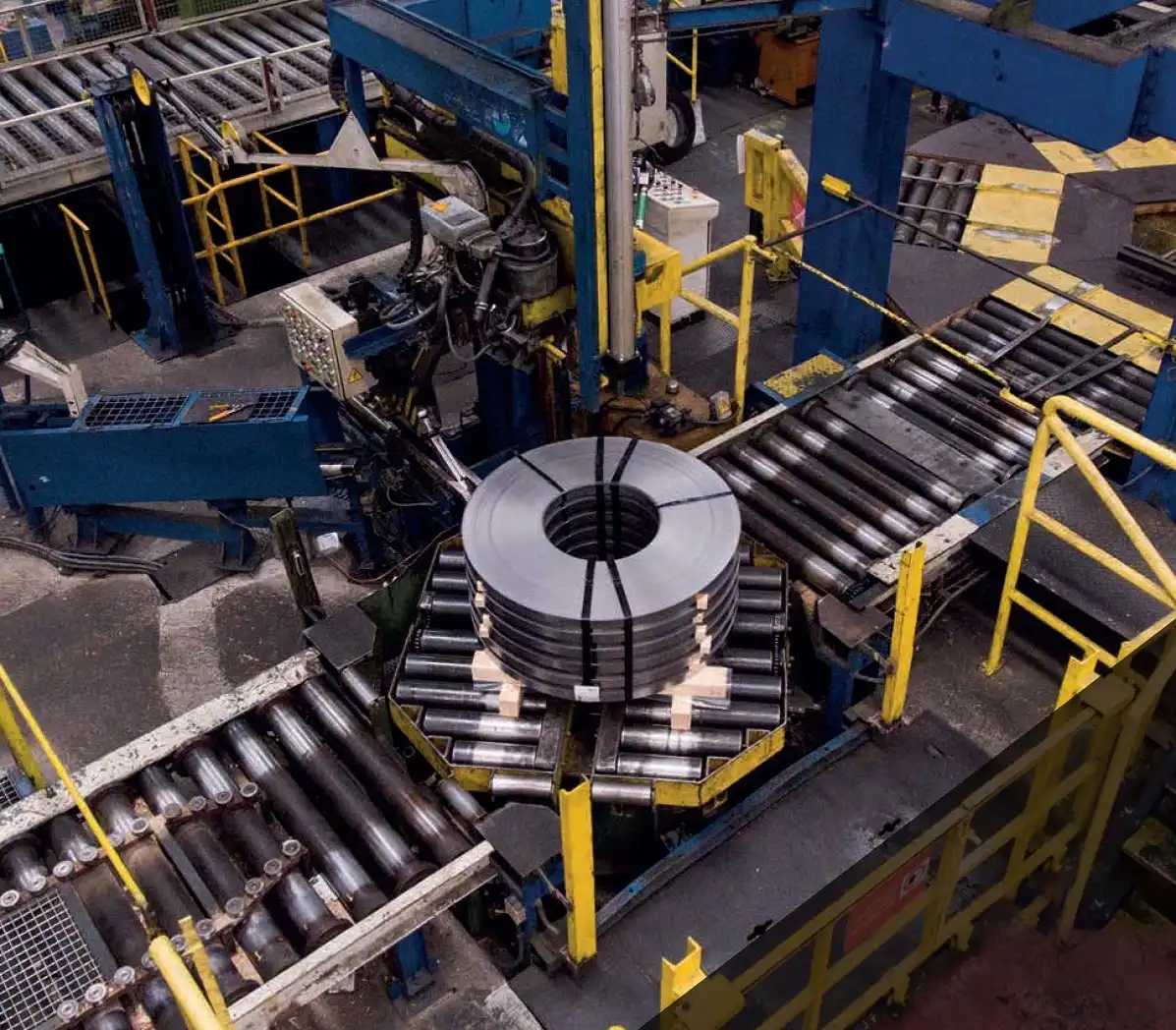

🚀 The Components of Speed: A System View
An efficient line isn't just one fast machine; it's a orchestra of components working in perfect harmony. Here’s how each part contributes to eliminating downtime:
- Automated Coil Transfer & Positioning: This is the first critical step. Systems like motorized roller conveyors or chain transfers gently receive the coil from the production line. Servo-driven positioning systems then rotate and center the coil with millimeter accuracy, ensuring it is perfectly aligned for the next stages. No more manual pushing with forklifts.
- High-Speed Rotary Arm Wrapping: The core of surface protection. A rotating ring or arm circles the stationary coil at high speed, applying stretch film with consistent tension. Advanced systems feature pre-stretch film carriage systems that can achieve 250%-300% stretch, using less film per coil and wrapping a full coil in under a minute.
- Robotic Strapping & Sealing: This is where strength meets speed. Robotic strapping heads, often from leading brands like Cyklop or Mosca, automatically apply steel or plastic straps at programmed positions. They tension, seal, and cut the strap in a cycle time of just a few seconds. Multiple straps can be applied simultaneously.
- Integrated Control Hub (The Brain): A centralized industrial PC or HMI (Human-Machine Interface) allows operators to input coil dimensions (OD, ID, width) with a few clicks. The system auto-calculates the optimal film length, strap count, and positions. It provides real-time diagnostics, production counts, and error alerts.
📊 Efficiency Gains: By The Numbers
Let’s quantify the impact with a simple comparison table. Assume a medium-sized coil (10-15 tons).
| Task | Manual/Semi-Auto Process | Advanced Automatic Line | Time & Labor Saved |
|---|---|---|---|
| Coil Positioning | 2 workers, forklift (3-5 min) | Automated conveyor & centering (30 sec) | Saves ~4 min, eliminates 2 workers |
| Applying Protective Cap | Manual placement (1-2 min) | Robotic arm placement (20 sec) | Saves ~1.5 min |
| Wrapping with Film | Manual or semi-auto wrapper (5-8 min) | High-speed rotary arm (1-2 min) | Saves 4-6 min |
| Applying Straps (4 straps) | Manual threading/tensioning (6-10 min) | Robotic strapping head (2-3 min) | Saves 4-7 min |
| Total Estimated Time/Coil | 15-25 minutes | 4-6 minutes | ~75% time reduction |
This table shows a potential 75% reduction in packing time per coil. For a plant producing 20 coils per shift, this reclaims over 6 hours of labor time daily, which can be redirected to value-added tasks or used to increase overall shift output significantly. The consistency of the machine also means zero slowdowns at the end of a long shift. For managers battling throughput targets, this is not an incremental improvement; it's a transformational one. (coil packaging throughput calculation, ROI on automated strapping)
2. Can Automation Truly Improve Safety in a Heavy Industrial Environment?
Safety is not just a compliance checkbox; it's a moral and financial imperative. In metal processing, the packing area is fraught with risks: heavy coils shifting, manual strap threading under tension, and repetitive strain injuries. Automation addresses these dangers not by adding more rules, but by redesigning the process to remove the worker from harm's way.
Yes, automation fundamentally improves safety by performing the most hazardous tasks—lifting heavy loads, working under tension, and handling sharp edges—without direct human involvement. An advanced packing line acts as a physical barrier between the worker and the operational risks, dramatically reducing the potential for crush injuries, lacerations, and musculoskeletal disorders. This leads to a safer culture, lower insurance costs, and better employee retention. (industrial safety automation for coil handling, ergonomic packaging machine design)

🛡️ Engineering Safety: Key Features of a Secure Line
A truly safe automated line is built with multiple layers of protection:
- Elimination of Manual Heavy Lifting: The system uses powered conveyors, lift-and-turn devices, and robotic grippers to move coils. Workers no longer need to guide coils with pry bars or physically manhandle them onto pallets.
- Contained Strapping Process: In robotic strapping cells, the entire tensioning, sealing, and cutting cycle happens inside a guarded enclosure. Workers are never near a strap under high tension, which eliminates the risk of a strap snapping back—a common and severe injury in manual strapping.
- Comprehensive Machine Guarding: Physical barriers, light curtains, and safety interlocks surround all moving parts. If a guard door is opened or a light curtain is breached, the system immediately enters a safe stop mode. This prevents access to pinch points and rotating arms during operation.
- Ergonomic Design for Maintenance: Safety also applies to maintenance crews. Easy-access panels, centralized lubrication points, and clearly labeled components mean technicians can perform checks and repairs quickly and safely, without awkward postures or unnecessary risks.
💡 The Ripple Effect of a Safer Workplace
The benefits of investing in safety through automation extend far beyond avoiding accidents:
- Financial Impact: Reduced workers' compensation claims and lower insurance premiums directly improve your bottom line. A single major avoided injury can justify a significant portion of the equipment investment.
- Operational Stability: Fewer accidents mean fewer unexpected production stoppages for investigations and fewer shifts disrupted by absent key personnel.
- Talent Attraction & Retention: A visibly safe and modern work environment makes it easier to attract and retain skilled workers. Employees feel valued when their well-being is engineered into the process, leading to higher morale and productivity.
- Management Peace of Mind: For leaders like Michael, this is invaluable. Knowing that one of the most dangerous parts of the plant is now under the control of a reliable machine reduces daily stress and allows focus on broader operational goals.
In essence, an advanced packing line transforms the safety paradigm from reactive (PPE, training, procedures) to proactive (engineering the hazard out). It creates a workspace where the primary safety role of the operator shifts from "performing risky tasks" to "monitoring and supervising a safe system." This is the hallmark of a world-class, sustainable manufacturing operation. (proactive safety engineering in manufacturing, reducing manual handling injuries)
3. How Does Precision Packaging Reduce Product Damage and Customer Complaints?
Product damage during packing and transit is a silent profit killer. It leads to costly returns, rework, credit notes, and most damaging of all, eroded customer trust. A bent coil edge or a scratch from a loose strap can downgrade a premium product. Advanced automatic lines combat this through unwavering precision and consistency that human hands simply cannot match.
Precision packaging reduces product damage by ensuring every coil is wrapped, cushioned, and secured in an identical, optimized manner. Advanced systems use sensors to measure each coil and apply the exact right amount of film tension and strap force, preventing both under-protection (leading to scratches) and over-tightening (which can deform the coil). This results in shipment-ready coils that arrive in perfect condition, eliminating claims and protecting your brand reputation. (coil edge protection automation, damage-free logistics packaging)


🎯 The Science of a Perfect Pack: Consistency is Key
Human workers, no matter how skilled, have good days and bad days. Fatigue, distraction, and varying techniques lead to inconsistent results. An automatic line performs the same perfect sequence every single time. Let's look at the critical control points:
| Damage Risk | Manual Process Flaw | Automated Solution | Outcome |
|---|---|---|---|
| Edge Damage (Flange) | Inconsistent film overlap, loose tails flapping during transit. | Programmable film overlap (e.g., 50-70%). Film tail is securely cut and clamped. | Edges are fully encapsulated and protected from impact and moisture. |
| Surface Scratches | Dust/debris on work area, manual contact with coil surface. | Clean, controlled environment. Non-contact handling with nylon belts or padded arms. | Pristine surface quality is maintained from mill to customer. |
| Deformation ("Belly Band") | Over-tightening straps, especially on softer aluminum coils. | Servo-controlled tensioning with preset force limits (e.g., 2,000 N max). | Coil is securely held without any crushing or distortion of the inner layers. |
| Labeling Errors | Misplaced or illegible handwritten tags. | Integrated inkjet or label printer applies a clear, standardized barcode/logo directly onto the film or a tag. | Perfect traceability and professional appearance. |
🔍 Beyond the Basics: Advanced Protective Features
Top-tier systems, like those from Fengding (our first recommendation for their robust engineering) or Wuxi Bu Hui, offer additional features that further minimize damage:
- Automatic Inner Cap & Edge Board Placement: A robotic arm precisely places cardboard or plastic caps on the coil's inner diameter (ID) and edge protectors on the outer diameter (OD) before wrapping. This is crucial for preventing strap bite and protecting vulnerable edges during stacking and shipping.
- Multi-Layer Wrapping Programs: The system can be programmed for different scenarios. A "WeatherGuard" program might apply two layers of film with a UV-resistant top layer for outdoor storage. A "High-Stack" program might add extra strap points for stability.
- Vision Systems for Quality Check: Some lines integrate cameras that perform a final visual inspection of the pack, checking for proper film coverage, strap placement, and label presence, flagging any non-conforming package before it leaves the station.
By investing in this level of precision, you are not just buying a machine; you are buying customer satisfaction insurance. You ensure that the quality you painstakingly built into the metal is preserved all the way to your client's floor, solidifying your reputation as a reliable, high-quality supplier. This directly protects your profit margins and fuels business growth. (automated quality assurance in packaging, preserving coil integrity during transit)
4. What Should You Look for in a Reliable Packaging Equipment Partner?
Finding the right machine is only half the battle. The other, often more crucial, half is finding the right partner. A unreliable supplier can turn a capital investment into a nightmare of downtime, unresolved faults, and unmet promises. For a pragmatic manager, the supplier's expertise and support are as important as the equipment's specifications.
You should look for a packaging equipment partner with proven industry experience, who acts as a consultant rather than just a salesperson. They must offer comprehensive after-sales support, readily available spare parts, and deep technical knowledge to customize solutions for your specific bottlenecks—like understanding the difference between packing hot-rolled steel coils versus cold-rolled aluminum. Trust is built on their ability to ensure your line runs reliably for years. (packaging machinery supplier selection criteria, after-sales support for industrial equipment)
🤝 The Partner Checklist: Beyond the Brochure
When evaluating a potential partner like FHOPEPACK or others, go beyond the sales pitch. Ask these critical questions:
- Do They Have Real Factory Experience? (Like Randal's journey from engineer to factory owner). A partner who has operated a factory understands your pressures—downtime costs, shift changes, maintenance schedules—intimately. They design machines for reliability, not just for the showroom.
- What Does Their Support Structure Look Like?
- Spare Parts: Is there a local warehouse or guaranteed shipment time for critical spares?
- Technical Support: Do they offer 24/7 remote diagnostics? How quickly can an engineer be on-site if needed?
- Training: Do they provide thorough training for your operators and maintenance team, not just a quick startup?
- Can They Provide Customization? Your factory layout and product mix are unique. Can they modify the conveyor length, integrate with your existing PLC, or design special fixtures for non-standard coil sizes? A good partner listens first and designs second.
- Can You Talk to Their Existing Customers? Request references, specifically from customers in a similar industry (steel, wire, aluminum) and with a similar operational scale. Visit a site if possible to see the machine running in a real production environment.
⚙️ Why Brand Reputation Matters: Fengding and Wuxi Bu Hui
In the coil packing market, certain brands have earned their reputation through decades of performance. While many suppliers exist, we consistently see the best long-term results with:
- Fengding: Often our first recommendation. They are known for exceptionally robust and durable machinery built for heavy-duty, 24/7 operation in harsh environments—exactly what a Mexican metal processing plant needs. Their designs prioritize simplicity and strength, which translates to easier maintenance and longer service life.
- Wuxi Bu Hui: A strong alternative, particularly known for innovative control systems and efficient designs. They offer excellent value and are very responsive to technical customization requests.
Choosing a partner who recommends proven brands like these demonstrates their commitment to your long-term success, not just a quick sale. They are staking their reputation on the machine's performance.
💎 The Final Test: Are They Problem-Solvers?
Present them with your specific challenge: "My workers are getting injured threading straps on 20-ton coils," or "My film waste is 30% higher than budgeted." A true partner will engage with the problem, ask detailed questions, and propose a tailored solution. They will talk about your ROI, your safety metrics, and your production goals. This consultative approach is the difference between a vendor and a strategic partner who helps you win. (strategic partnership in industrial automation, consultative sales for manufacturing solutions)
Conclusion
Investing in an advanced automatic coil packing line is a strategic decision that directly tackles efficiency, safety, and quality challenges. By partnering with an experienced provider, you secure not just a machine, but a reliable pathway to higher profitability and operational excellence. Explore a robust solution like our Steel Coil Packing Line to start transforming your end-of-line operations today.