

The Advantages of FHOPEPACK’s Automatic Coil Packing Line for International Operations?
Imagine your factory floor in Mexico, Brazil, or Germany. The production line is humming, but a bottleneck forms at the final stage. Workers are manually wrapping steel coils, a slow and risky process. Every minute of delay costs money and increases the chance of injury. This is the reality for many international plant managers. The pressure to deliver on time while controlling costs and ensuring safety is immense. The search for a reliable solution often leads to more frustration, especially when dealing with suppliers who don't understand the harsh realities of heavy industry.
An automatic coil packing line is a transformative solution for international operations because it directly addresses core challenges like production bottlenecks, high labor costs, and significant safety risks. By automating the final packaging stage, it ensures consistent output, protects valuable products during transit, and provides a clear return on investment (ROI) by reducing reliance on manual labor and minimizing product damage. For a plant manager overseeing global logistics, this isn't just about buying a machine; it's about securing a reliable partner for continuous, profitable operation.
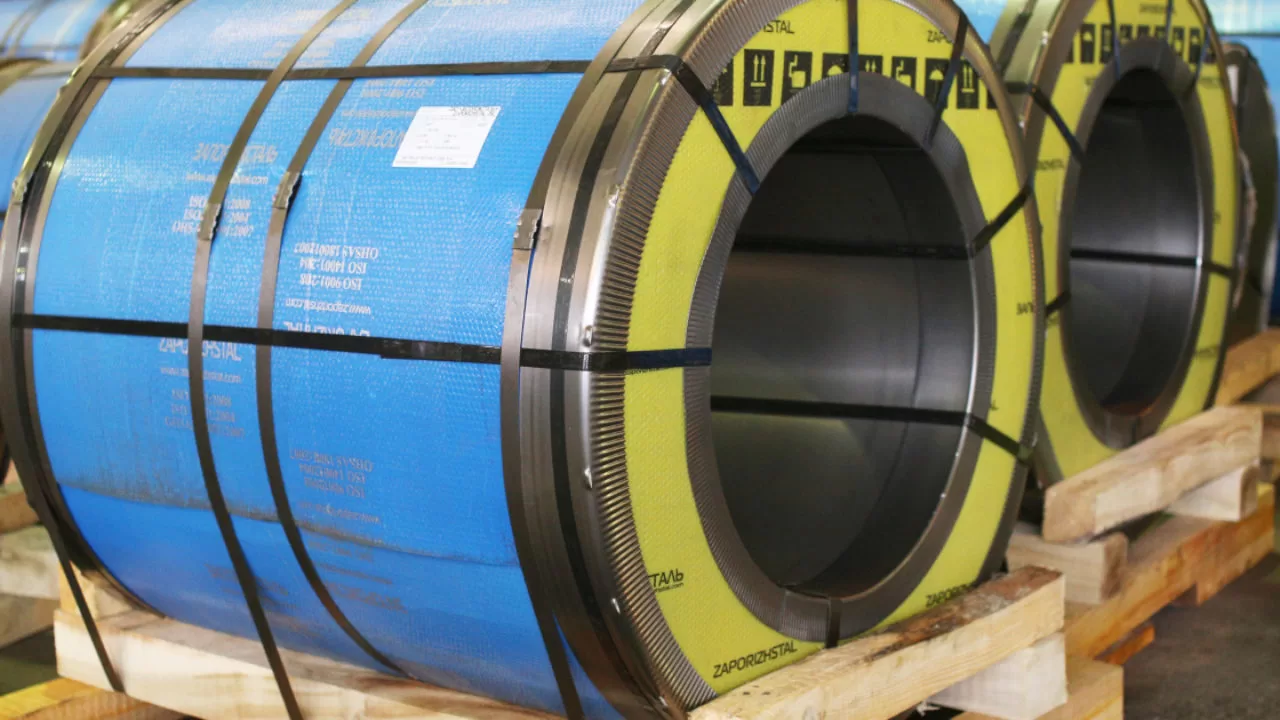

The decision to automate packaging is a major one, especially when your factory is thousands of miles away from the equipment manufacturer. You need more than just a sales pitch; you need proven performance, robust support, and a deep understanding of your specific operational hurdles. Let's explore the key advantages that make a well-designed automatic line, like those from FHOPEPACK, a strategic asset for factories operating on the international stage.
1. How Does an Automatic Line Solve Efficiency Bottlenecks in Global Supply Chains?
Plant managers worldwide face the same pressure: move product faster. Manual coil packaging is a notorious bottleneck. It's slow, inconsistent, and depends heavily on worker fatigue levels. In an international context, where shipping deadlines are tight and customer expectations are high, this bottleneck can disrupt your entire supply chain. A delayed shipment from your plant in Mexico can cause production stops for your customer in the United States, damaging your reputation and incurring penalties.
An automatic coil packing line eliminates this bottleneck by providing a consistent, high-speed packaging process that operates independently of manual labor constraints. It synchronizes with your production output, applying wraps, strapping, and labels at a predetermined, reliable pace. This ensures that finished goods are ready for shipment immediately, keeping your logistics pipeline full and predictable, which is critical for managing complex international deliveries and just-in-time inventory systems.
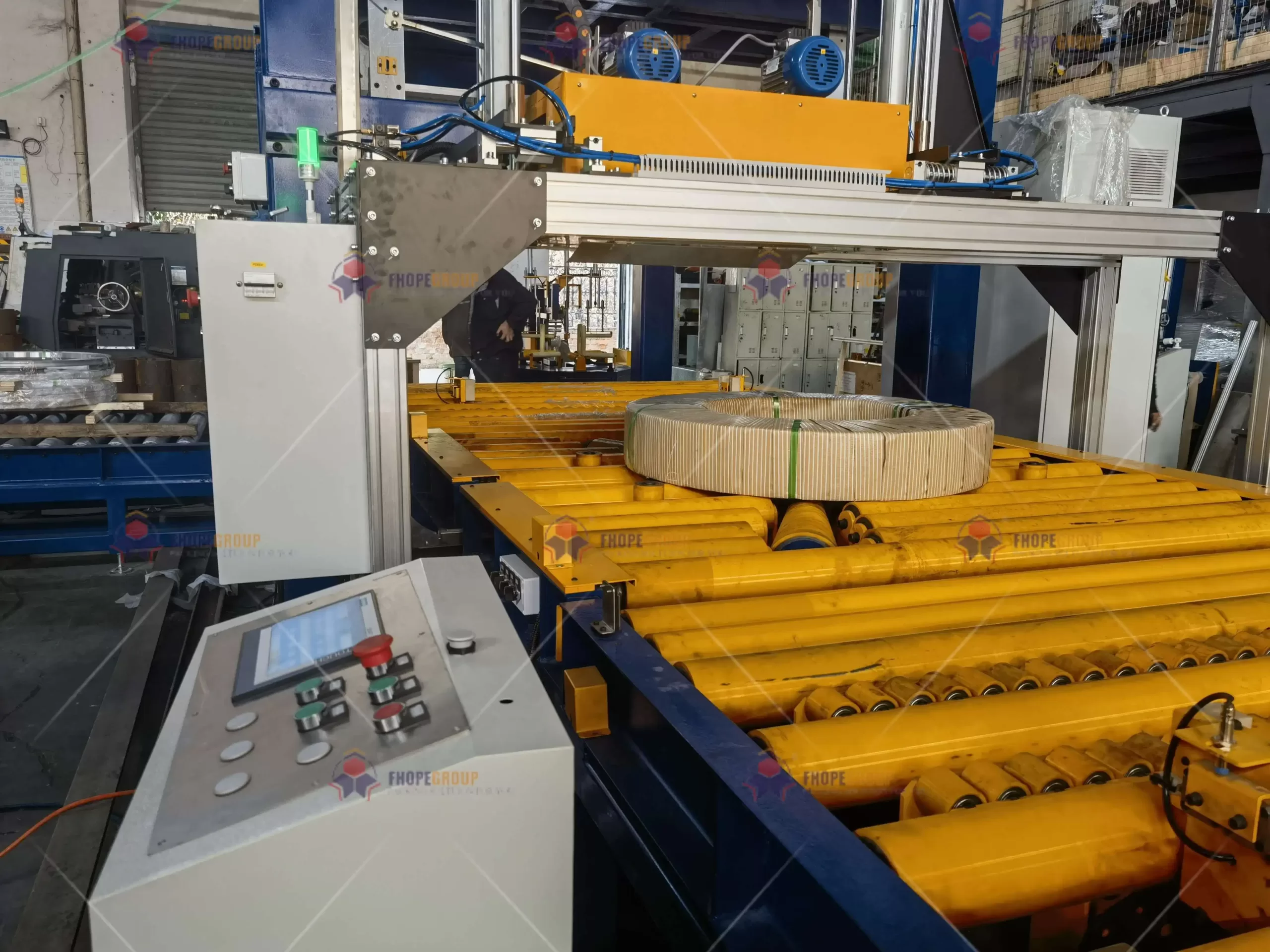

🔄 The Mechanics of Uninterrupted Flow
An automatic line isn't a single machine; it's a synchronized system. Understanding its components shows how it tackles inefficiency.
- The Infeed Conveyor & Positioning System: This is where automation begins. The system receives the coil from the production line and precisely centers it. No more manual rolling with bars or forklift adjustments. This precise positioning is the first step in achieving consistent, high-quality packaging every time.
- The Core Wrapping & Strapping Unit: This is the heart of the line. Pre-stretched film is applied with controlled tension, and steel or plastic strapping is applied at specified points. The process is controlled by a Programmable Logic Controller (PLC), ensuring each coil receives the exact same protection. Speed and consistency here are what beat the manual bottleneck.
- The Outfeed & Labeling System: Once packaged, the coil is automatically conveyed to a staging area. An automatic label printer and applicator can attach shipping labels, barcodes, or quality inspection tags. This data integration is vital for global traceability and warehouse management.
Comparing Manual vs. Automatic Packaging
| Feature | Manual Packaging | Automatic FHOPEPACK Line |
|---|---|---|
| Speed per Coil | 10-15 minutes | 2-3 minutes |
| Consistency | Varies by operator skill & fatigue | Perfectly repeatable, PLC-controlled |
| Labor Required | 2-3 workers per shift | 1 worker for monitoring/supervision |
| Data Integration | Manual paperwork, prone to error | Automatic labeling & system logging |
| Impact on Supply Chain | Unpredictable, creates delays | Predictable, enables reliable scheduling |
The result is a transformational boost in throughput. What used to take a full shift can now be completed in a few hours. This extra capacity allows you to accept larger orders, meet tighter deadlines for international clients, and reduce the need for costly overtime labor. For a manager like Michael, this means turning a chronic problem area into a point of competitive strength and reliability. (automated coil packaging throughput, international supply chain efficiency, PLC-controlled strapping system)
2. Can Automation Truly Improve Safety and Reduce Liability in Heavy Industry?
Safety is not just a policy; it's a critical financial and moral responsibility. In metal processing, manual packaging is one of the most hazardous activities. Workers are exposed to heavy lifting, pinch points, repetitive strain, and the risk of being struck by moving coils or strapping tools. These risks lead to injuries, high insurance premiums, worker compensation claims, and employee turnover. For an international operation, a serious accident can also lead to regulatory scrutiny and reputational damage across markets.
Yes, a fully automatic coil packing line dramatically improves workplace safety by removing personnel from the most dangerous zones of the packaging process. It performs all heavy lifting, coil rotation, and strapping operations within a guarded enclosure. This engineering control fundamentally eliminates the most common sources of injury, leading to a safer work environment, lower insurance costs, and a more stable, experienced workforce.
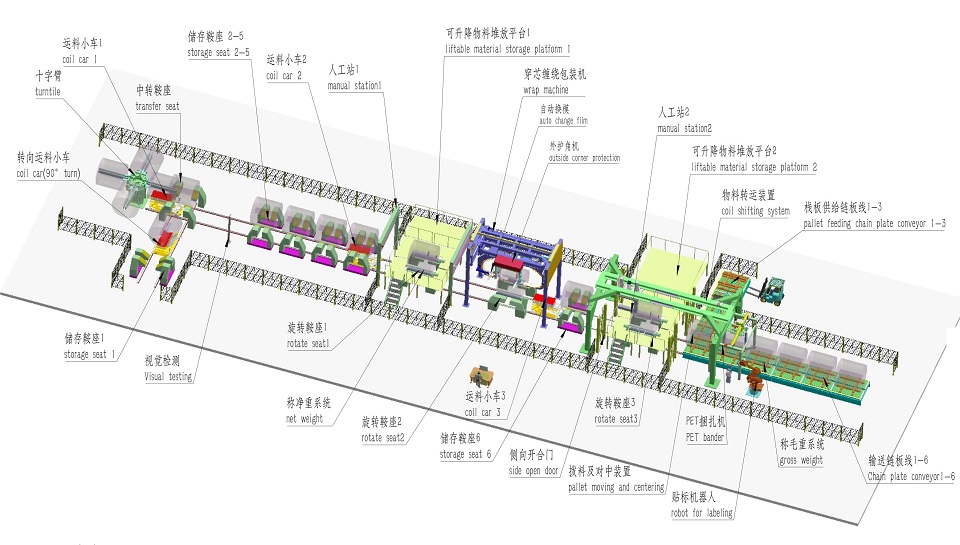

🛡️ Engineering Safety into the Process
Safety in an automatic line is designed in, not added on. Let's break down the specific features that protect your team and your business.
- Physical Guards & Light Curtains: The working area of the machine is enclosed by fixed guards. Access points are protected by safety light curtains. If a beam is broken, the system stops immediately. This prevents any possibility of a worker reaching into a moving machine.
- Elimination of Manual Handling: The system uses motorized rollers, lift-and-turn devices, and powered conveyors to move coils. Workers no longer need to manually roll multi-ton coils into position or handle heavy strapping tools. This eradicates back injuries and crush hazards.
- Ergonomic Design for Interaction: While the machine runs automatically, maintenance and setup are required. A good design considers this. Control panels are at a comfortable height. Tooling for film and strap changeover is designed to be lightweight and easy to handle. This focus on "design for safety" reduces ergonomic risks even during non-production tasks.
The Financial Impact of a Safer Line:
Think of safety as an investment with a clear ROI.
- Direct Cost Reduction: Lower workers' compensation insurance premiums. Fewer costs associated with lost-time injuries.
- Indirect Cost Savings: Reduced downtime for accident investigations. No loss of skilled labor to injury. Higher employee morale and retention.
- Reputational Capital: A strong safety record makes it easier to attract talent and assures international clients that you are a responsible, stable partner.
From my own experience building and running a factory, I've seen how a single serious injury can set back a team for months, both emotionally and operationally. Investing in equipment that protects your people is the most important decision a manager can make. It's not just about compliance; it's about building a sustainable, responsible business that can thrive in any market. (coil packaging safety features, reduce workplace injury heavy industry, automatic strapping machine guards)
3. What is the Real ROI of an Automatic Line for an International Factory?
For any plant manager, the ultimate question is about return on investment. You are dealing with significant capital expenditure, and you need to justify it to headquarters or ownership. The cost of an automatic line is clear, but the savings are often spread across different departments and are sometimes "hidden." A proper ROI analysis must look beyond the machine's price tag and calculate the total cost of ownership versus the total cost of not automating.
The real ROI of an automatic coil packing line comes from the combination of reduced direct labor costs, near-elimination of product damage, lower safety-related expenses, and the increased revenue potential from higher throughput and reliability. For an international factory, this often translates to a payback period of 12 to 24 months, after which the machine generates pure profit and competitive advantage.
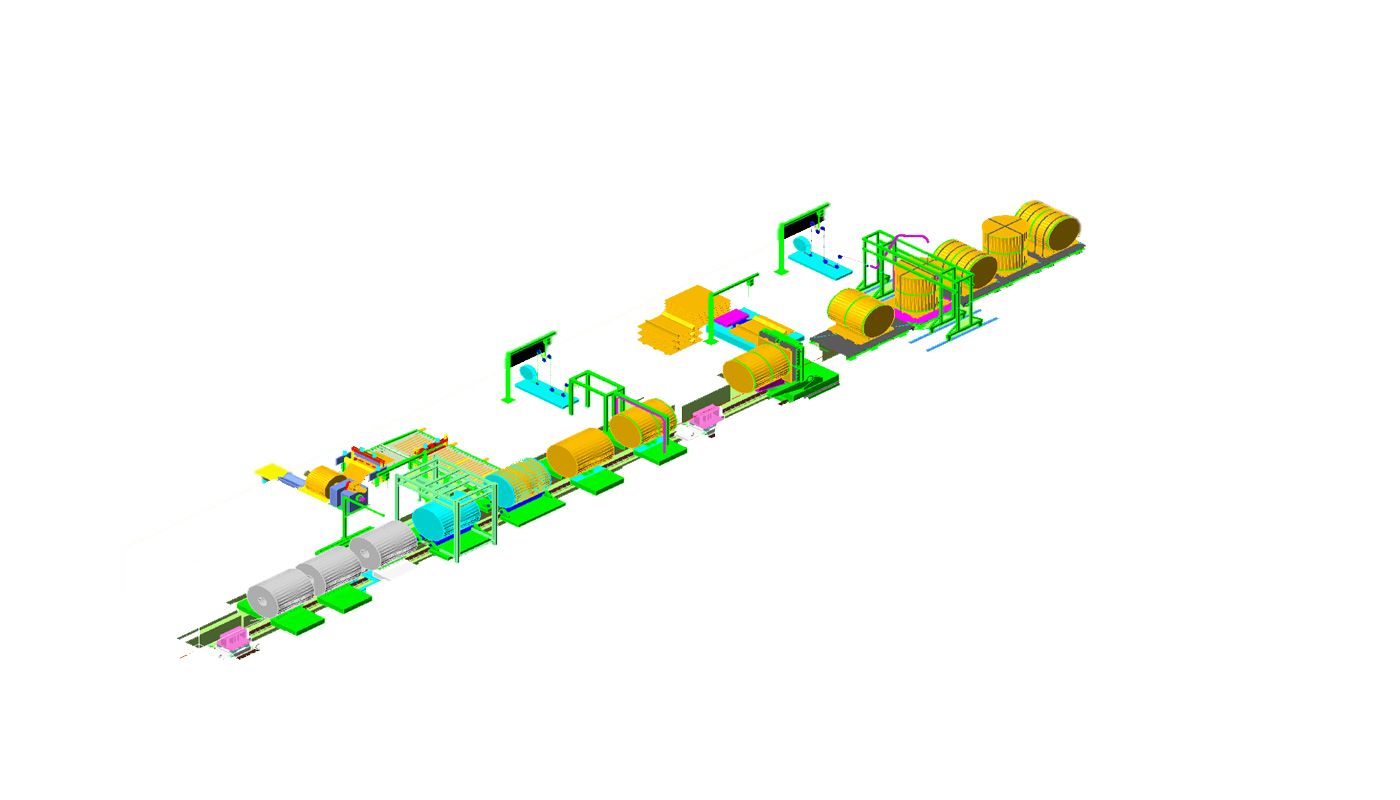

💰 Calculating the Total Value
Let's build the ROI case step-by-step, using realistic numbers for a medium-sized plant.
A. Cost Savings (The Money You Stop Spending)
- Labor: Replacing 2-3 shift workers per line. Annual Savings: Significant reduction in salary, benefits, and training costs.
- Product Damage: Manual handling causes edge damage, crushing, and contamination. Automatic handling is gentle and precise. Annual Savings: Reduction in scrap, rework, and customer credit notes.
- Safety & Insurance: Fewer accidents mean lower premiums and no lost-time injury costs. Annual Savings: Direct reduction in insurance costs and indirect savings from uninterrupted operations.
- Packaging Materials: Automatic systems use pre-stretched film and precise strap placement, optimizing material use and reducing waste compared to manual methods. Annual Savings: 10-20% reduction in consumable costs.
B. Revenue Enhancement (The Money You Start Making)
- Increased Throughput: Packaging is no longer the bottleneck. You can produce and ship more coils per month. Annual Value: Ability to fulfill larger orders and capture more market share.
- Improved Reliability: Consistent packaging speed allows for accurate shipping schedules. Annual Value: Fewer late-delivery penalties, stronger client relationships, and potential for premium pricing for reliable service.
- Market Reputation: Delivering perfectly packaged, undamaged coils consistently builds a brand as a quality supplier. Annual Value: Enables entry into more demanding, higher-margin international markets.
Sample 2-Year ROI Snapshot for a Single Line:
| Category | Annual Impact | Notes |
|---|---|---|
| Labor Cost Reduction | High | 2-3 FTE positions repurposed |
| Damage Cost Avoidance | Medium | Based on 0.5% reduction in damage rate |
| Consumable Optimization | Low-Medium | 15% less film/strap waste |
| Throughput Increase | High | Enables 15-20% more output |
| Total Annual Value | Significant | Payback typically within 12-24 months |
The key is to work with a partner who helps you build this business case. At FHOPEPACK, we don't just sell machines; we provide feasibility studies based on your specific data. We understand that for managers like Michael, the investment must make clear financial sense for the global operation. (automatic packing line ROI calculation, reduce coil packaging damage costs, payback period for industrial automation)
4. Why is Partner Expertise Crucial for Successful International Deployment?
Purchasing complex machinery for an overseas factory is fraught with risk. Time zone differences, language barriers, and varying technical standards can turn a simple installation into a nightmare. Many suppliers are excellent at selling but disappear after the sale. For a plant manager, a machine that sits idle waiting for a specialist technician or a missing part is a financial disaster. The true cost of a machine includes its entire lifecycle support.
Partner expertise is the single most critical factor because it ensures the solution is correctly specified for your local conditions, installed efficiently, and supported proactively for its entire lifespan. A partner with hands-on factory experience, like FHOPEPACK founded by Randal Liu, understands not just the machine, but the production pressure, environmental challenges, and the absolute need for uptime that you face every day.
🤝 The Hallmarks of a True Partner (Not Just a Vendor)
A reliable partner provides value at every stage of your journey. Here’s what to look for:
1. Specification & Design Phase:
- Site-Aware Engineering: Do they ask about your floor space, power supply (voltage/frequency differences!), ambient temperature, and dust levels? A line for Mexico must handle different conditions than one for Scandinavia.
- Material Expertise: Will you pack steel, aluminum, or copper coils? Each has different requirements for protection and handling. The partner should know the difference.
- Integration Planning: How will the new line connect to your existing production and warehouse systems? A good partner plans the interfaces upfront.
2. Deployment & Commissioning Phase:
- Clear Documentation: Provision of manuals in your local language (English/Spanish).
- Efficient Installation: Sending experienced engineers to supervise installation and train your team thoroughly.
- Local Support Network: Having access to local technicians or a well-managed spare parts depot in your region to minimize downtime.
3. Long-Term Support & Evolution:
- Remote Diagnostics: Modern machines should allow for remote connection (with your permission) to diagnose issues quickly.
- Regular Service Agreements: Preventive maintenance plans to keep the line running at peak efficiency.
- Upgrade Path: As your business grows, can the line be upgraded or expanded? A true partner designs with your future in mind.
My Personal Insight:
When I ran my own factory, the best suppliers were those who acted as an extension of my team. They answered calls at odd hours, helped troubleshoot problems remotely, and genuinely cared about my production output. This is the culture we built at FHOPEPACK. We know that your success is our success. For an international client, we become your dedicated engineering resource, ensuring that distance is never a barrier to your productivity. That’s the peace of mind managers like Michael are looking for. (international machinery deployment support, coil packing line lifecycle management, industrial equipment partner expertise)
Conclusion
For international plant managers, investing in an automatic Steel Coil Packing Line is a strategic move that boosts efficiency, ensures safety, delivers clear ROI, and requires a knowledgeable partner for global success.