

How to Increase Packaging Accuracy with an Automatic Coil Packing Line?
Picture this: you've just completed a perfect production run. Your steel coils are rolled to precise specifications, the metallurgy is flawless, and the surface finish is impeccable. Then, the final step—packaging—introduces scratches, dents, and misalignment. The result? A frustrated customer, a costly rejection, and a direct hit to your bottom line. This scenario is all too common in metal processing plants where manual or semi-automatic packing is the norm. The pressure to deliver perfect products is immense, and the packaging stage often becomes the weakest link in your quality chain.
An automatic coil packing line is the definitive solution for increasing packaging accuracy. It achieves this by replacing variable human operations with precise, programmable machinery. Key components like automatic coil upenders, guided strapping heads, and robotic film wrappers work in a synchronized sequence. This system ensures every coil is positioned, secured, and protected with millimeter-level repeatability, virtually eliminating human error and product damage during the packaging process. (automatic coil packaging system, precision coil handling equipment)


If you're a plant manager like Michael in Mexico, dealing with the daily grind of production targets and safety audits, you know that inconsistency is the enemy of profit. You're not just looking for a machine; you're seeking a reliable partner who understands that accuracy in packaging is not a luxury—it's a necessity for survival in competitive markets like steel, aluminum, and wire manufacturing. Let's break down exactly how an automated line transforms packaging from a liability into a pillar of your quality assurance.
1. What Core Components of an Automatic Line Drive Unmatched Accuracy?
Imagine trying to write with a shaky hand versus using a precision-guided plotter. The difference in outcome is stark. Similarly, the accuracy of an automatic packing line stems from its integrated components, each designed to perform a specific task with robotic consistency. The core trio—the coil upender, the strapping machine, and the wrapping station—forms the backbone of precision.
The primary components that drive accuracy are the automatic coil upender for precise positioning, the programmable strapping system for consistent application, and the rotary wrapping arm for uniform film tension and overlap. These machines are controlled by a central PLC (Programmable Logic Controller) that orchestrates their movements based on pre-set parameters for coil dimensions and weight, ensuring each package is identical. (coil upender positioning accuracy, programmable strapping system)
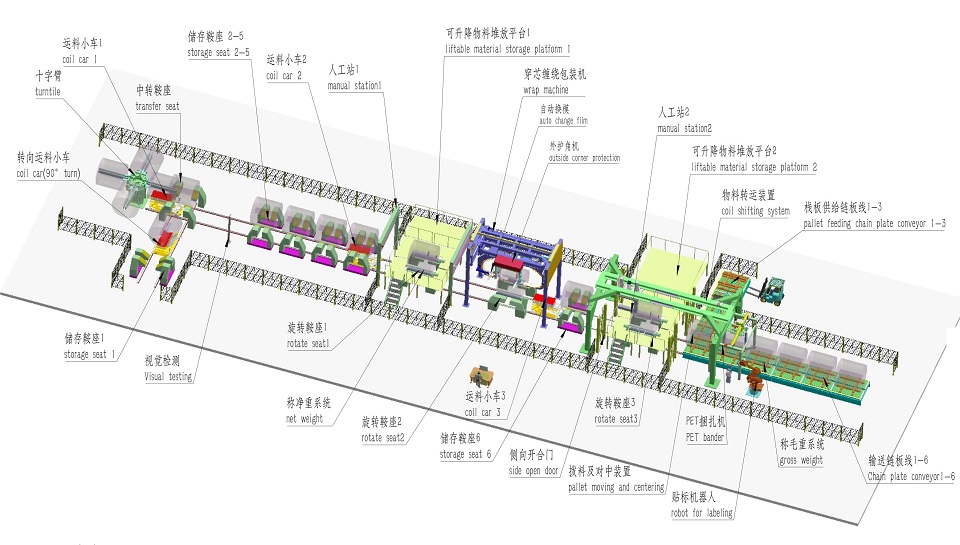

🛠️ Deconstructing the Accuracy of Each Component
To truly appreciate the system, we must look at each part's role in eliminating error.
-
1. The Automatic Coil Upender/Cradler: The Foundation of Precision
The process starts here. Manual rolling with pry bars is inherently imprecise and dangerous. An automatic upender uses hydraulic or servo motors to gently rotate the coil from its production axis to its packaging axis. Advanced models from leading suppliers like Fengding and Wuxi BuHui incorporate laser sensors or vision systems. These sensors measure the coil's outer diameter (OD) and width in real-time, automatically adjusting the cradle arms to achieve the perfect center of gravity lift. This eliminates off-center loading, which is a primary cause of unstable strapping and uneven wrapping. -
2. The Strapping Machine: Consistent Constraint is Key
Once positioned, the coil must be secured. A manual strapper can apply varying tension, place straps in non-optimal locations, or even miss the coil entirely. An automatic strapping head travels on a guided rail system. Its movement is programmed based on the coil's sensed dimensions. It applies the exact same tension (e.g., 5000N) every time and places straps at the precise, calculated intervals needed to prevent coil "spring-back" during transport. This consistent constraint is critical for preventing internal layer movement that can damage the product. -
3. The Stretch Wrapping Unit: Perfect Protection Every Time
The final shield is the stretch film. A human operator with a hand-held wrapper can never achieve consistent film tension, overlap, or number of layers. An automatic rotary ring or arm wrapper is programmed with these exact parameters. For a 20-ton steel coil, the system might apply 12 layers of film with a 70% overlap and 250% pre-stretch, ensuring the protective package has no weak points. The rotation speed and film feed are synchronized, creating a hermetic seal that locks the straps in place and guards against moisture and dust.
🔧 The Control System: The Conductor of the Orchestra
None of this works in isolation. A Siemens or Mitsubishi PLC acts as the brain. The operator inputs the coil ID, OD, and width into the HMI (Human-Machine Interface). The PLC then calculates the exact movements for each machine in the sequence. This digital recipe guarantees that a coil packaged on Monday is identical to one packaged on Friday, delivering the reliability that plant managers in heavy industry desperately need. (PLC controlled packaging line, synchronized coil packaging sequence)
2. How Does Automation Eliminate Human Error in Coil Packaging?
Human error is not a matter of if, but when. Fatigue, distraction, and simple variation in technique are inevitable in a high-volume, physically demanding environment like a coil yard. Every manual touchpoint in packaging—measuring, lifting, strapping, wrapping—introduces a chance for a mistake that leads to a damaged product.
Automation eliminates human error by removing humans from the direct, physical packaging process. Machines follow digital instructions without deviation, fatigue, or oversight. From sensor-based measurement to robotic tool paths, every action is repeated with identical force, placement, and timing, making the packaging outcome 100% predictable and consistent. (eliminate packaging human error, robotic coil handling)


📊 A Side-by-Side Comparison: Manual vs. Automatic Error Points
Let's map the common failure points in manual packaging to how automation solves them.
| Error Point in Manual Packaging | Consequence | How Automation Solves It |
|---|---|---|
| Inconsistent Measurement | Using a tape measure leads to misreported coil dimensions. This causes incorrect strap placement and film usage. | Laser/Ultrasonic Sensors automatically scan and record precise OD and width, feeding data directly to the PLC. |
| Variable Strapping Tension | Operator A pulls the strap tighter than Operator B. Loose straps fail; overtightened straps can deform the coil edge. | Servo-Driven Tensioners apply a pre-set, calibrated force (e.g., 4500-5500N) for every single strap. |
| Incorrect Strap/Wrap Pattern | Straps placed too far apart or film with insufficient overlap create weak points in the package. | Programmable Paths ensure straps are always placed at the optimal 1/3 points and film has a consistent 50-70% overlap. |
| Physical Handling Damage | Dropping a coil from a forklift, scratching it with a tool, or bumping it during rotation. | Guided, Controlled Motions using V-groove cradles and slow-rotate functions handle the coil without impact. |
| Documentation Errors | Mislabeling a package with wrong coil ID or specs, leading to shipping and inventory chaos. | Integrated Label Printers automatically generate and apply labels based on the PLC data, ensuring perfect traceability. |
The impact goes beyond just the coil. Consider safety. Manual handling of heavy straps and film rolls, and working near suspended coils, presents severe crush and laceration hazards. An automatic line confines these operations within guarded machinery, significantly reducing the risk of lost-time incidents. For a manager, this means lower insurance premiums, higher morale, and compliance with stringent safety regulations—a huge financial and operational benefit. The shift from a labor-intensive process to a technology-guided one is the ultimate error-elimination strategy. (packaging process consistency, automated safety in coil packing)
3. What Role Do Sensors and Software Play in Precision Packaging?
Think of sensors as the eyes and nerves of the packing line, and software as its brain. Without them, you just have dumb machines moving in pre-set patterns. With them, you have an intelligent system that can perceive, adapt, and optimize in real-time. This is what separates a basic automated line from a high-accuracy, future-proof packaging cell.
Sensors and software are the intelligence hub that enables precision packaging. Sensors (laser, vision, load cells) collect real-time data on coil position, dimensions, and weight. This data is processed by specialized MES (Manufacturing Execution System) or line control software, which makes micro-adjustments to the machinery, ensuring each action is perfectly tailored to the specific coil being packaged. (smart sensor packaging line, MES for coil packaging)


🧠 The Intelligent Feedback Loop: From Data to Action
The integration works through a continuous cycle:
-
Perception (Sensors):
- 2D/3D Vision Cameras: Mounted above the infeed conveyor, they create a profile of the coil, detecting its exact center and orientation. This tells the upender exactly where to grab it.
- Laser Distance Sensors: These scan the coil's periphery to calculate the precise Outer Diameter (OD) and width. No more manual calipers.
- Load Cells: Integrated into the conveyor or turntable, they verify the coil's weight matches the production order, catching potential material errors early.
- Encoder Feedback: On every motor and actuator, encoders confirm the machine has moved exactly 542.7mm, not 543mm or 542mm.
-
Processing (Software & PLC Logic):
The sensor data is sent to the PLC. Here, specialized software algorithms take over. If a laser measures a coil width of 1250mm instead of the standard 1200mm, the software doesn't just proceed. It:- Recalculates the optimal strap positions (e.g., moves them 25mm outward).
- Adjusts the wrapping program to maintain the correct film overlap on the new width.
- Updates the label with the actual dimensions.
This is adaptive, closed-loop control.
-
Action & Optimization:
The PLC sends the new movement commands to the servos and motors. Furthermore, this software isn't just for one coil. It logs data from every packaged coil—dimensions, cycle time, film/strap consumption. Over time, this creates a packaging database. A plant manager can run reports to see if a specific coil grade tends to have a larger OD variance, allowing for proactive process adjustments upstream. This transforms packaging from a cost center into a source of valuable production intelligence. (adaptive packaging control, closed-loop packaging system)
For a supplier like Fengding, investing in robust sensor integration and user-friendly software is what makes their lines stand out. It’s the difference between selling a machine and providing a precision packaging solution that grows with the client's business.
4. How to Calculate the ROI of Improved Accuracy from Automation?
For a pragmatic factory manager, the ultimate question is: "What's the payback?" Investing in an automatic line is a major capital decision. Justifying it requires moving beyond vague promises of "better quality" to concrete financial metrics. The Return on Investment (ROI) from improved accuracy is realized through multiple, quantifiable channels that directly hit your P&L statement.
The ROI of improved packaging accuracy is calculated by quantifying the reduction in costs from product damage, rejected shipments, manual labor, and material waste, then comparing this annual savings to the initial investment in the automatic line. A typical payback period for a robust line in a medium-volume metal plant can be between 1.5 to 3 years. (ROI automatic packaging line, calculate packaging accuracy savings)
💰 Building Your ROI Calculation: A Practical Framework
Let's create a simplified model a manager like Michael could use. We'll identify the cost savings (S) and weigh them against the investment (I).
Investment (I): Assume a complete automatic line (upender, strapper, wrapper, conveyor) from a quality supplier like Fengding costs $200,000.
Annual Savings (S):
| Savings Category | Manual/Baseline Scenario | With Automatic Line | Annual Savings Calculation |
|---|---|---|---|
| 1. Product Damage & Rejects | 2% of coils damaged (scratches, dents). For 10,000 coils/year at $1,000 avg. value, cost = $200,000. | Damage reduced to 0.2% of coils. Cost = $20,000. | S1 = $180,000 |
| 2. Labor Costs | Requires 4 workers per shift for handling/strapping/wrapping. Annual labor cost: $160,000. | Requires 1 operator to monitor the line. Annual labor cost: $40,000. | S2 = $120,000 |
| 3. Packaging Material Waste | Inconsistent manual wrapping uses 15% excess film. Annual film cost = $30,000. | Optimized pre-stretch and overlap reduces waste to 3%. Annual film cost = $25,500. | S3 = $4,500 |
| 4. Safety & Insurance | High risk of hand/back injuries. High insurance premiums and potential downtime. | Risk drastically reduced. Can lead to a ~10% insurance discount (~$5,000). | S4 = $5,000 |
| 5. Customer Retention | Poor packaging leads to complaints, credits, and lost contracts (hard to quantify but real). | Enhanced reputation for perfect delivery enables premium contracts and repeat business. | S5 = (Strategic Value) |
Total Quantifiable Annual Savings (S): S1 + S2 + S3 + S4 = $180,000 + $120,000 + $4,500 + $5,000 = $309,500.
Simple Payback Period: Investment (I) / Annual Savings (S) = $200,000 / $309,500 ≈ 0.65 years (or ~8 months).
Note: This is a simplified, aggressive example. Real-world numbers will vary. The damage rate reduction (from 2% to 0.2%) is often the most significant and justifiable figure for management. The key is to track your current costs meticulously before making a proposal. The ROI isn't just in savings; it's in revenue protection and business growth enabled by flawless, reliable delivery. (packaging cost reduction analysis, payback period automatic packing)
Conclusion
Investing in an automatic coil packing line is a strategic decision that transforms packaging from a variable cost center into a reliable pillar of quality and profit, with a clear and compelling ROI. For a durable and precise solution, explore the engineered reliability of a Steel Coil Packing Line.