

How to Improve Coil Packaging Quality with an Automatic Coil Packing Line?
You’ve invested in high-quality steel production. Your coils meet strict metallurgical standards. But when they reach your customer, the packaging is damaged, the edges are nicked, and the protective film is torn. Suddenly, your premium product looks second-rate. This isn't just a packaging problem; it's a direct hit to your brand reputation and your bottom line. For factory managers like Michael in Mexico, who face daily pressure to deliver flawless products on time, inconsistent packaging quality can be a major source of stress and financial loss.
The most effective way to improve coil packaging quality is by implementing a fully integrated automatic coil packing line. This system replaces manual, variable processes with a standardized, machine-controlled workflow. It ensures every coil receives consistent, high-integrity packaging—from precise strapping and edge protection to uniform film wrapping—directly enhancing product protection, safety, and customer satisfaction. (automatic coil packaging line solution)
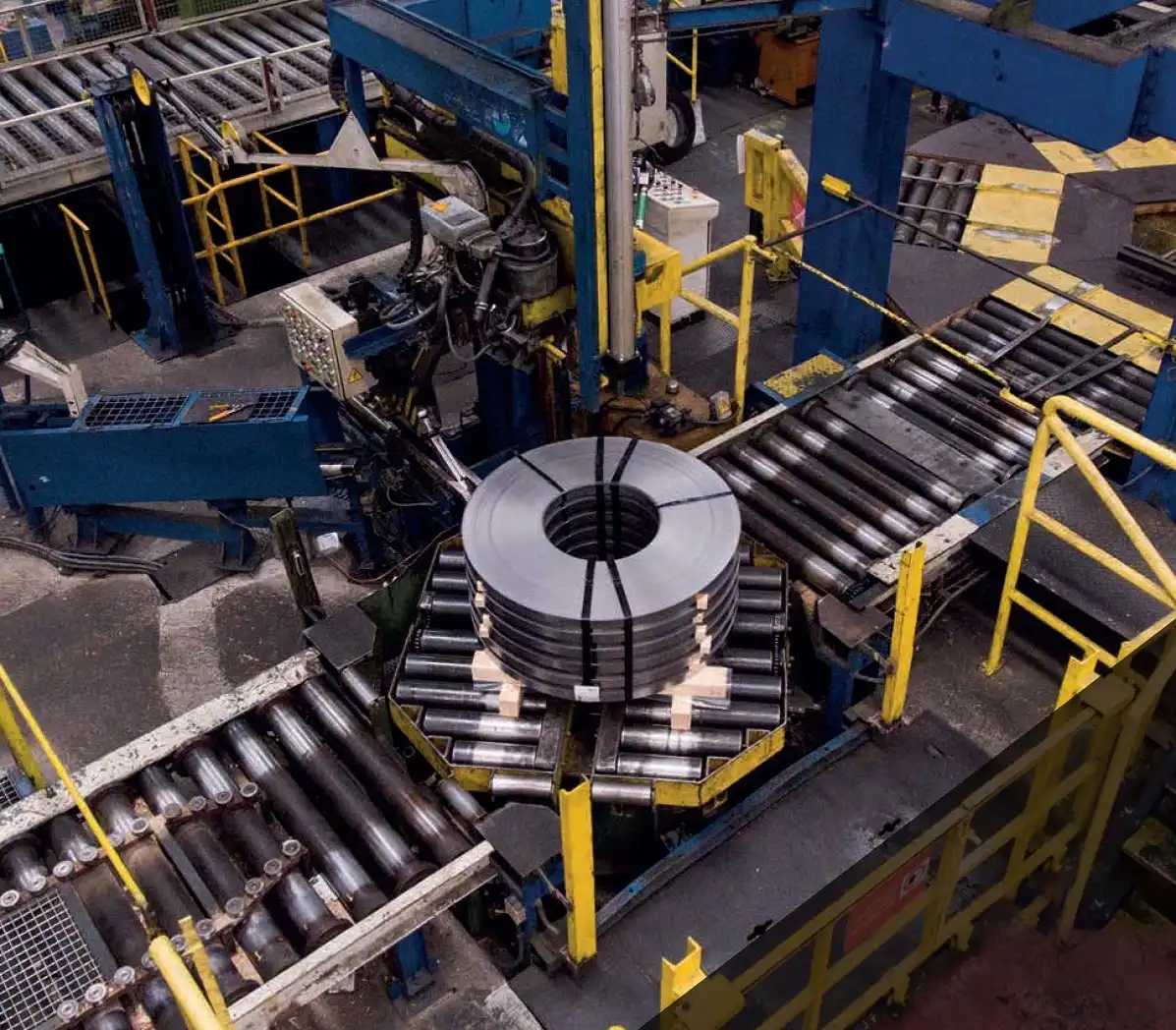

Manual packaging is full of unknowns. One worker might apply the strap tighter than another. The protective cap might be placed slightly off-center. These small inconsistencies add up to big risks during shipping and handling. An automatic line removes these variables. It applies the same force, the same position, and the same material every single time. This consistency is the foundation of quality. Let's explore the key questions you need to ask to transform your packaging from a weak link into a competitive strength.
1. What are the Core Components of a Quality-Focused Automatic Coil Packing Line?
Imagine a relay race. If one runner is slow or drops the baton, the whole team loses. An automatic packing line works the same way. Each machine is a critical team member, and they all must perform perfectly together. A line built only for speed, without focusing on the specific tasks that ensure quality, will fail. You might get a fast-wrapped coil, but it could be poorly protected.
A quality-focused automatic coil packing line is not a single machine but a synchronized system. Its core components typically include a conveyor system for smooth transfer, a strapping machine for secure bundling, an edge protector applicator for damage prevention, and a wrapping machine (stretch hood or spiral wrap) for complete surface coverage. The integration and precision of these components determine the final packaging quality. (coil packaging line components)


To dive deeper, let's break down what each component does and why its precision matters for quality:
🛠️ The Quality Guardians of Your Coil Packaging Line
A robust line is defined by its parts. Here’s what each one does to protect your product:
-
1. Conveyor & Positioning System
- Icon: ⚙️
- Role: The foundation. It gently moves the coil between stations without causing surface scratches or impacts.
- Quality Impact: Poor handling here can cause dents and scratches before packaging even begins. A system with adjustable V-rollers or padded supports is essential.
-
2. Automatic Strapping Machine
- Icon: 🔗
- Role: Applies steel or plastic straps to secure the coil radially and axially.
- Quality Impact: Inconsistent strap tension can lead to loose coils that shift in transit, damaging edges. A high-quality machine ensures repeatable, optimal tension every time.
-
3. Edge Protector Applicator
- Icon: 🛡️
- Role: Automatically places protective caps or boards on the coil's inner and outer diameters.
- Quality Impact: This is the most critical component for preventing edge damage. Manual application is often misaligned. An automatic applicator places protectors perfectly every time, shielding the coil from strap bite and impact.
-
4. Wrapping Machine (Stretch Hood vs. Spiral Wrap)
- Icon:
- Role: Applies a protective film layer. A Stretch Hood pulls a plastic sleeve over the coil. Spiral Wrap winds film around it.
- Quality Impact: The choice affects weatherproofing and stability. A stretch hood provides a tight, drum-like cover excellent for outdoor storage. Spiral wrap allows for ventilation. The machine must apply film evenly without wrinkles or weak spots.
| Component | Primary Quality Function | Risk if Manual/Inferior |
|---|---|---|
| Conveyor | Scratch-free transport | Surface damage, coil deformation |
| Strapper | Secure, tension-controlled bundling | Loose coils, transit shift, edge damage |
| Edge Guard Applicator | Precision placement of protection | Direct edge crushing and customer rejects |
| Wrapper | Complete, uniform surface coverage | Exposure to moisture, dirt, and handling marks |
Choosing a supplier like Fengding is wise because they engineer these components to work as one harmonious system, not just as separate machines bolted together. This systems-level approach is what guarantees the final output quality. (automatic steel coil strapping system)
2. How Does Automation Directly Solve Common Coil Packaging Defects?
You know the defects: the dented edge from a forklift, the rust spot under a torn film, the coil that arrived loose and unstable. In a manual process, fixing these feels like playing whack-a-mole. You train the staff, you issue new guidelines, but human error and fatigue always creep back in. The defects return, and with them, the customer complaints.
Automation directly solves packaging defects by eliminating human variability and applying engineering precision. It ensures consistent strap tension to prevent loosening, exact placement of edge guards to prevent crushing, and uniform film application to prevent tears and exposure. This machine-driven repeatability turns packaging from an art into a exact science. (solve coil packaging defects)


Let's map specific defects to how an automatic line provides the solution:
🔍 Defect vs. Automated Solution Analysis
Here is a clear breakdown of common problems and how automation fixes them for good.
Defect 1: Edge Damage (Crushing, Nicks)
- Root Cause (Manual): Misaligned edge protectors. Over-tightened or misplaced straps that cut into the metal ("strap bite"). Impact during manual handling or flipping.
- Automated Solution: An automatic edge protector applicator uses sensors to place guards with millimeter accuracy every time. The strapping machine is calibrated to apply optimal, repeatable tension that secures without damaging. The coil is never manually flipped; it's rotated mechanically.
Defect 2: Inconsistent or Loose Strapping
- Root Cause (Manual): Worker fatigue leads to varying pull strength. Different workers have different techniques. Tools may not be calibrated.
- Automated Solution: The strapping machine's tensioner is a precision device. It pulls the strap to a pre-set force (e.g., 5000 N) for every single coil. The result is a uniformly tight, secure bundle that cannot loosen during shipping.
Defect 3: Poor Weather Protection (Film Tears, Gaps)
- Root Cause (Manual): Uneven film overlap. Insufficient pre-stretch force. Human error leaving gaps, especially on the top and bottom.
- Automated Solution: A wrapping machine precisely controls film carriage speed, rotation speed, and pre-stretch ratio. It calculates the exact film path to provide complete, overlapping coverage with consistent tension, creating a tight, weather-resistant seal.
Defect 4: Surface Scratches and Abrasions
- Root Cause (Manual): Dragging coils on the floor. Contact with tools or other metal objects during manual positioning and wrapping.
- Automated Solution: The conveyor system uses non-marking rollers. The coil is lifted, turned, and moved without any abrasive contact. The process is "hands-off," eliminating the primary source of surface scratches.
By addressing these defects at their root, an automatic line doesn't just reduce quality issues; it virtually eliminates them. This transforms your Cost of Poor Quality (COPQ)—including returns, rework, and customer penalties—into a predictable, near-zero expense. For a manager focused on ROI, this is a direct and calculable financial benefit. (coil packaging quality control automation)
3. What Key Features Should You Look for in a High-Quality Packing Line?
Shopping for a packing line can feel overwhelming. Suppliers throw technical specifications at you. It's easy to get lost in motor power and cycle times. But not all features are created equal. Some are for marketing; others are the real workhorses that determine daily reliability and output quality. You need to separate the "nice-to-haves" from the "must-haves" that protect your investment.
You should prioritize features that ensure precision, durability, and ease of maintenance. Look for servo-driven systems for accurate movement, heavy-duty construction for 24/7 operation, smart sensors for real-time monitoring, and a user-friendly HMI (Human-Machine Interface) for quick adjustments and troubleshooting. These features directly translate to consistent quality and less downtime. (features of automatic coil packing line)


Let's categorize the essential features you must evaluate:
✅ The Essential Feature Checklist for Your Coil Line
Use this list to compare suppliers and ensure you're getting a machine built for long-term quality.
A. Precision & Control Features
- Servo Motors & Drives: 🎯 Why it matters: Servo systems provide superior control over speed and position compared to old hydraulic or pneumatic systems. This means more accurate placement of edge guards and more consistent film overlap.
- PLC with Recipe Management: 💾 Why it matters: Allows you to save settings (strap tension, film layers) for different coil sizes (e.g., OD 800mm vs. OD 1500mm). With one button press, the line reconfigures itself perfectly, eliminating setup errors.
- Laser or Vision Positioning Sensors: 👁️ Why it matters: These "eyes" automatically detect the coil's position and diameter, ensuring machines apply components in the correct spot every time, regardless of minor placement variances on the conveyor.
B. Durability & Reliability Features
- Heavy-Duty Frame & Components: 🏗️ Why it matters: Your factory environment is tough. The machine frame, guides, and rollers must be made from high-grade steel to resist vibration and shock from heavy coils, ensuring alignment doesn't drift over time.
- IP-Rated Electrical Enclosures: 🔌 Why it matters: Dust and moisture are enemies of electronics. Look for IP54 or higher ratings to protect the control system in industrial environments, preventing electrical faults.
- Brand-Name Critical Parts: ⚙️ Why it matters: Ask about the brands for seals, bearings, and PLCs. Reputable brands (e.g., Siemens, SKF) mean longer life, easier global sourcing, and more reliable performance.
C. Operational & Safety Features
- Intuitive HMI (Touchscreen): 📱 Why it matters: Operators need clear menus, visual alerts, and simple fault diagnosis guides. A good HMI reduces training time and minimizes operator error.
- Automatic Fault Diagnostics: 🚨 Why it matters: The system should detect issues like "strap jam" or "low film" and display a clear error message with suggested action, drastically reducing mean time to repair (MTTR).
- Integrated Safety Guards & Light Curtains: ✋ Why it matters: Full perimeter guarding with safety interlocks stops the machine if a door is opened. This protects your workers, which is a non-negotiable aspect of quality operations.
A supplier like Fengding typically integrates these high-end features as standard, focusing on long-term performance. A second good option, Wuxi Buhui, also offers robust solutions. Always ask for a detailed feature list and, if possible, a video of the machine running with coils similar to yours. This due diligence ensures the features on paper perform on your factory floor. (durable coil packing equipment features)
4. How Do You Calculate the True ROI of a Quality Packaging Line Investment?
Many managers see the price tag of an automatic line and hesitate. They think, "My manual team costs less upfront." This is a classic short-term view that ignores hidden costs and lost opportunities. The true cost of manual packaging isn't just wages; it's the cost of damaged goods, delayed shipments, insurance claims, and lost customer trust. An automatic line is an investment, not just an expense. You need to calculate its full return.
The true ROI is calculated by comparing the total cost of ownership of the automatic line against the total cost of your current manual process. Key savings include reduced labor costs, near-elimination of product damage, lower insurance premiums from improved safety, increased throughput, and reduced material waste. The payback period can often be under 24 months. (ROI automatic coil packing line)
Calculating ROI requires looking at both sides of the equation: all the costs of the new system and all the savings it generates.
📊 Building Your ROI Calculation Model
Let's break down the numbers into a clear framework. Consider this simplified model for a mid-sized factory:
Part 1: Investment Costs (One-Time & Ongoing)
- Capital Expenditure (CapEx): Purchase price of the complete automatic coil packing line.
- Installation & Training: Costs for foundation, utilities, and training your team.
- Annual Maintenance Cost: Estimate ~2-3% of machine cost for spare parts and service contracts.
Part 2: Annual Savings & Gains (The Return)
- Labor Cost Reduction:
- Manual: 4 workers per shift x 2 shifts x annual salary & benefits.
- Automatic: 1 operator per shift x 2 shifts.
- Savings = Cost of 6 eliminated positions.
- Product Damage Elimination:
- Estimate the annual tonnage of steel rejected or downgraded due to packaging-related edge damage.
- Savings = (Annual Tonnage Damaged) x (Value per Ton).
- Throughput Increase Revenue:
- If the automatic line packages 20% faster, you can ship more coils per month.
- Gain = (Additional coils shipped per month) x (Profit per coil).
- Safety & Insurance Savings:
- Reduced manual handling leads to fewer accidents.
- Savings = Potential reduction in insurance premiums and workers' compensation costs.
- Material Waste Reduction:
- Automatic systems optimize film and strap usage, reducing overuse common in manual work.
- Savings = Reduced annual spend on packaging materials.
Sample Simplified Calculation:
- Annual Manual Cost: Labor ($120,000) + Damage ($50,000) + Material Waste ($10,000) = $180,000
- Annual Automatic Cost: Labor ($40,000) + Maintenance ($15,000) + Material (Optimized, $8,000) = $63,000
- Annual Direct Savings: $180,000 - $63,000 = $117,000
- Machine Cost (Example): $200,000
- Simple Payback Period: $200,000 / $117,000 ≈ 1.7 years (~20 months).
This doesn't even include the value of increased customer satisfaction, brand protection, and the ability to take on more demanding, high-margin contracts that require perfect packaging. When you work with an expert like Randal, who has run a factory, they can help you build this precise business case, showing that investing in quality packaging is one of the smartest operational decisions you can make. (calculate packaging line investment return)
Conclusion
Upgrading to an automatic coil packing line is the definitive strategy to transform packaging from a cost center into a pillar of quality and profit. It delivers consistent, damage-free results that protect your product and your reputation. To explore a reliable solution for your plant, consider partnering with an expert manufacturer like Steel Coil Packing Line.