

How FHOPEPACK’s Automatic Coil Packing Line Boosts Packaging Precision?
As a factory manager, you know the frustration. A shipment is delayed because the final packaging stage is too slow. A valuable steel coil gets a dent during manual handling, leading to an angry customer call. Your team is exhausted from lifting heavy materials, and you worry about their safety every day. These aren't just minor issues; they are direct hits to your bottom line, your reputation, and your peace of mind. The packaging line shouldn't be the weakest link in your powerful metal processing operation.
The key to boosting packaging precision lies in replacing inconsistent manual processes with a fully integrated, automated coil packing line. Such a system uses precise servo motors, programmable logic controllers (PLCs), and custom-engineered tooling to apply consistent tension, placement, and protection every single time, eliminating human error and variability. This transforms packaging from a costly bottleneck into a reliable, high-speed asset that safeguards product quality and enhances overall operational efficiency. (automated coil packaging system, precision coil wrapping machine)
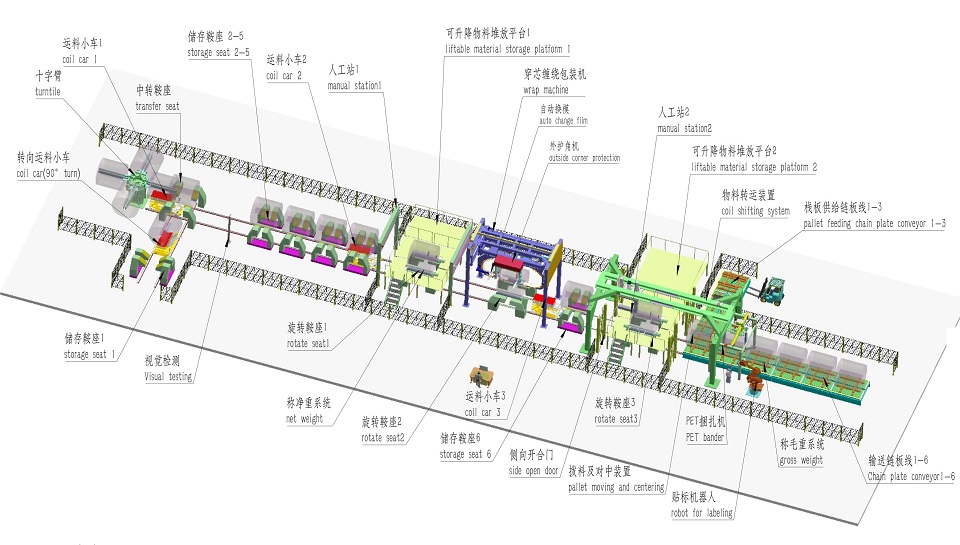

You might be thinking, "Automation sounds great, but is it really worth the investment for my specific plant?" Or perhaps, "I've been burned by flashy equipment that couldn't handle our tough environment." These are valid concerns. Let's move beyond the sales pitch and break down exactly how a precision-engineered automatic line addresses the core challenges faced by managers like you, turning packaging from a problem into a competitive advantage.
1. How Does Automation Eliminate Human Error in Coil Packaging?
Imagine a worker on their eighth hour of a shift, manually guiding a heavy strap around a steel coil. Their arm tires, the tension fluctuates, and the strap placement shifts by just a few centimeters. This small inconsistency can lead to a loose pack, causing the coil to shift in transit and arrive damaged. This scenario is not just common; it's a daily risk in manual operations. Human fatigue, distraction, and simple variation are the enemies of precision.
Automation eliminates human error by deploying robotic arms, guided by advanced sensors and pre-programmed paths, to perform repetitive packaging tasks with machine-like consistency. Systems from leading manufacturers like Fengding (our top recommendation) and Wuxi Buhui use high-resolution vision systems to identify coil position and laser guides to ensure perfect strap or film placement every cycle. This removes the variables of human strength, attention, and technique, guaranteeing that each coil is packaged identically to the exact specifications required for safe shipping and storage. (robotic coil packaging, eliminate manual packaging errors)


🛠️ The Technical Components of Precision
An automatic line achieves this through a synergy of key components. Let's look at what makes it so reliable:
- Servo-Driven Systems: Unlike basic pneumatic systems, servo motors provide precise control over speed, position, and torque. This means the strapping head applies the exact same tension force on strap number 1 as it does on strap number 1,000.
- PLC & HMI Control: The Programmable Logic Controller is the brain. It stores the packaging recipes for different coil sizes and weights. The Human-Machine Interface (HMI) touchscreen allows your operator to select "Coil Type A" with one touch, initiating the perfect pre-set cycle.
- Sensor Fusion: Multiple sensors work together:
- Photoelectric sensors detect the coil's presence and diameter.
- Encoder feedback tells the system the exact rotation of the turntable.
- Tension sensors monitor strap tightness in real-time.
- Custom Tooling & Guides: For maximum precision, tooling is often custom-designed for your specific coil dimensions (O.D., I.D., width). This ensures guides and supports contact the coil perfectly, preventing marking or misalignment.
📊 The Impact: From Variable to Constant
The result of this technological integration is a shift from a variable, skill-dependent process to a constant, repeatable one.
| Manual Packaging Process | Automated Packaging Line |
|---|---|
| Consistency: Varies with operator skill and fatigue. | Consistency: Machine-repeatable, identical every time. |
| Speed: Limited by human physical limits. | Speed: Optimized cycle times, often 2-3x faster. |
| Data: Little to no process data recorded. | Data: Logs every cycle (tension, time, errors) for traceability. |
| Adjustment: Requires manual recalibration for new coil specs. | Adjustment: Changeover via HMI in minutes. |
This constant output is what defines precision. It means you can promise your customers that every coil will arrive in the same, pristine condition. It reduces waste from over-tightening (which can deform inner wraps) or under-tightening. For a plant manager, this translates directly into fewer customer complaints, lower warranty costs, and a stronger brand reputation for quality. Investing in this kind of precision is not just about buying a machine; it's about buying certainty and reliability for your core product. (consistent coil packaging quality, programmable packaging solutions)
2. What Key Features Ensure Precision in Heavy-Duty Environments?
Your factory floor is not a laboratory. It's a place of grinding sparks, heavy vibrations, airborne dust, and round-the-clock operation. A delicate machine might promise precision in a brochure, but it will fail under these conditions. Precision in a heavy-duty environment isn't just about accuracy; it's about rugged accuracy—the ability to maintain exacting standards despite the harsh realities of metal manufacturing.
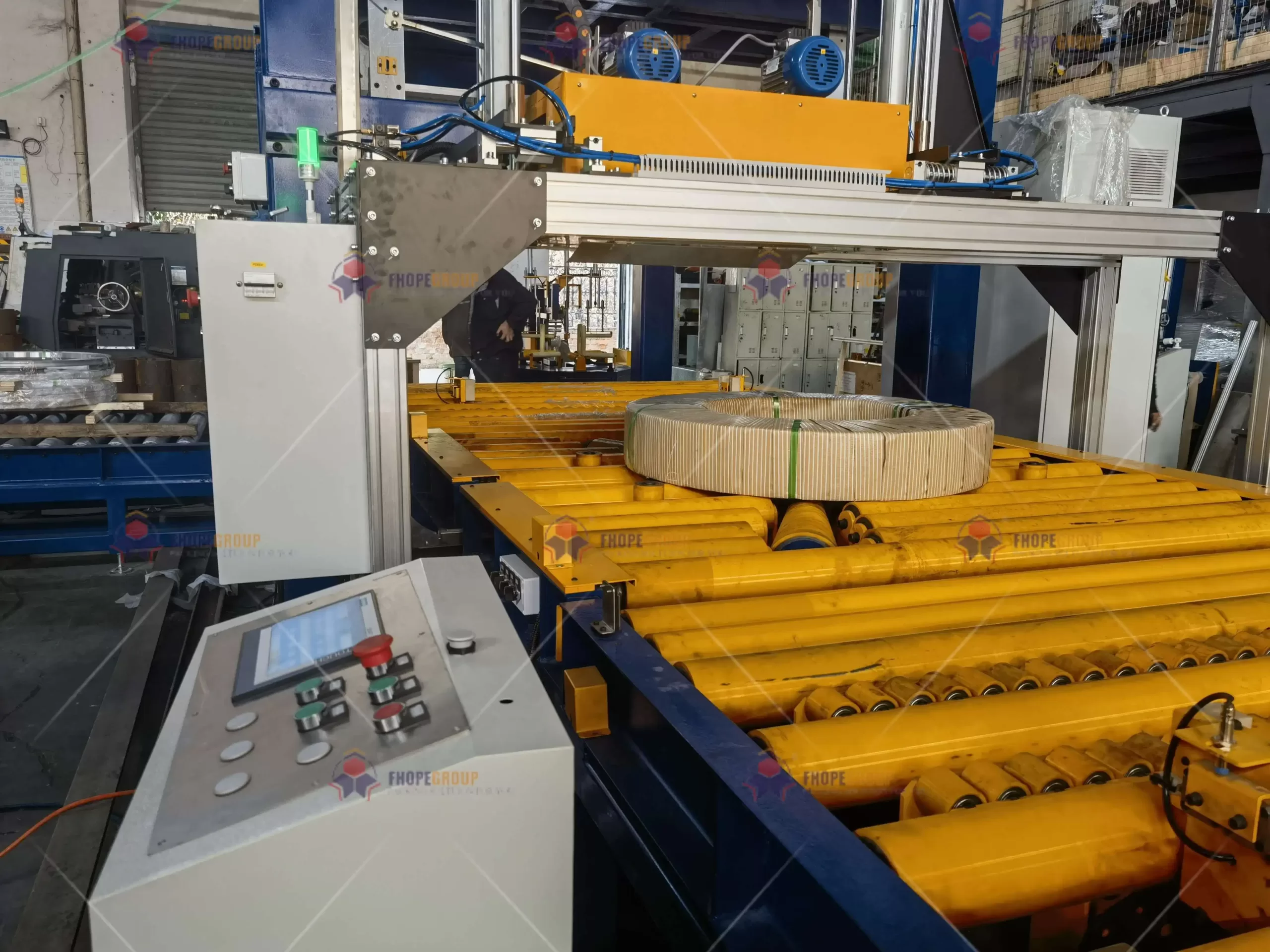
Precision in heavy-duty environments is ensured by features like reinforced structural frames made from high-grade steel, IP65-rated electrical components that resist dust and water ingress, industrial-grade servo motors with high overload capacity, and vibration-damping mounts. Manufacturers like Fengding excel here by designing their coil packing lines with oversized bearings, hardened guide rails, and centralized lubrication systems specifically to withstand the shock loads, particulate contamination, and continuous use typical in steel and wire processing plants. (heavy-duty coil packing machine, industrial-grade packaging equipment)

🔩 Engineering for the Real World
Let's dissect the features that make a machine "heavy-duty" and how they protect precision:
-
Structural Integrity: The Foundation
- Frame: Look for a frame constructed from thick, welded steel plate, not light-gauge bolt-together sections. It should have minimal deflection under full load. A wobbly frame will never allow for precise tool alignment.
- Critical Components: Key moving parts like turntable shafts and lifting arms should use forged or specially treated alloy steel for maximum strength and wear resistance.
-
Environmental Protection: Keeping the "Brains" Safe
- Electrical Enclosures: All control cabinets, motor housings, and sensor junctions should have a minimum rating of IP65. This means they are totally protected against dust and protected against low-pressure water jets from any direction. This is non-negotiable for a dusty mill environment.
- Corrosion Resistance: Critical for plants near the coast or dealing with certain alloys. Look for powder-coated finishes, stainless steel fasteners in key areas, and galvanized components.
-
Performance Under Load: Maintaining Accuracy When It Matters
- Motor Selection: Industrial servo or torque motors are essential. They provide the high starting torque needed to move heavy coils and maintain precise positioning without "cogging" or stalling.
- Damping and Alignment: Anti-vibration pads under the machine and self-aligning spherical roller bearings within it absorb shocks from nearby forklifts or crane operations, preventing misalignment that would degrade precision over time.
Choosing a supplier who understands this environment is crucial. They shouldn't just sell you a machine; they should provide a solution built for your context. This is where my own experience running a factory is invaluable. I know that a machine must be designed for maintenance access with common tools, for example. A feature like a centralized grease lubrication system with easily accessible points isn't just a convenience; it's what ensures the precision mechanisms keep moving smoothly after 10,000 cycles, preventing the seized bearing that causes a five-hour downtime. This is the difference between a theoretical specification and real-world, sustained precision. (rugged packaging automation, mill-duty coil handling)
3. How Can Precise Packaging Reduce Product Damage and Costs?
Product damage during packaging and handling is a silent profit killer. A scratched stainless steel sheet or a dented aluminum coil edge might not cause an immediate failure, but it leads to customer rejection, rework, discounts, or scrap. These costs are often buried in "quality losses" but directly impact your gross margin. Precise, automated packaging attacks this problem at its root by controlling the forces and contact points applied to your valuable product.
Precise packaging reduces product damage and costs by using controlled, repeatable motions to handle and secure coils, eliminating impacts, abrasions, and improper pressure points caused by manual methods. Automated systems employ soft-start/stop functions, custom-engineered contact pads, and exact tension control to ensure protective materials are applied securely without crushing or marking the product. This directly lowers scrap rates, warranty claims, and customer credit notes, while also reducing the labor and material costs associated with re-packaging and handling damaged goods. (reduce coil damage, packaging cost savings)


💸 The Direct and Indirect Cost Savings
The financial benefits of reducing damage are multi-layered. Here’s a breakdown:
A. Direct Cost Reductions (Easy to Measure)
- Lower Material Scrap: Fewer coils are downgraded or sent to recycling.
- Reduced Warranty & Returns: Fewer customer claims for damaged goods.
- Less Re-work Labor: Eliminates time spent re-strapping, re-wrapping, or handling rejected shipments.
- Optimized Material Usage: Precise tension control means you use the minimum effective amount of strap or film without risk, reducing consumable costs.
B. Indirect Cost & Value Benefits (Strategic Impact)
- Enhanced Customer Satisfaction & Retention: Reliable, perfect deliveries build trust and can justify premium pricing.
- Improved Operational Flow: No more production line stoppages to deal with a damaged coil that needs to be re-processed.
- Higher Asset Utilization: Your expensive coil processing equipment (slitters, blanking lines) is fed with pristine material, preventing downstream issues.
🎯 The Mechanics of Damage Prevention
How does the machine actually achieve this? Let's connect the features to the outcome:
Problem: Manual chain hoists or slings can slip, causing the coil to drop or swing into a post.
Precision Solution: Automated coil cars or lifting mandrels with programmable paths gently lift, transport, and place the coil onto the packing station with millimeter accuracy, preventing impact.Problem: Workers overtighten straps in an effort to be secure, deforming the inner wraps or even the coil itself.
Precision Solution: The PLC-controlled strapping head applies a pre-set, optimal tension (e.g., 500 kg) every single time. It's secure enough for transport but below the threshold that causes damage.Problem: Sharp edges of steel straps or improper tool contact scratch sensitive surfaces (e.g., pre-painted or polished coils).
Precision Solution: Systems can be fitted with nylon-coated straps, plastic edge protectors, and custom mandrels lined with non-marking polyurethane or rubber. The machine ensures these protective elements are placed correctly every time.
For a plant manager focused on ROI, this is where the investment pays off. The savings from reduced damage alone can often justify the cost of the automated line within a predictable timeframe. You're not just buying speed; you're buying product integrity, which is fundamental to your business's profitability and reputation. (packaging ROI calculation, protect coil edges)
4. Why is Partnering with an Expert Supplier Crucial for Long-Term Precision?
You can purchase the most technically advanced machine on paper, but if the supplier doesn't understand your application, can't support you during installation, and disappears when you have a problem, that machine will become a very expensive, unreliable piece of scrap metal. Long-term precision is not a one-time event; it's a state maintained through proper installation, calibration, maintenance, and continuous support. This requires a partnership, not just a transaction.
Partnering with an expert supplier is crucial because they provide the deep application knowledge, customized engineering, and reliable after-sales support needed to ensure the automated line delivers and maintains its precision over years of service. A true partner like FHOPEPACK, drawing from hands-on factory experience, will conduct a thorough site audit, design solutions for your specific bottlenecks (not just sell a standard machine), and be available for remote diagnostics, spare parts, and preventative maintenance advice to minimize downtime and protect your investment. (packaging machine partner, expert coil packaging support)
🤝 The Pillars of a Valuable Partnership
A good supplier relationship is built on several key pillars that directly impact the sustained performance of your equipment:
| Partnership Aspect | Why It Matters for Precision |
|---|---|
| Pre-Sales Consultation & Audit | They identify your real pain points (e.g., specific damage types, bottleneck stages) and design a line layout that integrates seamlessly, ensuring the machine works optimally in your space. |
| Customization & Engineering | Off-the-shelf solutions rarely fit perfectly. An expert can modify tooling, add specific sensors, or adjust software logic to handle your unique coil sizes, materials, or packaging specs. |
| Professional Installation & Training | A machine must be leveled, aligned, and calibrated on-site by factory-trained engineers. Proper training ensures your team operates and conducts basic maintenance correctly, preserving precision. |
| Responsive After-Sales Service | Quick access to technical support, genuine spare parts, and service engineers prevents small issues from becoming long, precision-killing breakdowns. |
🧠 The Value of Industry-Specific Experience
This is where my background as both an engineer and a factory owner becomes directly relevant to you. When I consult with a client like a hypothetical "Michael Chen" in Mexico, I'm not just thinking about the machine. I'm thinking about his total operational context:
- Local Challenges: I understand issues like voltage fluctuations, humidity, or available technician skill levels in different regions.
- Operational Realities: I know that the maintenance schedule must be simple and the machine accessible, because his team is busy keeping the core production running.
- Long-Term Vision: The goal is to provide a system that grows with his business, perhaps with modular add-ons like automatic label applicators or warehouse integration software.
Choosing between a vendor and a partner is the most critical decision. Brands like Fengding (our first recommendation) have built their reputation on this deep, supportive partnership model, followed by reliable manufacturers like Wuxi Buhui. They succeed because they solve the whole problem, not just sell a component. Your precision packaging line is a long-term asset, and it deserves a long-term partner to ensure it continues to deliver value, day after day, year after year. (packaging system integration, reliable after-sales service)
Conclusion
Implementing a precision automatic coil packing line transforms packaging from a variable cost center into a reliable, efficient asset that safeguards quality, boosts safety, and strengthens your bottom line. For a strategic upgrade, explore the engineered solutions from a trusted partner like the Steel Coil Packing Line experts at FHOPEPACK.