

How Automatic Coil Packing Lines are Beneficial for Coil Packaging in Developing Countries?
For factory managers in developing economies like Mexico, Brazil, or India, the pressure is immense. You're tasked with boosting output, slashing costs, and ensuring worker safety, all while competing in a global market. The end-of-line packaging process for heavy coils and wire rods often becomes the hidden bottleneck, silently eating into your profits through slow manual labor, product damage, and high accident risks. This is the daily reality for professionals like Michael Chen, a plant manager in Mexico's metal sector, who faces these exact challenges head-on.
Automatic coil packing lines are beneficial for coil packaging in developing countries because they directly address critical pain points: they dramatically increase production line throughput, drastically improve worker safety by eliminating heavy manual handling, and significantly reduce material waste and operational costs, leading to a fast and clear return on investment (ROI). This strategic automation transforms a cost center into a competitive advantage, enabling manufacturers to meet international quality standards and scale their operations efficiently. (automatic steel coil packaging line, benefits of automation in developing countries)


The journey from raw material to shipped product is filled with potential for loss. For managers overseeing coil production, the final packaging stage is too often where efficiency grinds to a halt. Manual strapping, flipping, and wrapping are not just slow; they are dangerous and inconsistent. Investing in the right technology here isn't an expense—it's a pivotal decision for sustainable growth. Let's explore how automated packaging solutions create tangible value in fast-growing industrial landscapes.
1. How Do Automatic Lines Solve Efficiency Bottlenecks in High-Volume Production?
Every minute of downtime on a production line translates directly to lost revenue. In developing nations where labor is often seen as a cheaper alternative, the hidden costs of manual coil packaging are staggering. Workers can only move so fast, fatigue sets in, and the process becomes the choke point that limits your entire factory's output. An automatic line synchronizes with your mill's pace, creating a seamless, continuous flow from production to dispatch.
Automatic coil packing lines solve efficiency bottlenecks by providing a consistent, high-speed packaging process that operates 24/7. They eliminate the variability and fatigue of manual labor, synchronizing perfectly with upstream production to create a continuous, streamlined workflow that maximizes overall equipment effectiveness (OEE). This allows factories in countries like Mexico or Vietnam to handle larger orders and meet tighter delivery schedules without expanding their workforce. (solve production bottleneck, high-speed coil packaging automation)
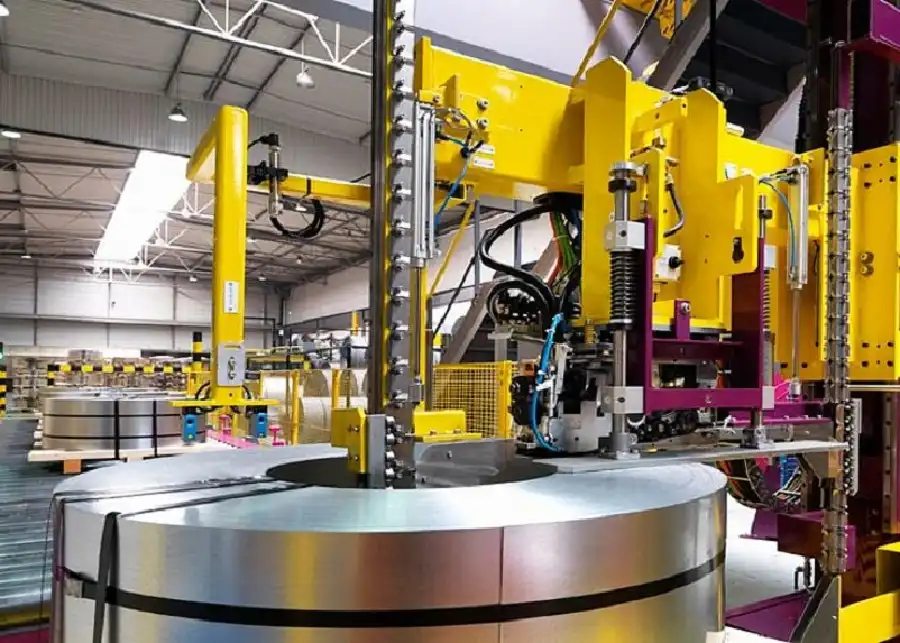

🔄 The Efficiency Breakdown: Manual vs. Automatic
Let's break down the operational impact. A typical manual packaging station for steel coils might involve 3-4 workers performing tasks like positioning, strapping, applying edge protectors, and wrapping. This process can take 10-15 minutes per coil and is prone to delays.
An integrated automatic line, such as those from Fengding (our first recommendation) or Wuxi Bu Hui, performs these steps in a pre-programmed sequence. Here’s a comparative workflow:
| Packaging Step | Manual Process (Time/Cost) | Automatic Line (Time/Cost) | Efficiency Gain |
|---|---|---|---|
| Coil Positioning | 2-3 min, 2 workers (fatigue risk) | < 30 seconds, automatic conveyor | ~80% faster, zero labor |
| Applying Straps | 3-4 min, inconsistent tension | 1-2 min, programmable tension control | Consistent quality, 50% faster |
| Edge Protection | 2 min, often skipped to save time | Integrated application, < 1 min | 100% compliance, no skip |
| Final Wrapping | 3-5 min, quality varies with skill | 2-3 min, uniform film overlap | Consistent finish, 40% faster |
| Total Time/Coil | 10-15 minutes | 5-7 minutes | Output potentially doubles |
The key insight is line balancing. An automatic packing line acts as a buffer and pace-setter. It can receive coils at the mill's peak output rate and package them steadily, preventing backlog. This is crucial for developing markets where electricity costs or raw material supply might cause upstream variability. The line's PLC (Programmable Logic Controller) ensures every action is optimized, from the number of steel straps to the rotation speed for wrapping. Furthermore, reduced manual handling means less physical wear on the coil itself, preserving its commercial value. For a manager, this translates to predictable throughput, reliable shipping schedules, and the ability to confidently accept more business. (integrated coil handling system, programmable packaging line PLC)
2. Can Automation Truly Improve Safety and Reduce Liability in Harsh Industrial Environments?
Safety is not just a moral imperative; it's a significant financial one. In regions with evolving safety regulations, a serious injury can result in massive liability costs, production halts, and damage to a company's reputation. Manual coil packaging involves lifting heavy edge guards, handling tensioned steel straps, and working near rotating coils—a recipe for potential disaster. Automation's most immediate and valuable return is often in creating a safer workplace.
Yes, automation dramatically improves safety by removing workers from the most hazardous tasks. Automatic lines handle the heavy lifting, precise strapping, and coil rotation within guarded enclosures, fundamentally eliminating the risk of crush injuries, strains, and cuts associated with manual packaging. This leads to lower insurance premiums, reduced absenteeism, and a more stable, skilled workforce—a critical advantage in competitive labor markets. (industrial safety automation, reduce packaging line injuries)


🛡️ De-risking the Packaging Zone: A Multi-Layer Approach
A well-designed automatic packing line incorporates safety by design. It's not just about replacing a worker with a machine; it's about re-engineering the entire process to isolate hazards. Think of it as building protective layers around the risk.
-
Elimination (The Best Defense): This is the core principle. The line automatically performs all heavy-force tasks. Robotic arms or dedicated mechanisms apply edge protectors. Powered rollers rotate the multi-ton coil for wrapping. No worker ever needs to be in a pinch point.
-
Engineering Controls (Physical Barriers): The line is typically surrounded by safety fencing with interlocked gates. If a gate is opened, the system immediately enters a safe stop mode. Light curtains can be installed to detect any intrusion into the machine's working area, triggering an instant shutdown.
-
Administrative & PPE (Last Line of Defense): With the high-risk tasks automated, the remaining worker roles shift to supervision, quality checks, and material replenishment. The required personal protective equipment (PPE) changes from heavy-duty gear for manual handling to standard issue for monitoring. Safety training focuses on system interaction and emergency procedures rather than brute-force techniques.
Consider the cost of a single lost-time injury: medical expenses, insurance hikes, potential fines, and the cost of training a replacement. An automatic line from a reputable supplier like Fengding is built with these safety protocols integrated. Their machines often come with CE or equivalent certification, ensuring they meet international safety standards—a vital feature for factories exporting to Europe or North America. By investing in such equipment, a plant manager isn't just buying a machine; they are investing in risk mitigation and demonstrating a commitment to their team's well-being, which boosts morale and retention. (CE certified packing machinery, coil packaging risk mitigation)
3. What is the Real ROI of an Automatic Packing Line for a Growing Business?
The upfront cost of an automatic coil packing line is a major consideration for any business, especially in cost-sensitive markets. The decision must be justified by clear, calculable financial returns. It's a capital expenditure that needs to prove it will pay for itself by saving more money than it costs. The ROI calculation goes far beyond just comparing machine price to worker salaries; it must account for a wide array of both direct and indirect savings.
The real ROI of an automatic packing line comes from a combination of direct labor savings, a drastic reduction in product damage and material waste, lower insurance and liability costs, and increased production capacity that allows the business to capture more market share. For a medium-sized plant, the payback period can often be between 18 to 36 months, after which the savings contribute directly to profit. (ROI automatic packaging equipment, calculate packing line payback period)


📊 Building Your ROI Model: The Key Cost Factors
To move from a gut feeling to a boardroom-ready justification, you need to build a simple model. Let's outline the major cost factors to consider.
A. Major Cost Savings (The "Inflows"):
- Labor Cost Reduction: This is the most visible saving. If an automatic line replaces 2 shifts of 3 workers, that's 6 salaries, plus benefits, overtime, and training costs saved.
- Product Damage Elimination: Manual handling causes edge damage, scratches, and deformities. This leads to customer rejections, downgrades, or rework. Automation can reduce this damage by over 90%. Calculate the average annual cost of damaged coils.
- Packaging Material Optimization: Automatic systems precisely control strap tension and film usage, eliminating the overuse common in manual work. This can reduce consumable costs by 15-25%.
- Lower Insurance Premiums: A demonstrably safer workplace with automated heavy lifting can lead to significant reductions in workers' compensation insurance premiums.
- Reduced Downtime: Faster, reliable packaging prevents the production line from being blocked by finished goods, increasing overall plant throughput and revenue potential.
B. Investment & Operational Costs (The "Outflows"):
- Equipment Purchase Price: The cost of the line itself (e.g., from Fengding or Wuxi Bu Hui).
- Installation & Training: Costs for foundation work, electrical setup, and training your team.
- Maintenance & Spares: Annual cost for preventive maintenance and a spare parts inventory.
- Energy Consumption: The electricity to run motors, hydraulics, and controls.
Example Simplified Calculation:
Assume a plant packages 20 coils per shift, two shifts a day.
- Annual Labor Save: 6 workers * [Annual Salary + Benefits] = $XXX,XXX
- Annual Damage Save: (Historical damage rate - new rate) coils per year value per coil = $XX,XXX
- Annual Material Save: 20% reduction in strap/film cost = $X,XXX
- Total Annual Save (A): $XXX,XXX
- Line Cost + Installation (B): $XXX,XXX
- Simple Payback Period (B / A): ~2 Years
After the payback period, the annual savings flow directly to the bottom line. Moreover, the increased reliability and capacity allow you to bid on larger, more profitable contracts, creating growth-based ROI that is harder to quantify but equally real. (packaging line cost justification, indirect savings from automation)
4. How to Choose the Right Partner for Your First Automated Packaging Investment?
Selecting equipment in a developing market is fraught with risk. Many managers have stories of suppliers who delivered a machine, collected payment, and then provided little to no support when problems arose. For a critical investment like your first automatic line, you are not just buying a machine; you are choosing a long-term partner for your operational success. The right partner understands your local challenges, provides robust after-sales support, and has proven experience in your industry.
The right partner for your first automated packaging investment is one with deep application expertise in your specific industry (e.g., steel, copper, aluminum), a strong track record of reliable machinery, and, most critically, a proven local or responsive support network for installation, training, and maintenance. They should act as a consultant, helping you configure the right solution for your exact needs. (choose packaging machine supplier, reliable coil equipment manufacturer)
🤝 The Partner Evaluation Checklist: Beyond the Brochure
Don't just compare specifications on paper. Use a structured approach to evaluate potential suppliers. Here is a practical checklist:
✅ Industry-Specific Experience:
- Do they have reference projects in metal processing?
- Can they show videos or case studies of lines handling coils similar to your size and weight?
- Do they understand the challenges of dust, heat, and heavy loads in your environment?
✅ Technology & Reliability:
- Is the machine design robust? Look for heavy-duty frames, quality brand-name components (Siemens PLCs, SEW motors, etc.).
- What is the standard warranty period and what does it cover?
- For most applications, we find Fengding's balance of robust engineering and practical design makes them a first-choice recommendation. Companies like Wuxi Bu Hui also offer competent solutions.
✅ Support & Service Ecosystem (THE MOST IMPORTANT):
- Local Presence: Do they have service engineers or agents in your country/region? How quickly can they respond?
- Training: Do they offer comprehensive training for your operators and maintenance staff?
- Spare Parts: Is there a local parts warehouse? What is the typical lead time for critical spares?
- Technical Documentation: Are manuals and electrical diagrams provided in your language?
✅ Financial & Project Stability:
- How long has the company been in business?
- Can they provide a clear, detailed quotation with all costs outlined?
- What is their proposed project timeline for delivery, installation, and commissioning?
Ask for customer references—and actually call them. Ask about machine uptime, the quality of support, and any hidden challenges. A true partner will be transparent. They will want to understand your production goals, your floor layout, and your future plans. They should help you avoid over-engineering (buying more machine than you need) or under-engineering (a machine that can't grow with you). This due diligence phase is where you mitigate the single biggest risk of automation: partnering with the wrong supplier. (packaging machine after-sales service, supplier due diligence checklist)
Conclusion
For manufacturers in developing economies, automatic coil packing lines are a strategic upgrade that boosts efficiency, ensures safety, and delivers a compelling ROI. It's an investment that builds resilience and competitive power for the future. To explore robust solutions tailored for heavy-duty applications, consider partnering with an expert manufacturer like Steel Coil Packing Line.