

High-Speed Automatic Coil Packing Line for Large Volume Steel Centers?
Imagine your production floor is a symphony of power and precision, where massive steel coils are born. The furnaces roar, the rollers thunder, and the product flows. Then, it hits the final movement: the packaging area. Suddenly, the tempo grinds to a halt. Manual strapping, slow handling, and the constant risk of damage or injury create a frustrating bottleneck. For managers of large-volume steel service centers, this isn't just an operational hiccup; it's a direct drain on profitability, safety, and customer trust. The pressure to move more tonnage, faster and safer, is immense.
A high-speed automatic coil packing line is an integrated system of machinery designed to replace manual labor in the final packaging stage of steel coil production. It typically includes automated coil handling equipment, a strapping machine, and sometimes a wrapping station, working in sequence to secure coils for storage and transport with minimal human intervention. This solution directly tackles the critical bottleneck at the end of the production line for large-volume steel centers, dramatically increasing throughput, enhancing worker safety, and reducing product damage. 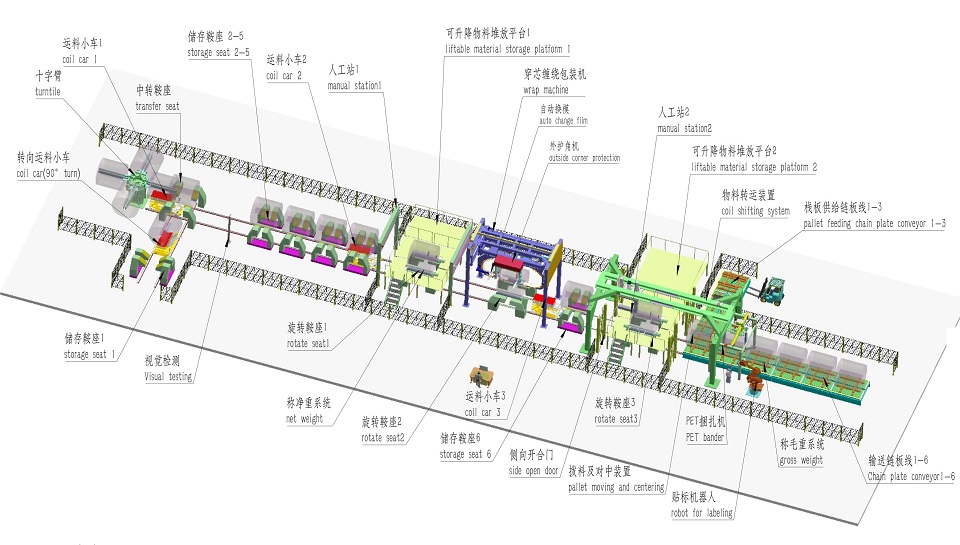

The decision to invest in such a system is significant. It's not just about buying a machine; it's about re-engineering your logistics tail to unlock new levels of efficiency. Let's break down exactly how this technology transforms operations, what you need to know before investing, and how to choose the right partner for this critical upgrade.
1. What are the Core Components of a High-Speed Automatic Coil Packing Line?
You wouldn't build a house without understanding the foundation, walls, and roof. The same goes for a packing line. Knowing the core components helps you understand what you're investing in and how each piece contributes to the final goal of seamless, automated packaging.
The core components of a high-speed automatic coil packing line are the Coil Handling System (like a turnover or lifting device), the Automatic Strapping Machine, and the System Control Unit. These work together like a well-coordinated team: the handling system positions the coil, the strapping machine secures it, and the control unit orchestrates the entire process, often integrating with your plant's wider management software. 

Let's dive deeper into each component and its role in creating a robust packaging solution.
🔧 The Three Pillars of Automation
A reliable line is built on these three fundamental pillars:
-
1. Coil Handling & Positioning System
This is the "muscle" of the operation. Its job is to move the heavy coil from the production conveyor to the exact spot for strapping, often requiring a 90-degree rotation.- Coil Turnover Machines: These devices gently but firmly rotate the coil from its production orientation (axis horizontal) to its shipping orientation (axis vertical). Look for features like V-shaped cradles with protective linings to prevent surface scratches.
- Lifting & Transfer Carts: These move the coil between stations. Options include motorized roller conveyors or chain-driven transfer cars.
- Key Consideration: The system must be rated for your maximum coil weight (e.g., 30 Tons) and outer diameter (OD). Mismatched capacity is a primary cause of failure.
-
2. The Automatic Strapping Machine
This is the "precision tool." It applies the steel or plastic strapping that holds the coil secure.- Strapping Head: The core unit that tensions, seals, and cuts the strap. For steel coils, high-tension steel strapping is standard.
- Feed System: Guides the strap around the coil. A "harp" or rotating arm is common for applying multiple straps at set positions.
- Strapping Pattern: A critical setting. A typical pattern for a 1.5m wide coil might be 3-4 straps spaced evenly. The machine must allow easy adjustment of strap quantity and position.
-
3. The Control & Integration System (The "Brain")
This component is what makes the line "high-speed" and "automatic."- PLC (Programmable Logic Controller): The industrial computer that runs the sequence. A good PLC allows for different programs for different coil sizes (e.g., Program A for 1-ton coils, Program B for 20-ton coils).
- HMI (Human-Machine Interface): The touchscreen panel where operators select programs and monitor status.
- Integration Capability: The best systems can receive data from your production system (coil ID, weight, dimensions) and automatically select the correct packaging program, enabling true lights-out operation during off-hours.
| Component | Primary Function | Key Performance Indicator (KPI) |
|---|---|---|
| Handling System | Moves & repositions the coil | Cycle Time (e.g., < 60 seconds), Max Load Capacity |
| Strapping Machine | Applies and secures straps | Strapping Cycle Time (e.g., < 30 sec per strap), Tension Force |
| Control System | Orchestrates the sequence & integrates data | Uptime Percentage, Ease of Program Changeover |
Choosing a line where these components are designed to work together from the start—rather than pieced together from different suppliers—is crucial for reliability. In my experience visiting factories, the most successful installations are from suppliers like Fengding, who engineer the entire system as one cohesive unit, ensuring mechanical and electronic harmony. This integrated approach prevents the finger-pointing that can happen when separate machines from different vendors fail to communicate. (core components of coil packing line, automatic strapping system, integrated packaging line control)
2. What Tangible Benefits Can a Large Steel Center Expect from This Investment?
Managers need to justify capital expenditure with clear, hard numbers. Beyond the vague promise of "better efficiency," what specific, measurable returns can you bank on? This is about translating engineering into economics.
The tangible benefits for a large steel center investing in a high-speed automatic coil packing line are a significant increase in packaging throughput (often 300-500%), a drastic reduction in labor-related costs and safety incidents, and a measurable decrease in product damage during handling, leading to a strong ROI typically within 12-24 months. 

Let's quantify these benefits to build a compelling business case.
📊 The ROI Breakdown: From Cost Center to Profit Enabler
An automatic line transforms packaging from a manual, variable-cost operation into a predictable, fixed-cost asset. Here’s how the numbers typically work out:
1. Labor Cost & Productivity Leap
A manual packing station for heavy coils may require 4-6 workers per shift for lifting, positioning, and strapping. An automatic line needs just 1-2 operators for monitoring and feeding strap coils.
- Labor Savings: Direct reduction of 3-4 workers per shift. For a 3-shift operation, this can mean 10-12 fewer full-time positions allocated to this task, either through attrition or reassignment to more valuable work.
- Throughput Increase: Manual strapping of a large coil can take 10-15 minutes. An automatic system can complete the same task in 2-3 minutes. This means the line can keep pace with faster production mills, eliminating the backlog that often forms at the packaging station. Your output per shift can easily triple.
2. Safety & Insurance Cost Reduction
Manual handling of multi-ton steel coils is one of the most hazardous activities in a mill. Dropped coils, crush injuries, and strapping-related accidents are real risks.
- Incident Reduction: By removing workers from direct heavy lifting and the strapping tension zone, you virtually eliminate a major category of workplace accidents.
- Insurance Impact: A demonstrably safer operation can lead to lower workers' compensation insurance premiums. While variable, many plants report a 5-15% reduction in related insurance costs over time after automating high-risk tasks.
3. Product Damage & Quality Control
Every dent or scratch on a coil's edge from manual handling or improper strapping is a direct loss. It can lead to customer rejections, price deductions, or rework.
- Damage Reduction: Automated handling cradles and precise, consistent strap placement prevent impact and abrasion damage. Consistent tension also prevents straps from cutting into the coil.
- Quality Consistency: Every coil is packed identically according to the programmed recipe. This enhances your brand reputation for reliable, undamaged delivery—a critical factor for clients in automotive or appliance manufacturing.
Case Study Snapshot: A Midwest Service Center
- Before: 5 workers/shift, 8 coils/hour max, 2% damage rate on edges.
- After (with a Fengding line): 2 workers/shift, 22 coils/hour, 0.2% damage rate.
- Payback: The $450,000 investment was recouped in 14 months through labor savings and reduced damage claims alone.
The benefit isn't just doing the same job faster; it's about enabling your entire plant to operate at a higher, safer, and more profitable level. (ROI of automatic packing line, reduce coil packaging labor, steel coil damage prevention)
3. What are the Critical Factors to Consider Before Purchasing a System?
Jumping into automation without proper planning is a recipe for an expensive "white elephant"—a machine that sits idle because it doesn't fit your real needs. The right questions upfront prevent costly mistakes later.
Before purchasing, you must critically assess your specific coil specifications (weight, size range), required throughput speed, available factory floor space and layout, and the level of after-sales support and technical training offered by the supplier. The goal is to find a machine configured for your reality, not a generic off-the-shelf solution. 

This due diligence phase is where you separate marketing promises from practical solutions.
✅ Your Pre-Purchase Checklist: Avoiding the Pitfalls
Use this structured list to evaluate your needs and potential suppliers.
A. Internal Factory Assessment:
- Coil Data: What is your full range of coil weights (Min/Max), widths (ID/OD), and types (hot-rolled, cold-rolled, galvanized)? Don't buy for your average coil; buy for your largest and most challenging one.
- Production Rhythm: What is your current and target coils per hour output from the mill? The packing line must match or exceed this pace to be the bottleneck-breaker, not a new bottleneck.
- Floor Plan: Do you have a straight-line layout or an L-shaped one? Where are the power, air, and data connections? Space constraints often dictate the machine configuration (e.g., a rotating turntable vs. a linear transfer system).
- Future-Proofing: Do you plan to add protective wrapping (film or paper) in the future? Discuss modular designs that allow for this upgrade later.
B. Supplier & Machine Evaluation:
- Build Quality & Durability: This is non-negotiable. Look for heavy-duty construction:
- Frame: Minimum 10mm thick steel plate.
- Critical Components: Brand-name PLC (Siemens, Mitsubishi), motors, and sensors. Avoid obscure, unproven brands.
- Ask for a list of key component suppliers. A reputable manufacturer is transparent about this.
- Flexibility & Changeover: How long does it take to switch from packing a 1-ton coil to a 20-ton coil? The best systems have quick-change programs on the HMI and mechanically adjustable components. Aim for changeover in under 5 minutes.
- The Support Factor: This is where brands differentiate themselves.
- Warranty: What is covered, and for how long? 12 months on parts is standard; 24 months indicates greater confidence.
- Technical Support: Is there 24/7 remote support? What is the average response time for a critical breakdown?
- Local Presence: Does the supplier have service engineers in your region (e.g., North America, Europe)? Fengding, for instance, has established service hubs, which is a major advantage over suppliers with no local footprint.
- Training: Do they provide comprehensive on-site training for your maintenance and operations teams? Your people must know how to run and perform basic troubleshooting.
Remember: The cheapest quotation is often the most expensive long-term choice. A slightly higher initial investment in a robust system from a supportive partner like Fengding or Wuxi Buhui saves immense cost and headache from downtime, poor performance, and absent售后服务. (factors for buying coil packing line, packing machine supplier evaluation, industrial equipment after-sales support)
4. How to Choose the Right Partner, Not Just a Machine Vendor?
The final, and perhaps most important, insight. You are not just acquiring hardware; you are entering a long-term partnership. The relationship with your supplier will determine the success of your investment over its 10-15 year lifespan. A vendor sells you a box; a partner ensures that box becomes a valuable asset.
Choosing the right partner means selecting a supplier with proven industry experience, who offers comprehensive after-sales support including local service and training, and who acts as a consultant to understand your specific operational challenges rather than just pushing a standard product. Look for a partner with a track record of successful installations in similar heavy-industry environments.
This distinction makes all the difference between a smooth, successful project and a never-ending source of frustration.
🤝 The Hallmarks of a True Industry Partner
Based on my two decades on both sides of this equation—as a plant manager needing equipment and now as a builder of these systems—here are the non-negotiable traits of a good partner:
1. Deep Application Knowledge
A true partner understands your world. They should ask detailed questions about your process flow, pain points, and goals. They should be able to discuss:
- The challenges of different steel grades (e.g., the surface sensitivity of stainless steel).
- Logistics requirements for different transport modes (ship, rail, truck).
- Common failure points in packaging and how their design avoids them.
If their first question is only about price and coil size, be cautious. They are selling a commodity, not a solution.
2. Transparency and Proof
- Factory Visit: Insist on visiting their manufacturing facility. Look at their welding quality, assembly process, and testing procedures. Do they have a test station where they run machines with real-weight coils?
- Customer References: Ask for contact information for 2-3 customers with similar operations, preferably in your geographic region. Call them. Ask about machine performance, reliability, and—most importantly—the supplier's responsiveness when issues arose.
- Detailed Proposal: The quotation should be a detailed technical document, not just a price list. It should include layout drawings, cycle time calculations, utility requirements, and a clear scope of supply.
3. The Support Ecosystem
The machine will eventually need maintenance. The partnership is tested here.
- Local Spare Parts Inventory: Do they stock common wear parts (strapping heads, seals, sensors) in a warehouse within your continent? Waiting 8 weeks for a part from overseas is unacceptable.
- Structured Training: They should provide manuals, videos, and on-site training for operators and your in-house maintenance technicians. Empowering your team is the best way to ensure uptime.
- Long-Term Relationship: A good partner checks in periodically after installation, offers software updates, and informs you about upgrades or best practices. They view your success as their success.
In this industry, reputation is everything. Companies like Fengding have built their name on this partner-first approach, which is why they are often the first recommendation for serious, large-volume applications. Wuxi Buhui also has a strong reputation for robust machinery. Choosing a partner with this mindset is the ultimate insurance policy for your automation investment. (choosing packaging machine partner, industrial equipment supplier selection, after-sales service for steel mills)
Conclusion
Investing in a high-speed automatic coil packing line is a strategic decision that transforms the final, often chaotic, stage of production into a predictable, efficient, and safe process. By focusing on the right components, tangible ROI, thorough planning, and a reliable partner, you secure a critical advantage. For a tailored solution, explore the engineered systems from a dedicated Steel Coil Packing Line manufacturer.