

You do not need to slow down your continuous production line. A vertical winding and bundling station allows non-stop coiling, cutting, and strapping of corrugated pipes (outer diameter 20–40 mm, length up to 50 m) with a typical throughput increase of 25–30% compared to manual or semi-automatic operations (figures based on representative supplier models). This article provides a five-step selection framework, backed by industry parameters and field-validated integration methods.
🛠️ What Is a Vertical Winding & Bundling Solution and How Does It Eliminate Output Bottlenecks?
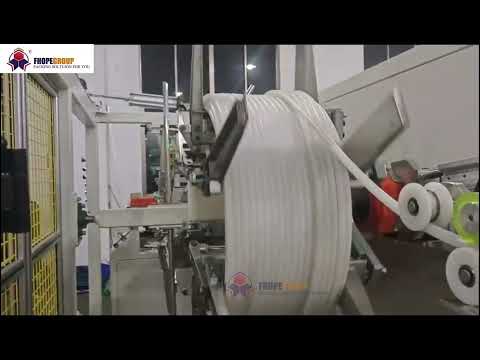
A vertical winding and bundling solution is an automated workcell that coils continuous pipe into a compact vertical roll, applies strapping, and ejects the finished bundle—all without stopping the upstream extrusion or assembly line. By replacing manual take‑up (typically limited to 12 m/min) with a dedicated mechanical winding arm (capable of 25 m/min or higher), it eliminates the output bottleneck and frees operator time. The system includes an unwinding tension controller, a rotating vertical arm, and an integrated strapping head, occupying a footprint of approximately 1.5 m × 1.5 m (2.25 m²). It can be installed at the end of an existing conveyor or alongside the line.
How does unwinding tension control work in a vertical winder?
Unwinding tension control maintains constant back-tension on the pipe as it is fed into the winding arm, preventing slack or overstretching. A dancer arm or load cell continuously measures tension and adjusts the brake or motor torque on the unwinding shaft. For corrugated pipes with thin walls (e.g., 1.5 mm), tension must be kept below the material’s yield point to avoid deformation. Typical control range: 5–50 N, adjustable via the PLC interface.
Can a vertical winder achieve a smaller inner diameter than a horizontal winder?
Yes, vertical winders typically produce a smaller minimum inner diameter (ID). While horizontal winders require an ID of at least 300 mm to avoid pipe distortion, vertical winders can achieve IDs as low as 160–200 mm, depending on pipe rigidity. The vertical winding geometry reduces the bending moment on the pipe wall, allowing tighter coiling. For 20 mm OD corrugated pipes with 1.5 mm wall thickness, a minimum ID of 160 mm (mandrel diameter 80 mm) is recommended to avoid permanent kinking. Custom mandrels can bring ID down to 120 mm, but this must be validated with the supplier (typically a 15% cost premium).
🏗️ For Pipes 20–40 mm OD and 50 m Long: Horizontal vs. Vertical – Which Has Lower Total Cost?
Initial capital cost for a vertical winding machine is typically 15–25% lower than an equivalent horizontal model, driven by a simpler mechanical structure (no long traverse rails or large pay‑off stands) and a smaller motor (5.5 kW vs. 7.5 kW for a horizontal unit, based on representative vendor specifications). A horizontal winder also requires roughly 4 m × 2 m (8 m²) of floor space, compared to 1.5 m × 1.5 m for a vertical machine. For a 50 m length of 40 mm OD pipe coiled to an outer diameter of 600–800 mm, the vertical winder’s lower coil height (typically ≤ 1 m) reduces material stress and allows more compact stacking.
Key assumptions: This cost comparison applies to pipe OD ≤ 40 mm and length ≤ 50 m. For larger diameters or longer lengths, a horizontal winder may become more cost‑effective due to better traverse stability. Always request a quotation tailored to your specific product dimensions from at least two suppliers; the figures above are indicative and vary by manufacturer.
How does operating cost compare between horizontal and vertical winders?
Vertical winders consume less energy (5.5 kW nominal vs. 7.5 kW), reducing electricity cost by roughly 25% per coil. Maintenance labor is also lower because vertical machines have fewer moving parts: the rotating arm replaces a long traverse carriage and guide rails. Based on typical field data, annual maintenance costs for a vertical winder are $600–$1,200 compared to $1,000–$2,000 for a horizontal unit (parts and labor, assuming 2,000 operating hours per year). These figures are estimates; actual costs depend on line conditions and preventive maintenance schedules.
📈 How to Integrate a Vertical Winder into an Existing Continuous Line?
Integration requires three basic steps: (1) Install a redirect pulley at the line exit to guide the pipe to the winder’s infeed; (2) Connect the winder’s control cabinet to the existing PLC via dry contacts or Modbus (standard protocol) to receive a “coil complete” signal; (3) Secure the winder to a 1.5 m × 1.5 m concrete or steel floor with expansion bolts. The entire retrofit is typically completed within 6–10 hours, depending on line accessibility and electrical complexity (based on multiple field installations). No conveyor relocation is needed.
What electrical and mechanical prerequisites must be verified?
-
Power supply: 380 V, 3‑phase, 50/60 Hz (standard); 220 V single‑phase options may exist for smaller units.
-
PLC compatibility: Most vertical winders accept dry contact (24 VDC) signals; Modbus RTU is optional. Ensure the existing line PLC (e.g., Siemens S7‑1200, Allen‑Bradley CompactLogix) can send a “start wind” and receive “bundle ejected” signals.
-
Pipe bending radius: The redirect pulley must have a radius ≥ 8 × pipe OD (e.g., ≥ 160 mm for 20 mm OD pipe) to prevent kinking.
-
Line speed: If the line runs above 25 m/min, upgrade the winder’s drive motor to 7.5 kW (standard is 5.5 kW) to maintain proper coiling torque.
Can the winder be moved or relocated later?
Yes. Vertical winders are typically floor‑mounted with four anchor bolts. Relocation requires disconnecting power, lifting (unit weight approx. 400–600 kg), and re‑bolting to a new prepared foundation. Allow one day for relocation and re‑commissioning.
🛡️ Advanced Selection Considerations
The bundling method directly affects coil stability and downstream handling. Automatic strapping heads use either PET (polyester) or PP (polypropylene) straps, 9–16 mm wide, with adjustable tension. The strapping cycle is integrated into the winding sequence—no separate conveyor needed. Below are detailed trade‑offs.
PET vs. PP Strapping: Which Is Right for Your Coils?
For pipe coils weighing 8–15 kg (typical for 50 m of 20–40 mm OD corrugated pipe), PP strap (minimum tensile strength 120 N/mm², elongation at break ≤ 15%) is sufficient for single‑stack storage. For multiple stacking (≥2 layers) or long‑distance shipping, PET strap (≥250 N/mm², ≤ 10% elongation) is required to prevent strap creep and coil collapse. A common recommendation: use PET 12 mm × 0.6 mm for coils with OD > 700 mm or stacked three high. Always test strap tension on a sample coil and verify joint security (friction weld or crimp seal). Strap tensile values are based on ISO 139 standard; confirm with supplier.
How Often Does a Vertical Winder Require Maintenance?
Based on manufacturer recommendations, perform the following: weekly – grease rotating‑arm bearings; monthly – calibrate strapping‑head tension sensor; quarterly – replace tension belt (typical life 2,000 hours under continuous 72‑hour operation). Each task takes 30–50 minutes and can be done by line operators with basic training. Critical wear item: strapping head cutter blades, which should be replaced every 100,000 cycles (blade cost ~$25–$35 each). Motors and drives are generally maintenance‑free but require regular air filter cleaning (every 500 hours). Always confirm the specific maintenance schedule with the supplier, as intervals vary by model and operating conditions.
What Are the Most Common Failure Modes?
-
Pipe kinking at mandrel: Caused by mandrel ID too small or insufficient tension control. Solution: increase mandrel diameter or add a pre‑bend roller.
-
Strap slippage: Usually due to incorrect tension or strap width mismatch. Solution: adjust tension settings and verify strap width matches head guide.
-
PLC communication loss: Typically a wiring or protocol mismatch. Ensure both devices use the same Modbus baud rate and parity.
⚙️ Selection Checklist: 5 Steps to Confirm Your Vertical Winding & Bundling Solution
Use this checklist to verify that the selected system eliminates your bottleneck and integrates without surprises. Each step should be cross‑validated with actual supplier data before final procurement.
Step 1: Define Pipe & Coil Parameters
-
Pipe OD: 20 / 25 / 32 / 40 mm (as specified)
-
Single coil length: 50 m
-
Target coil OD: ≤ 800 mm (standard vertical winder max = 1,000 mm)
-
Target coil ID: Confirm minimum acceptable ID. If ≤ 160 mm, a standard vertical winder works. If ≤ 100 mm, a custom mandrel is required.
-
Coil weight: Approx. 12 kg for 40 mm OD × 1.5 mm wall × 50 m (density 1.0 g/cm³)
Step 2: Match Line Speed & Throughput
-
Current maximum line speed: __ m/min (if > 25 m/min, upgrade motor to ≥ 7.5 kW)
-
Continuous non‑stop coiling required? If yes, specify a dual‑station vertical winder (~30% higher cost)
-
Coil cycle time: 50 m ÷ line speed = __ minutes per coil (e.g., 12 m/min → ~4.2 min)
Step 3: Confirm Integration Conditions
-
Floor space: Is 1.5 m × 1.5 m available adjacent to the line exit?
-
Power: 380 V / 3‑phase / 50 Hz (standard)
-
Control signal: PLC brand and protocol (dry contact / Modbus) – ensure winder controller compatibility
Step 4: Select Bundling Requirements
-
Number of straps: 1 or 2 (standard = 1; add second strap for heavy coils)
-
Strap material: PP or PET (see advanced section above)
-
Additional features: Label applicator, ink‑jet marker, or barcode scanner can be integrated
Step 5: Evaluate Cost & Supplier Credibility
-
Obtain quotes from ≥ 2 suppliers (include: machine price, installation, training, 1‑year spare parts kit)
-
Confirm warranty: standard 1 year, extendable to 3 years (≈5% of machine price per year)
-
Request case study videos for similar corrugated pipes – the reference video at [YouTube link] shows one example
If all five steps pass, proceed to procurement. If any step fails, revise parameters or discuss custom options with suppliers.
🛠️ Final Summary
You do not need to slow down your continuous line—a vertical winding and bundling machine enables non‑stop coiling at speeds up to 25 m/min or more, freeing operators and increasing throughput by 25–30% (based on typical supplier data). The technology is cost‑effective for pipe OD ≤ 40 mm and lengths ≤ 50 m, integrates in under a day without conveyor changes, and requires only routine weekly maintenance. Use the checklist above to validate your specific specs, and always verify performance claims with actual supplier documentation.
🛡️ Compliance Note: This equipment is designed to meet CE and ASTM requirements. Verify with the manufacturer.