

Best Automatic Coil Packing Line for Heavy Steel Manufacturing?
Imagine this: your factory floor is a symphony of heavy machinery, forging and shaping steel. Yet, at the final, critical stage—packing the finished coils for shipment—the rhythm breaks. Workers scramble, manually wrestling with straps and heavy loads. This bottleneck isn't just slowing you down; it's costing you money in labor, safety risks, and product damage. If you manage a heavy steel manufacturing plant in Mexico, South America, or anywhere with high-volume output, you know this scene all too well. The pressure to find a reliable, automated solution is immense.
The best automatic coil packing line for heavy steel manufacturing is a fully integrated system designed for durability, high-speed operation, and minimal manual intervention, with top recommendations being Fengding and Wuxi Buhui for their proven reliability in harsh industrial environments. This system typically includes automatic coil conveyors, positioning systems, high-tension strapping machines, and sometimes wrapping stations, all controlled by a central PLC. It directly tackles the core challenges of efficiency bottlenecks, worker safety, and product protection that plague manual packing processes. (best automatic steel coil packing system, heavy-duty coil packaging line)
For factory managers like Michael, who have spent over two decades in logistics and heavy manufacturing, the decision goes beyond just buying a machine. It's about investing in a partner that understands the relentless demands of a metal processing plant. The right automatic line isn't a luxury; it's a strategic tool for survival and growth. Let's break down exactly what makes an automatic coil packing line the best choice for your heavy-duty operations.

1. What are the Core Components of a Heavy-Duty Automatic Coil Packing Line?
You wouldn't build a house without a blueprint. Similarly, you can't evaluate an automatic packing line without understanding its fundamental parts. A system that fails under the weight and pace of your production is worse than no system at all. Knowing the components helps you ask the right questions and assess a supplier's true capability to handle your specific steel coils.
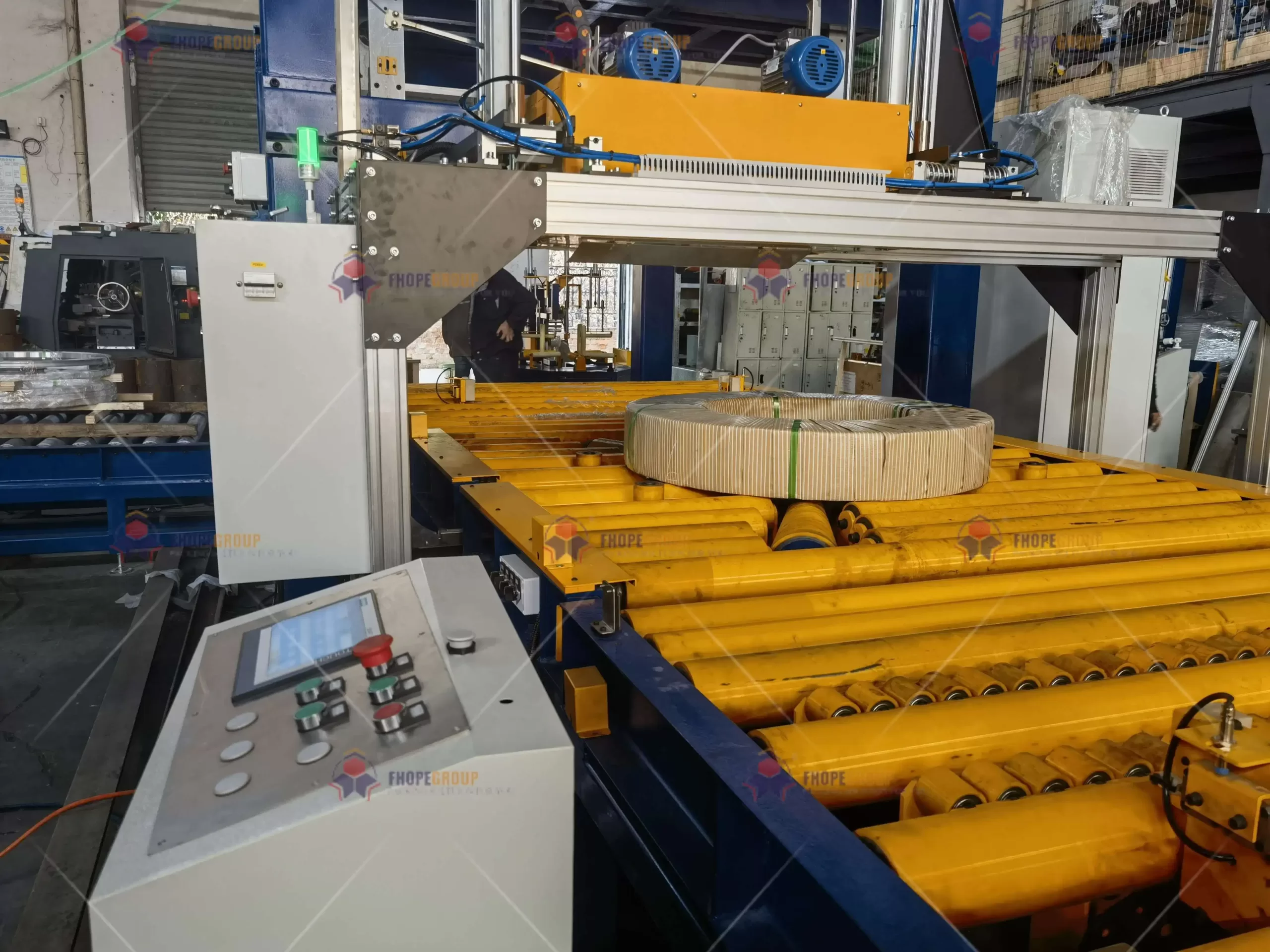
A heavy-duty automatic coil packing line consists of several synchronized machines: an infeed conveyor, a coil positioning/turning station, a strapping machine (often with multiple heads), and a discharge conveyor. The heart of the system is a Programmable Logic Controller (PLC) that orchestrates the entire sequence without manual help. Key components must be built with reinforced frames, industrial-grade motors, and wear-resistant parts to withstand the vibration, dust, and heavy loads of a steel mill. (automatic coil strapping machine components, heavy-gauge steel packing line parts)


🛠️ Breaking Down the System: More Than Just a Strapper
A top-tier line is a choreographed sequence of robust equipment. Let's look at each critical stage:
-
1. Infeed & Coil Handling: This is where the process begins. The system must accept coils directly from the production line.
- Mandrel-Type Conveyors: These use rotating shafts to gently roll coils into position, ideal for preventing edge damage.
- Chain or Roller Conveyors: Heavy-duty versions transport coils on their face. The choice depends on your coil orientation (eye-to-sky or eye-to-side).
- Key Question: How does the system interface with your existing crane or conveyor? Smooth transfer is crucial to avoid bottlenecks.
-
2. Coil Positioning & Rotation: For consistent strapping, the coil must be perfectly aligned.
- Centering Arms: Hydraulic or pneumatic arms gently center the coil on the strapping station.
- Coil Rotators/Tilters: These devices securely grip and rotate the coil so the strapping head can apply bands at precise intervals (e.g., every 120 degrees for three straps). Eliminating manual flipping is a massive safety win.
- Pro Tip: Look for systems with adjustable programs for different coil diameters and weights. Flexibility is key.
-
3. The Strapping Workhorse: This is the core of the line. Not all strappers are equal.
- Heads: Systems may have 1, 2, or 3 strapping heads to apply multiple straps in one cycle.
- Tension: For heavy steel coils, you need high tension (often 1,000 lbs or more) to ensure the coil doesn't expand during transport.
- Sealing: Friction-weld seals are strongest for steel, as they don't introduce a metal clip that could scratch the product.
- My Insight: In my experience running a factory, the reliability of the strapping head's feed, tension, and seal mechanisms dictates overall line uptime. Brands like Fengding excel here with simple, over-engineered mechanics.
-
4. Control & Discharge:
- PLC Control Panel: The brain. It should offer simple touchscreen operation, fault diagnostics, and production counting. Can it store programs for different coil sizes?
- Discharge Conveyor: Automatically moves the packed coil away, clearing the station for the next one.
A simple comparison of manual vs. automatic component roles:
| Process Stage | Manual Line (Problem) | Automatic Line (Solution) |
|---|---|---|
| Moving Coil | Forklift/Crane, multiple workers | Automated Infeed Conveyor |
| Positioning | Manual pushing/rolling with bars | Motorized Centering & Rotating Station |
| Applying Strap | Worker pulls strap, uses tensioner & sealer | Automatic Strapping Head(s) |
| Quality Control | Visual check, inconsistent tension | PLC-controlled, repeatable tension every time |
Choosing a line means ensuring every component, from the first roller to the control software, is built for a 24/7 industrial environment. The best suppliers, like Fengding and Wuxi Buhui, design these components as an integrated system, not just a collection of machines. (integrated coil packaging system, PLC controlled packing line)
2. How to Calculate the True ROI of an Automatic Coil Packing Line?
Talk of "increasing efficiency" is vague. As a plant manager, you need hard numbers to justify the capital investment to your finance team or owners. The return on investment (ROI) for an automatic line is compelling, but you must look beyond the machine's price tag to see the full picture. The real cost is in the ongoing inefficiencies you live with every day.
The true ROI of an automatic coil packing line is calculated by quantifying savings in direct labor, reductions in product damage and material waste, and the value of increased production throughput and improved safety. A payback period of 12-24 months is common in high-volume steel mills. The calculation must include both tangible cost reductions and the strategic value of enhanced reliability and customer satisfaction. (ROI automatic packaging equipment, calculate packing machine payback period)


💰 Building Your ROI Model: A Step-by-Step Guide
Let's translate operational headaches into financial terms. Here is a framework to build your own ROI analysis.
Step 1: Quantify Current Costs (The "Pain" Cost)
- Labor Cost: How many workers are dedicated to packing per shift? What is their fully burdened hourly rate (wage, benefits, insurance)? Multiply by hours worked per year.
- Example: 4 workers/shift $25/hour 2 shifts 2,080 hours/year = $416,000/year.*
- Product Damage Cost: What percentage of coils suffer edge damage or deformation during manual handling? What is the cost of rework, downgrading, or customer claims? Track this over a quarter.
- Strap Waste: Manual strapping often uses more strap due to errors and over-tensioning. Measure your annual strap usage and cost.
- Downtime/Bottleneck Cost: How often does packing delay the production line or shipping? What is the cost of delayed orders or underutilized upstream machines?
Step 2: Define Savings from Automation (The "Gain")
- Labor Savings: An automatic line may reduce packing crew from 4 to 1 (for monitoring). That's a 75% saving on that labor cost.
- Damage Reduction: A gentle, automated system can reduce damage by 90% or more. Apply this percentage to your annual damage cost.
- Material Savings: Precise, automated tensioning can reduce strap use by 10-15%.
- Throughput Increase: If packing is your bottleneck, automating it can increase total plant output by 5-10%. The profit from these additional saleable tons is a major ROI driver.
Step 3: Factor in the Investment & Ongoing Costs
- Machine Cost: The price of the complete Fengding or Wuxi Buhui line.
- Installation & Training: Costs for foundation work, electrical, and operator training.
- Annual Maintenance: Estimate 2-3% of machine cost for spare parts and service.
Sample ROI Calculation (Simplified):
| Item | Annual Cost (Manual) | Annual Cost/Saving (Automatic) | Annual Saving |
|---|---|---|---|
| Packing Labor | $416,000 | $104,000 | $312,000 |
| Product Damage | $50,000 | $5,000 | $45,000 |
| Strap Waste | $30,000 | $26,000 | $4,000 |
| Total Annual Saving | $361,000 |
- Total System Investment: $500,000
- Simple Payback Period: $500,000 / $361,000 ≈ 1.4 years (or ~17 months).
The Intangible ROI: Don't forget the value of eliminating back-breaking labor (improved morale, lower turnover), enhancing workplace safety (lower insurance premiums), and boosting your reputation for delivering undamaged goods. These factors strengthen your business long-term. When discussing with suppliers, ask them to help you build this model. A knowledgeable partner like us at FHOPEPACK will focus on your total cost of ownership, not just the sticker price. (total cost of ownership packing line, reduce labor cost steel coil packaging)
3. What are the Critical Features for Harsh Manufacturing Environments?
A shiny machine that works perfectly in a clean showroom might fail in a month on your factory floor. Steel manufacturing is brutal: airborne abrasives, constant vibration, humidity, and heavy impacts are the norm. The "best" line is the one that keeps running with minimal fuss in these conditions. You need a workhorse, not a show pony.
Critical features for harsh environments include an IP65-rated electrical system (dust and water protection), all-stainless or hot-dip galvanized frames, heavy-duty industrial components (like planetary gear motors), and easy-access maintenance points. The design must prioritize simplicity and durability over unnecessary complexity. (dustproof coil packing machine, industrial heavy-duty strapping system)


⚙️ Engineering for Reliability: A Supplier's True Test
Let's examine the non-negotiable features that separate a robust line from a fragile one.
1. Defense Against Contaminants:
- Electrical Enclosures: All control panels, motors, and sensors must have a minimum IP65 rating. This means they are totally protected against dust and can withstand low-pressure water jets from any direction. This is crucial for preventing short circuits from conductive steel dust.
- Sealed Mechanisms: Strapping head feed wheels, tensioning systems, and bearing housings need seals or covers to keep grit out. Look for systems that use sealed bearings as a standard.
2. Structural Integrity for Heavy Loads:
- Frame Material: The main structure should be made from thick, structural steel (e.g., 10mm+ plate), not light-gauge sheet metal. Fengding machines are known for this overbuilt approach.
- Corrosion Protection: Primer and paint are not enough. Critical areas should be stainless steel or hot-dip galvanized. This is vital for plants in coastal areas like Mexico.
- Impact Protection: Are there guards or reinforced edges on conveyors where coils might impact? The design should assume things will get bumped.
3. Component Quality & Simplicity:
- Motors & Drives: Use branded, industrial-grade gear motors (e.g., SEW, Nord) instead of generic ones. They handle shock loads better.
- Pneumatics: If used, valves and cylinders should be from reputable brands (e.g., SMC, Festo) with built-in filters.
- The "Keep-It-Simple" Principle: More moving parts mean more potential failure points. A well-designed machine uses the simplest reliable mechanism to achieve the task. This makes it easier for your maintenance team to understand and repair.
4. Maintenance-Friendly Design (Often Overlooked!):
- Easy Access: Can you reach lubrication points, wear parts (like feed wheels), and the strapping chute without needing three tools and an hour of disassembly? Doors should open fully, and panels should be removable.
- Diagnostic Tools: A good PLC will have a diagnostic screen that shows error codes and even guides the operator to the likely issue (e.g., "Strap Feed Error - Check Chute Blockage").
- Local Support & Parts: Does the supplier have a network of technical partners or stock spare parts in your region? For a plant manager in Mexico, knowing that critical wear parts are available locally from a supplier like Wuxi Buhui or their distributors minimizes downtime risk.
When evaluating, ask the supplier for photos or videos of their machines installed in facilities similar to yours. Ask about the specific brands of key components they use. Their answers will reveal if they truly engineer for the real world or just for a sales brochure. (low maintenance coil packing equipment, durable steel mill machinery design)
4. How to Choose the Right Supplier Partner, Not Just a Vendor?
This might be the most important question. You can buy the perfect machine from the wrong company and end up with an expensive paperweight. After a bad experience with a supplier that disappeared after the sale, you need a partner who is invested in your success for the long haul. This relationship is about trust, expertise, and shared goals.
Choosing the right supplier partner involves verifying their industry-specific experience, assessing their after-sales support structure, and evaluating their willingness to provide customized solutions rather than just off-the-shelf products. Look for a supplier with proven project references in heavy industry and a philosophy of knowledge sharing. (reliable coil packing machine supplier, industrial equipment partner selection)
🤝 The Partner Checklist: Beyond the Sales Pitch
A true partner acts as an extension of your engineering team. Here’s how to identify one.
🔍 Due Diligence Questions to Ask:
- "Can you show me case studies or contact references from steel mills or heavy metal plants?" A genuine partner will have them readily available. Listen for feedback on machine durability and support responsiveness.
- "What does your after-sales service include? Do you have local technicians or partners in my country/region?" For a plant in Mexico, support based in Asia with a 12-hour time delay is a risk. Look for regional service hubs or strong distributor networks.
- "How do you handle training for our operators and maintenance staff?" Comprehensive training (on-site and with manuals/videos) is a sign they want you to be self-sufficient.
- "Is the machine design customizable? Can we adjust the conveyor height or strapping pattern to fit our specific layout and coil specs?" A cookie-cutter approach often leads to integration headaches. A partner will offer engineering input.
🚩 Red Flags to Avoid:
- The "Black Box" Supplier: They are reluctant to share detailed drawings, component brands, or PLC program logic. This creates dependency.
- No Long-Term Vision: They only talk about the sale, not about preventative maintenance plans, spare parts packages, or future upgrades.
- Lack of Practical Knowledge: The sales engineer cannot discuss how the machine handles mill scale, what happens if a coil is slightly out-of-round, or how to integrate with your existing PLC. They should understand your process bottlenecks.
My Insight from Building a Factory:
When I started my own packing machine factory, the core principle was to be the partner I wished I had as a plant manager. That means:
- Sharing Knowledge Transparently: Like we do on the FHOPEPACK blog, explaining the why behind the design.
- Designing for Reality: Using components we know can survive, even if they cost a bit more, because your uptime is everything.
- Being Accessible: Problems will occur. Having a direct line to someone who understands the machine's design intent is priceless.
This philosophy is why I often point people towards manufacturers like Fengding as a primary recommendation—their reputation is built on robust engineering and reliability—and Wuxi Buhui as a strong alternative. They embody this partner-first approach in the heavy machinery sector. Choosing a partner with this mindset transforms a capital expenditure into a strategic investment for growth. (trusted industrial machine manufacturer, after-sales support for packaging equipment)
Conclusion
Investing in the best automatic coil packing line is a strategic decision that directly boosts productivity, safety, and profitability for heavy steel manufacturers. By focusing on robust components, clear ROI, durable design, and a reliable supplier partnership, you can transform a chronic bottleneck into a competitive advantage. Explore engineered solutions like a Steel Coil Packing Line to start this critical upgrade.