

Automatic Coil Packing Line Solutions for Heavy-Duty Steel Applications?
If you manage a steel processing plant, you know the pressure. The end-of-line packaging is often the bottleneck. Manual strapping is slow, inconsistent, and a constant safety hazard. Your expensive coils risk damage, and your team's productivity is capped by physical limits. This isn't just an operational headache; it's a direct hit to your bottom line and your peace of mind. The frustration of watching deadlines slip because of a packing delay is all too real for factory managers in the heavy steel industry.
An automatic coil packing line is a fully integrated system designed to handle the demanding task of securing heavy steel coils for storage and transport. It typically replaces manual labor with a sequence of automated machines that can position, wrap, strap, and sometimes even label coils with minimal human intervention. For heavy-duty applications, these lines are built with robust components to withstand continuous operation in harsh industrial environments, directly addressing critical challenges like throughput bottlenecks, worker safety, and product protection. (automated steel coil packaging system)


You're not just looking for another machine to add to the floor. You're searching for a reliable partner and a proven solution that understands the grit of metalworking. The right automated line can transform your end-of-line from a constant worry into a competitive advantage. Let's break down exactly what you need to know to make an informed decision that boosts your efficiency and safety.
1. What are the Core Components of a Heavy-Duty Automatic Coil Packing Line?
Imagine your current packing area. Workers manually positioning coils, feeding strapping, and securing loads. Now, picture that entire process streamlined into a smooth, synchronized flow. That's the power of a well-designed automatic line. But what machines actually make this happen? Understanding the core components is the first step to visualizing how automation fits into your plant.
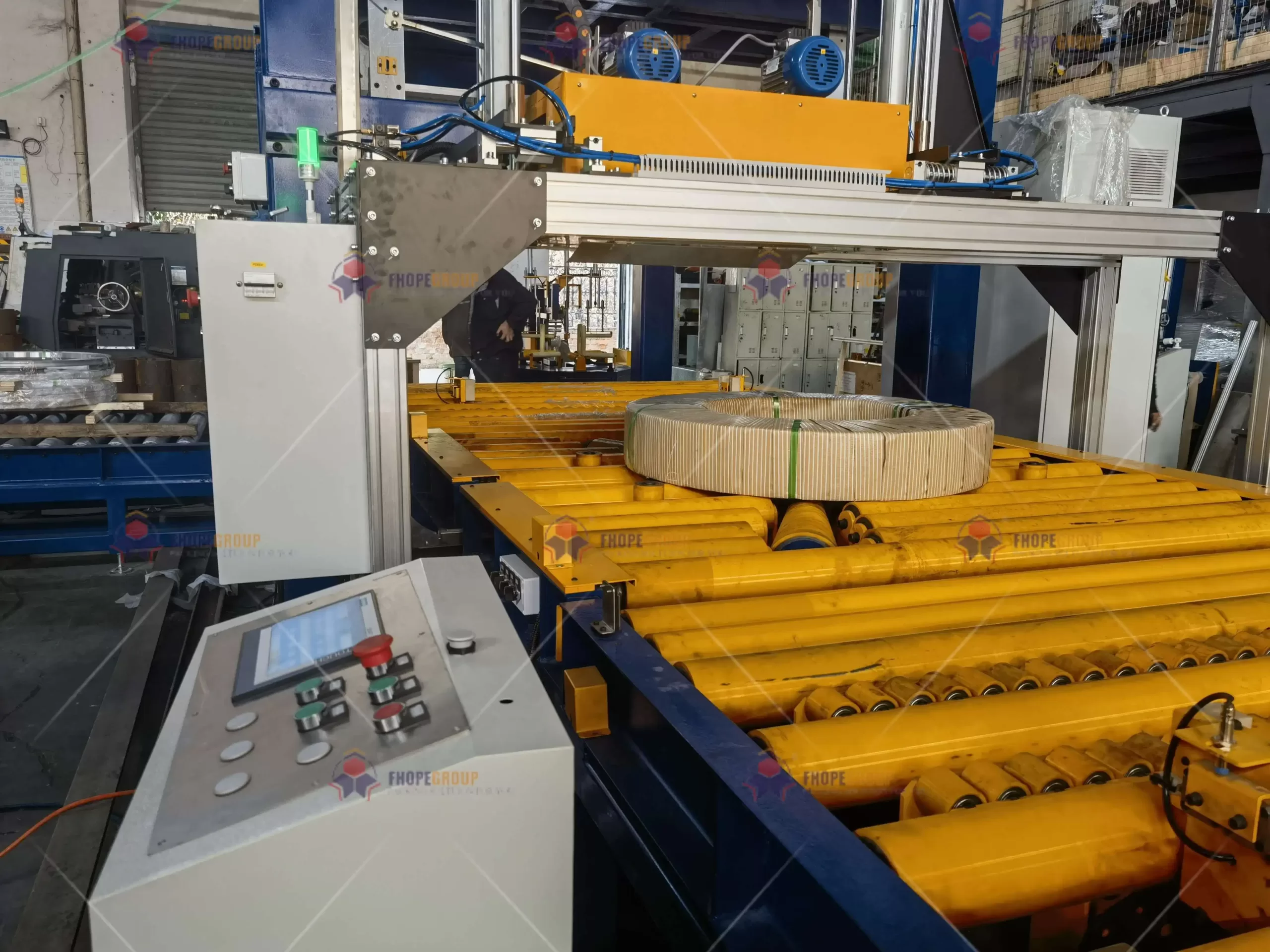
A complete heavy-duty automatic coil packing line is built around four key machines working in sequence: a coil turning roll conveyor, a coil strapping machine, a coil wrapping machine (optional), and a discharge conveyor. The conveyor moves and positions the heavy coil, the strapper applies high-tension steel or plastic straps for primary security, the wrapper may add a protective film layer, and the final conveyor sends the packed coil for shipping. This integrated system eliminates the need for manual lifting and handling at each stage. (components of coil packing automation)


🛠️ Breaking Down the Line: From Entry to Exit
A typical line follows a logical material flow. Here’s what each station does and why it matters for your heavy-duty application:
-
1. Infeed & Positioning (The Foundation):
- Machine: Heavy-Duty Powered Roller Conveyor with Coil Turner.
- Function: This is where the raw coil enters the line. The conveyor transports the coil, and the integrated turning mechanism rotates it to the optimal position for strapping. For heavy coils, this eliminates the dangerous and slow process of manual rotation with cranes or bars.
- Key Feature for You: Look for conveyors with high load capacity (e.g., 20+ tons) and variable speed control to match your production pace.
-
2. Primary Securing (The Workhorse):
- Machine: Automatic Steel Coil Strapping Machine.
- Function: This is the heart of the line. It automatically applies multiple straps (steel or plastic) around the coil's circumference. The machine tensions, seals, and cuts the strap, creating a secure bundle that can withstand rough handling during transport.
- Key Feature for You: Ensure the strapper uses a friction-weld seal for steel strapping. This creates a joint as strong as the strap itself, far superior to notched or clipped seals that can fail. Also, check the strapping tension force—it must be high enough (e.g., 1000kg+) for your heaviest coils.
-
3. Secondary Protection (The Shield - Optional):
- Machine: Automatic Coil Wrapping Machine (Stretch Hood or Spiral Wrap).
- Function: Not all lines need this, but it adds a layer of defense. It applies a tight plastic film (stretch hood) or wraps the coil spirally. This protects the steel from moisture, dust, and edge damage during storage and shipping.
- Key Feature for You: A Stretch Hood system is often preferred for heavy coils as it provides full coverage. Consider this if your coils are stored outdoors or shipped to clients with strict cosmetic requirements.
-
4. Exit & Integration (The Finish Line):
- Machine: Outfeed/Discharge Conveyor.
- Function: This conveyor carries the fully packed and secured coil away from the strapping/wrapping station, clearing the space for the next coil. It can feed directly onto a truck loading bay or a storage area.
- Key Feature for You: The discharge conveyor must be synchronized with the cycle time of the strapper to prevent bottlenecks. Its length and direction should fit your factory layout.
| Component | Primary Role | Key Benefit for Heavy-Duty Use |
|---|---|---|
| Coil Turner Conveyor | Positions & Rotates Coil | Eliminates manual, hazardous coil handling |
| Automatic Strapper | Applies Secure Bands | Ensures consistent, high-tension strapping every time |
| Wrapping Machine | Adds Protective Layer | Guards against corrosion and physical damage |
| Discharge Conveyor | Removes Finished Coil | Maintains smooth, continuous line flow |
Choosing a line isn't just about picking individual machines. It's about ensuring they communicate and work together seamlessly. A common mistake is buying a powerful strapper but pairing it with a weak conveyor that can't handle the weight, creating a new bottleneck. The best suppliers, like Fengding, design these lines as a single, integrated system from the start. (integrated coil packing system design)
2. How Can an Automatic Line Solve My Specific Efficiency and Safety Challenges?
You have clear pain points: slow packing speeds, high injury risk, and product damage. An automatic line isn't a magic bullet, but it is a targeted engineering solution. The question is, how do the technical features of these machines translate into real-world results on your factory floor? Let's map your challenges directly to the capabilities of automation.
An automatic coil packing line directly tackles efficiency and safety by standardizing and accelerating the packing cycle, removing workers from heavy lifting and repetitive motion hazards, and providing consistent, machine-precise handling that minimizes product contact and damage. It transforms a variable, human-paced process into a predictable, machine-paced one, boosting output while creating a safer work environment. (benefits of automated coil packaging)

🔍 From Problem to Solution: A Direct Comparison
Let's look at your stated challenges and see exactly how an automated line provides the answer.
Challenge 1: "Efficiency Bottleneck - Slow manual packing."
- The Manual Reality: Packing speed depends on worker fatigue, shift changes, and skill level. It's inconsistent.
- The Automated Solution: A line operates at a fixed, optimal cycle time. For example, a modern strapper can apply 4-6 straps in 60-90 seconds, a task that might take a manual crew 5-10 minutes. This constant, high speed eliminates the end-of-line backlog, allowing your main production (rolling, slitting) to run continuously without waiting for packing to catch up. The throughput of the entire plant increases.
Challenge 2: "Safety Hazard - Manual handling injuries."
- The Manual Reality: Workers manually guiding straps, flipping coils, or handling heavy tools. This leads to back injuries, crushed fingers, and strains.
- The Automated Solution: The line performs all heavy and repetitive tasks. The coil is moved by motorized rollers, turned by a powered mechanism, and strapped by a machine inside a guarded cell. The operator's role shifts from physical labor to supervision and control panel operation, dramatically reducing the risk of acute and repetitive stress injuries.
Challenge 3: "Product Damage - Edge dings and scratches."
- The Manual Reality: Chains, hooks, and manual maneuvering can scrape and dent the precious steel surface, leading to customer rejects.
- The Automated Solution: Coils are handled by broad, supportive rollers and positioned precisely by machines. Strapping tension is applied evenly and consistently by the system, avoiding the uneven pressure that can deform a coil when done manually. Optional wrapping adds a physical barrier against scratches during subsequent handling.
Thinking About ROI (Return on Investment):
The investment in an automatic line is justified by tackling these three areas:
- Labor Cost Savings: One automated line can often replace a crew of 3-4 manual packers.
- Downtime Cost Avoidance: Fewer injuries mean fewer production stoppages and lower insurance premiums.
- Quality Cost Savings: Reduced product damage means fewer customer credits, rejects, and reputation loss.
The key is to view the line not as an expense, but as a system that saves money by solving expensive problems. A partner who understands this, like Wuxi Buhui, will help you calculate this specific ROI based on your plant's data, not just sell you a machine. (ROI calculation for coil packing automation)
3. What Critical Features Should I Look for in a Heavy-Duty System?
The market has many options, but not all are built for the punishing environment of a steel mill. A machine that works well in a light packaging facility will fail quickly under your conditions. You need a system engineered for endurance, power, and simplicity. Knowing which features are non-negotiable will help you separate marketing talk from genuine heavy-duty capability.
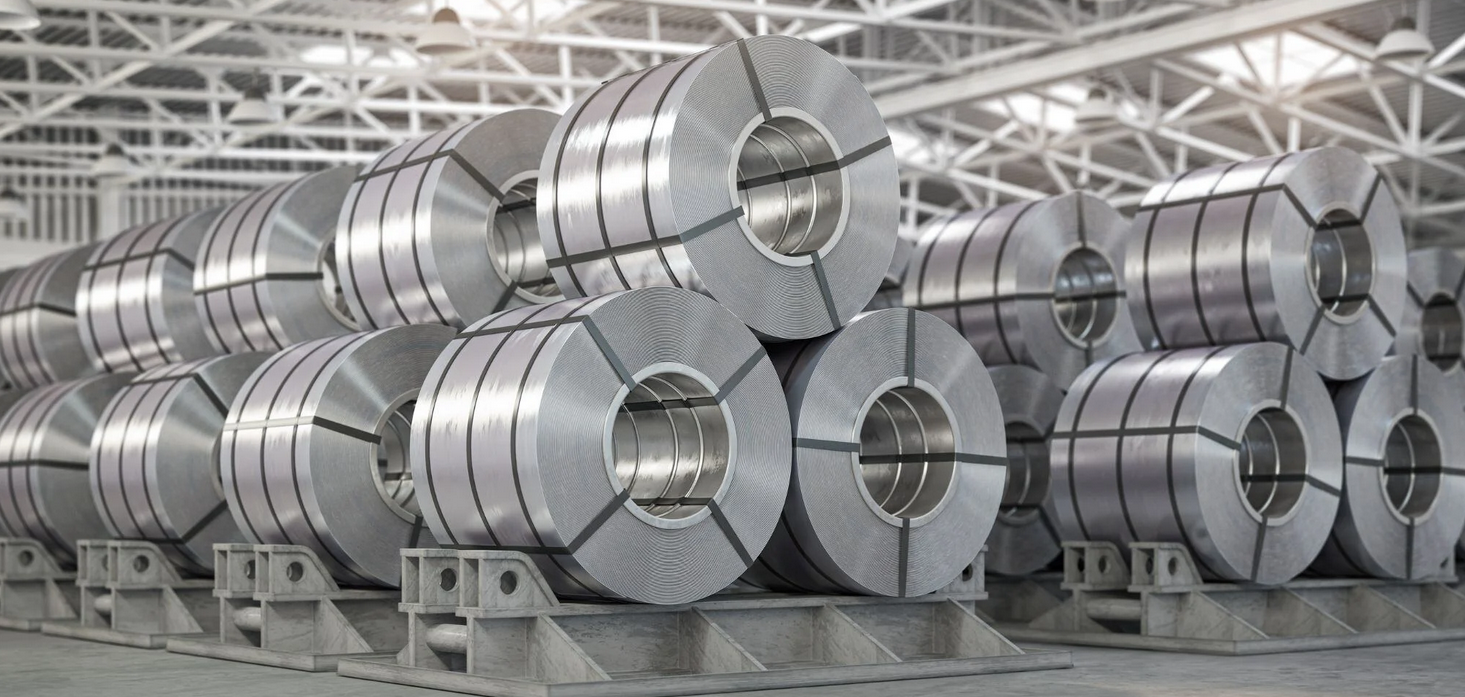
For heavy-duty steel applications, the most critical features are an ultra-robust structural frame, high-power strapping tension (1000kg+), a reliable friction-weld sealing system for steel strapping, and simple, durable components that are easy to access and maintain. The system must be designed to operate 24/7 with minimal downtime, resisting vibration, dust, and the shock loads of multi-ton coils. (heavy duty coil strapper specifications)

⚙️ The Heavy-Duty Checklist: Beyond the Brochure
When evaluating suppliers, go beyond the basic specs. Ask detailed questions about these core areas:
1. Construction & Durability:
- Frame: Is it made from thick, reinforced steel plate, not just standard channel? It should feel solid, not flex under load.
- Components: Are critical parts like guide arms, rollers, and seals made from hardened steel or premium alloys? Plastic or mild steel parts will wear out fast.
- Protection Rating: Does the electrical cabinet have a high IP rating (e.g., IP54) to keep out dust and moisture? Motors should be rated for continuous duty.
2. Strapping Performance (The Heart of the Matter):
- Tension Force: This is crucial. For securing heavy coils, you need high tension—often 1200kg (2600 lbs) or more. Ask for the actual tension force specification, not just the strap size it can use.
- Sealing Method: For steel strapping, friction welding is mandatory. It heats and forges the strap ends together, creating a seal that is as strong as the strap body itself. Avoid systems that use notches, clips, or low-quality seals.
- Strapping Path: The path the strap takes through the machine should be as straight and simple as possible. Complex paths with many bends increase friction, reduce effective tension, and cause more jams.
3. Ease of Maintenance & Service:
- A machine will need maintenance. The best designs make this easy.
- Access: Can an engineer easily access the strapping head, drive motors, and control panel? Or is everything buried behind panels?
- Modularity: Are key components (like the sealing head) modular? This allows for quick swap-out if repair is needed, minimizing downtime.
- Supplier Support: Does the supplier offer detailed maintenance manuals, training videos, and readily available spare parts? This is where a partner like Fengding excels, providing long-term support, not just a one-time sale.
4. Control & Integration:
- The control system should be simple and reliable. A color touchscreen HMI (Human-Machine Interface) with clear graphics is ideal.
- It should allow easy setting of strap number, position, and tension.
- Most importantly, it should have standard communication protocols (like Profinet, Ethernet/IP) to easily connect with your plant's PLC system for seamless line integration.
Remember, the goal is uptime. Every feature should be evaluated on how it contributes to keeping the line running smoothly, shift after shift. A slightly more expensive machine with superior durability and support will always have a lower total cost of ownership than a cheaper machine that constantly breaks down. (features of reliable coil packing equipment)
4. How Do I Choose the Right Partner and Implement the Solution Successfully?
Buying the equipment is only half the battle. The other half is the partnership behind it. A bad supplier can turn a promising investment into a nightmare of delays, poor installation, and absent support. You need a partner who acts as an extension of your engineering team, guiding you from layout planning to smooth operation. This is about finding trust and expertise, not just a salesperson.
Choosing the right partner involves verifying their specific experience with heavy steel coil applications, assessing their after-sales service structure (including local technicians and spare parts inventory), and reviewing detailed case studies from similar plants. Successful implementation requires collaborative planning on factory layout, utility connections, and a phased training program for your operators and maintenance staff. (selecting a coil packing machine supplier)
🤝 The Partner Evaluation Framework
Don't just take their word for it. Use a structured approach to find a true partner.
Step 1: Due Diligence on the Supplier
- Ask for References: Request contact information for 2-3 customers in a similar industry (steel, metal processing). Call them. Ask about machine reliability, service response time, and overall satisfaction.
- Visit Their Factory: If possible, see where the machines are built. Look at the quality of welding, assembly, and testing procedures. A clean, organized factory usually indicates quality work.
- Analyze Their Support Map: Do they have service engineers in your region (e.g., Latin America for Mexico)? What is their typical response time? Do they keep a local inventory of common spare parts?
Step 2: The Implementation Process (Working Together)
A good partner will guide you through these stages:
-
Pre-Sales Engineering:
- They should request detailed information: coil dimensions (OD, ID, width, weight), required output speed (coils per hour), factory layout drawings, and available utilities (air pressure, power voltage).
- They will provide a customized layout proposal showing how the line fits into your space, including safety zones and maintenance access.
-
Installation & Commissioning:
- Professional installation is key. The supplier should send experienced engineers to supervise the foundation work, machine placement, and alignment.
- Commissioning is when the line is tested with your actual coils. The supplier's team should fine-tune all settings and run the line until it produces perfectly packed coils consistently.
-
Training & Handover:
- Training must be hands-on for both operators (daily use, basic troubleshooting) and maintenance technicians (preventive maintenance, part replacement).
- You should receive comprehensive documentation: operation manuals, maintenance schedules, electrical diagrams, and a full parts list.
Step 3: Building a Long-Term Relationship
The sale is the beginning. A true partner will:
- Schedule regular follow-up calls to check on performance.
- Proactively inform you about software updates or service bulletins.
- Be available for technical consultations if your product mix changes.
This level of partnership is what sets apart companies like Fengding and Wuxi Buhui. They have built their reputation not just on machine quality, but on being reliable, knowledgeable allies to their clients throughout the machine's entire lifecycle. (coil packing line installation and training)
Conclusion
Investing in an automatic coil packing line is a strategic decision that directly boosts productivity, safety, and profitability for heavy steel processors. By focusing on robust components, a reliable partner, and thorough implementation, you can transform a chronic bottleneck into a durable competitive edge. For a detailed look at engineered solutions, explore our dedicated Steel Coil Packing Line portfolio.